

MindBridge AI
MindBridge · Marketing
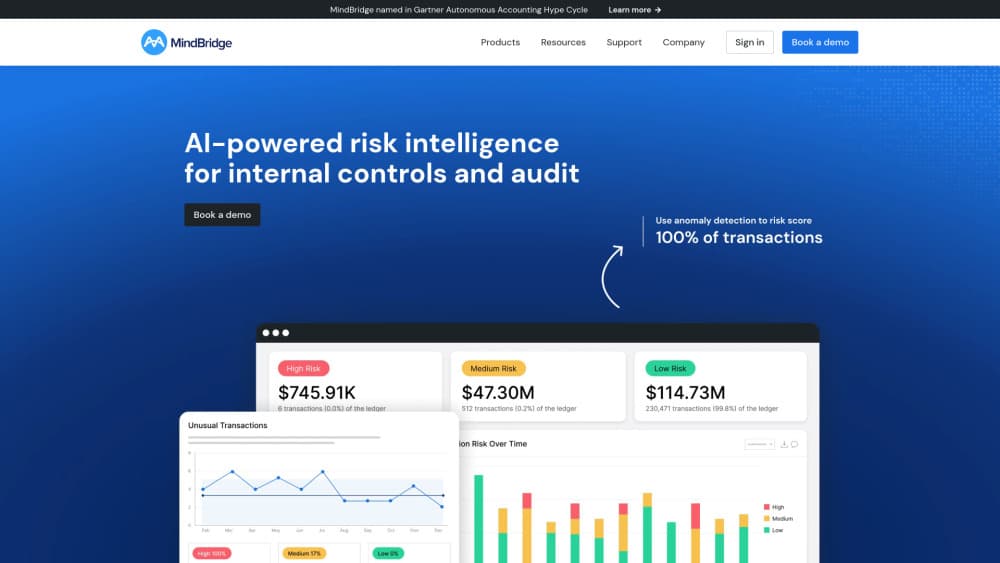
MindBridge AI is a financial oversight platform that scans every transaction in a ledger, flags unusual patterns, and helps audit and finance teams decide where to look first.
About MindBridge AI
What Is MindBridge AI
MindBridge AI is AI audit software built for people who have to sign off on financial data, and the wider audit analytics platform serves the same audience. It reads a full general ledger, journal entries, vendor lists, and payroll records, then ranks what looks off. The pitch is coverage: a sample of 50 invoices tells you little, while a scan of a million rows can surface the one duplicate payment nobody would have opened.
The company started in Ottawa in 2015 and sells mainly to accounting firms, internal audit groups, and enterprise finance teams. Its AI Auditor product became the anchor of that business, and the platform now markets itself as an oversight layer that runs continuously rather than once a year at close.
The limits matter as much as the features. Everything depends on clean, well-mapped data going in, so a messy chart of accounts slows the first analysis down. Pricing isn't published, and there's no self-serve signup, which puts the tool out of reach for solo practitioners who just want to test it on a small client.
Getting Started
- Talk to the sales team and scope which oversight use case you need: financial close, spend, or external assurance work.
- Export the ledger and related files from your accounting system, then map accounts, vendors, and users to the platform's data model.
- Configure the risk models and business rules that match your entity, industry, and materiality thresholds.
- Run the analysis, review the ranked risk scores, and export findings into your workpapers or send them to the engagement team.
Product Information
A quick look at MindBridge AI's pricing, supported platforms, and performance.
Best for
The users, tasks, and scenarios where this tool fits best.
Users
- External auditors
- Internal audit and controllership teams
- CPA firms doing advisory work
Tasks
- Journal entry testing
- Duplicate and split payment checks
- Fraud risk assessment
Scenarios
- Year-end audit fieldwork
- Monthly close review
- Post-acquisition data review
Key features
Full Population Analysis
MindBridge AI analyzes every transaction in scope rather than a sample, and the platform handles data sets of up to a billion transactions in a single run. For an auditor, that changes the nature of testing: you stop guessing which 40 entries to pull and start reviewing the ranked shortlist the model produced. The tradeoff is that large files take time to prepare and validate before the first analysis.
Ensemble Risk Scoring
The engine behind its transaction anomaly detection combines statistical models, hand-written business rules, and unsupervised machine learning. Each method misses different things, so the ensemble catches patterns a single approach would drop. Scores come with the reasoning attached, which is what makes them usable in a workpaper.
Explainable Findings
Every flagged item carries documentation on why it scored high: which rule fired, which peer group it deviated from, what the expected range was. That level of detail matters when a partner or a regulator asks how a conclusion was reached. It also keeps the tool from becoming a black box that auditors learn to ignore.
Financial Close Oversight
The close module watches the entries that land in the final days of a period, where manual adjustments and last-minute postings cluster. Finance teams get a ranked view of unusual activity before the numbers are locked, so corrections happen while the ledger is still open.
Spend Integrity Monitoring
This module targets the vendor side: duplicate payments, invoices split to stay under approval thresholds, vendors sharing bank details with employees, and payees that don't match any approved master record. It's the kind of review that used to need a spreadsheet and a lot of patience.
Integrations and API Access
MindBridge connects with tools such as Xero, Databricks, and Fieldguide, and the developer portal ships an API plus SDKs for pulling analysis results into other systems. Teams that already run a data warehouse can push results into their own dashboards instead of exporting spreadsheets by hand.
Pros and cons
Pros
- Coverage is the real selling point: full population testing finds duplicates and odd journal entries that sampling misses.
- Findings are explainable, so a high score can be defended in a review meeting instead of taken on faith.
- The ensemble approach blends rules with machine learning, which suits firms that need deterministic, repeatable results.
- API and SDK access let larger teams fold results into existing audit workflows rather than adding another silo.
Cons
- No published pricing and no free trial, so evaluating the platform means sitting through a sales process first.
- Data preparation is the bottleneck. Poorly mapped accounts or messy vendor masters will delay the first analysis, and that work falls on your team.
- The product is built for firms and enterprise finance departments, which leaves small practices and solo accountants with little reason to look.
Frequently asked questions
It reads a company's financial transaction data and flags entries that deviate from expected patterns, then ranks them by risk so audit and finance teams know where to start. The output is a prioritized list with reasons attached, not a pass or fail verdict.
Related content
Explore related tools, skills, and articles for MindBridge AI.
MindBridge AI Alternatives

ngram 2.0
ngram · Video · Marketingngram 2.0 is an AI video generator for teams. It turns a prompt, a screen recording, or a product URL into a narrated explainer, product demo, or AI avatar video, and every scene stays editable.

shippedit.me
Krawlup · Marketing · Businessshippedit.me now redirects to Krawlup, a web platform that audits SEO, AEO and page speed every week, then hands the fixes to AI coding agents over MCP.

MePersona
MePersona, Inc. · Writing · Productivity · MarketingMePersona is an AI unified inbox for creators. It learns your voice, drafts replies to fan messages from 12 platforms, and sends only what you approve.