

AI Secured
Mindgard Ltd · AI Detection
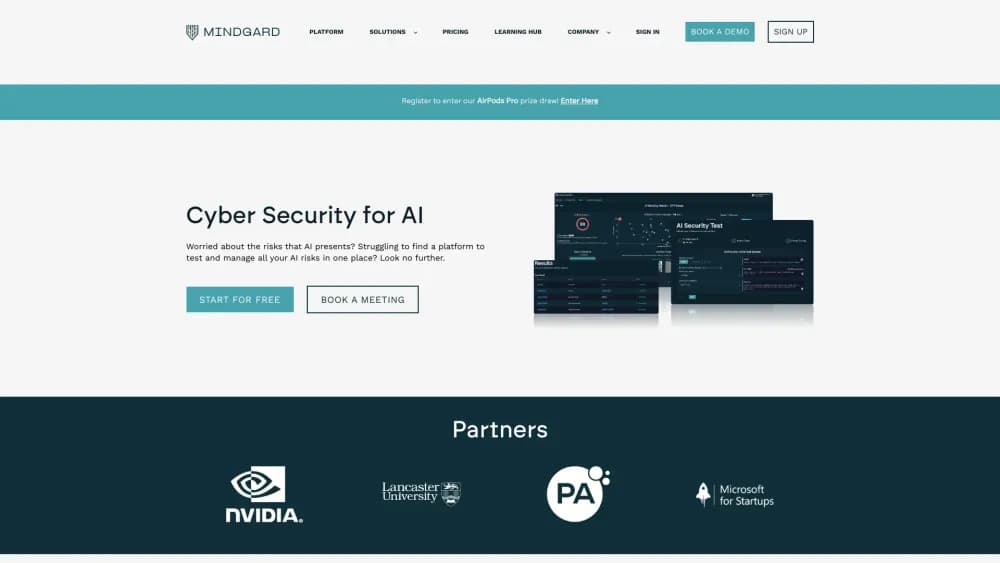
Mindgard is an AI security platform for automated AI red teaming. It probes LLMs, agents, and multimodal models, proves which flaws are exploitable, and maps findings to OWASP and MITRE ATLAS.
About AI Secured
What Is Mindgard
Mindgard is a security testing platform for AI systems, built by a team that spun out of Lancaster University in 2022 and now works from London and Boston. You point it at a model, an application, or an agent, and it goes after that system the way a determined attacker would. It maps what the system can reach, looks for weak guardrails, then chains prompts and tool calls until something gives.
The product sits at the testing layer, not the filtering layer. Guardrails and firewalls block traffic at runtime. Mindgard hunts for the traffic that slips past those controls, then hands your team a reproduction path, an impact statement, and a suggested fix. That order matters. Plenty of teams already own a scanner that returns a wall of warnings. What they lack is proof that a specific warning leads somewhere worth fixing before launch.
Two constraints shape the experience. Pricing is quote based, with no self-serve signup or free tier, so a first look means a sales conversation. The platform also needs a reachable endpoint that speaks JSON over HTTP. That requirement is normal for DAST for AI tools, which judge behavior by sending live requests rather than reading code. If your model only runs inside a desktop app or a private notebook, expect more setup through the Python SDK.
Getting Started
- Request a demo or trial at mindgard.ai and agree on scope: which systems, which environments, and how often tests should run.
- Connect the target. A model inference endpoint or an application API is enough. The web console, CLI, Python SDK, and Burp Suite extension all reach the same project.
- Run a baseline test, then read results by attack path rather than by raw finding count. Each entry lists the steps taken, the response evidence, and the framework item it maps to.
- Fix what's exploitable, retest to confirm the fix holds, and wire the same test into CI/CD so the next model update gets checked without a meeting.
Product Information
A quick look at AI Secured's pricing, supported platforms, and performance.
Best for
The users, tasks, and scenarios where this tool fits best.
Users
- AppSec teams with LLM features in production
- ML engineers shipping agents that call tools
- Compliance and risk leads facing the EU AI Act or a NIST AI RMF review
- Penetration testers and consultancies
Tasks
- Red teaming a chatbot or copilot before launch
- Regression testing after a model swap
- Chasing one suspected flaw
- Building audit evidence
Scenarios
- A support agent that can issue refunds
- A retrieval assistant over internal documents
- A regulated rollout where paperwork lands before the feature ships
Key features
Agent-Native Reconnaissance
Before it fires a single payload, Mindgard profiles the system: which model answers, what tools and APIs the agent can reach, how guardrails respond to odd input. That profile decides where the attacks go. It's closer to how a person scopes a target than how a scanner walks a checklist, and it tends to surface higher impact paths with fewer requests.
Adaptive Attack Paths
The attack library covers jailbreaks, prompt injection, data extraction, and guardrail bypass, but the platform doesn't stop at one-shot prompts. It chains steps and reacts to what the system returns, which is how real attackers get from a harmless question to an action with consequences. Attacks are mapped to MITRE ATLAS entries as they run. Coverage starts with LLM security testing and extends to vision, audio, and multimodal models.
Evidence You Can Reproduce
Every finding includes the prompts used, the responses received, and the path that connected them. Engineers can replay the sequence, and a manager can read the impact statement without decoding a risk score. This is the part that separates a useful report from a pile of alerts.
Remediation Guidance and Retests
Each finding comes with suggested controls, from input preprocessing to output filtering to tighter tool permissions. You apply a fix, rerun the same attack path, and get a clean pass or a new variant that still gets through. That loop is the point: the platform is built for repeated testing, not a one-off report.
CI/CD, CLI, SDK, and Burp Suite
A GitHub Action pulls the current CLI on every workflow run, so new attack techniques arrive without anyone editing a config. The Python SDK covers models that can't expose a network endpoint, and the Burp Suite extension puts AI testing inside a workflow pentesters already use. REST access covers custom pipelines.
Framework Mapping and Reporting
Results map to OWASP Top 10 for LLMs, MITRE ATLAS, NIST AI RMF, and EU AI Act obligations, and reports can be pushed into a SIEM or ticketing system. For teams that have to show a regulator or a customer what was tested, the mapping saves a translation step. It doesn't decide whether a gap is material for your business.
Runtime Protection After the Test
Testing finds the gap; runtime protection watches for attempts to use it. Mindgard offers detection and response for AI traffic in production, so the same platform that proved a flaw exists can flag exploitation attempts later. Teams that only want pre-release testing can skip this layer.
Pros and cons
Pros
- Findings come with reproduction steps and response evidence, which makes triage and sign-off faster than arguing over a severity score.
- Reconnaissance runs before attacks, so results reflect the actual system, including its tools and guardrails, rather than an isolated model endpoint.
- The CLI, Python SDK, GitHub Action, and Burp Suite extension fit existing security and engineering workflows instead of demanding a new one.
- Framework mapping covers the four references auditors ask about most: OWASP LLM Top 10, MITRE ATLAS, NIST AI RMF, and the EU AI Act.
- The research pedigree is real. The company has disclosed more than 150 AI vulnerabilities and staffs a team with AI security PhDs, which shows in the attack design.
Cons
- There's no public price list, no free tier, and no self-serve signup. Evaluating it takes a sales call, and budgeting takes a scoped quote.
- A reachable JSON endpoint is a hard requirement for the simplest path. Models locked inside an app need SDK work before testing starts.
- Coverage numbers such as thousands of attack scenarios are vendor claims. No independent benchmark confirms them, so treat the totals as marketing until your own test run backs them up.
- Results still need an experienced reviewer. The platform proves exploitability, but judging business impact for your data and your users stays with your team.
Frequently asked questions
Mindgard tests AI systems for security flaws. It maps a model or agent, runs attacks against it, validates which weaknesses are actually exploitable, and gives your team the evidence plus remediation guidance. Security teams use it before launch and again after every model or configuration change.
Related content
Explore related tools, skills, and articles for AI Secured.
AI Secured Alternatives
Isgen AI
Isgen · AI DetectionIsgen AI is a web-based AI detector that scores text for machine authorship and shows you which sentences and phrases push the number up. It's built for teachers, editors, students, and writers. Their question is simple: did this draft come from ChatGPT, GPT-5, Claude, Gemini, DeepSeek, or another model? You paste or upload content, run a scan, and get a Human, AI, and Mixed breakdown in seconds. There's also a companion editor that scores text while you write it.
Humanizeai Tools
Humanizeai Tools · Writing · AI DetectionHumanizeai Tools is a web-based AI humanizer that rewrites machine-generated text so it sounds like a person wrote it, which is the whole point of the category it belongs to. Paste a draft from ChatGPT, Claude, or Gemini, run it through the tool, and it swaps out the phrases and sentence patterns that AI detectors flag. If your goal is to make AI text sound human before you publish it, this is the kind of tool built for exactly that. It suits students, bloggers, and marketers who need copy that reads naturally and clears tools like GPTZero, Copyleaks, and Winston AI after a single pass.

Hidemyai
Hidemyai · Writing · AI DetectionHidemyai is an AI content humanizer. It rewrites text from ChatGPT, Jasper, and similar tools so the result reads like a person wrote it. You paste your draft, pick a document type and tone, and the service returns a version meant to bypass AI detectors such as Originality.ai, Turnitin, and ZeroGPT. It targets writers, marketers, and students who lean on AI drafts but can't ship copy that sounds robotic. The promise is simple: make AI content undetectable.