

MindReader v1
Cassini Research · AI Detection
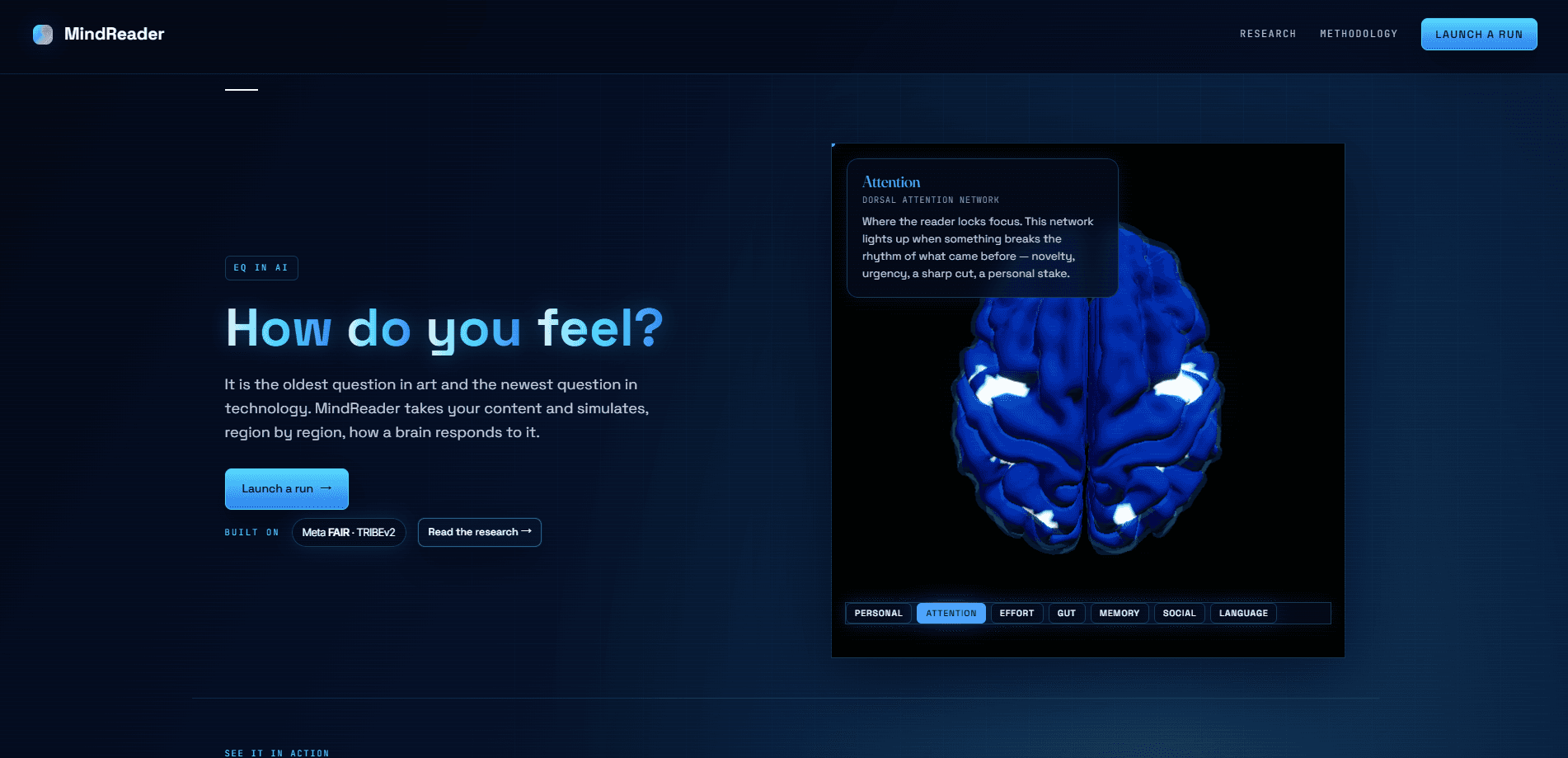
MindReader v1 is a web tool that takes your content and simulates how a human brain responds to it, region by region. You paste a script, drop in a call transcript, or upload text, and it returns a cortical heatmap plus seven system readings covering attention, gut reaction, personal resonance, effort, memory, social drive, and language. It's built for people who do AI ad testing, sales call analysis, and pitch review, and who want a signal before spending real money on an audience. Call it a content testing tool that reads the room before the room shows up.
About MindReader v1
What Is MindReader v1
MindReader v1 is an AI brain response simulator built by Cassini Research. Instead of asking people how content made them feel, it runs the content through a computational model trained on real fMRI data, then reports which cortical systems the material is likely to light up. The pitch is straightforward: stop guessing whether a script lands, and get a read on emotional impact before launch.
Emotional impact analysis normally means questionnaires, panels, or behavioral tests. Those measure opinions about experience, not the experience itself. MindReader flips that. The person isn't the variable. The content is.
The model rests on TRIBE v2, a system from Meta FAIR that predicts blood-flow activity across the cortex. MindReader uses that prediction layer to score seven systems at once, including attention, gut reaction, and memory. Every run models 20,484 brain surface points one second at a time, based on fMRI from more than 720 participants.
The big limitation is scope. This is an experimental v1 tuned mostly toward sales-call language, and only text readouts are live right now. Audio and video are paused while the team hardens the pipeline. Free access is also paused. You can't just sign up and start testing.
Getting Started
- Prepare your content as text. Aim for roughly 150 to 900 words for the cleanest readout.
- Choose a run type. A single readout digs into one script, while an A/B diff compares two versions of the same message.
- Request access by messaging Cassini Research on X, since free usage is currently on hold.
- Paste your content into the launcher and start the run. Each trial takes about 6 to 12 minutes.
- Read the results. You get a cortical map, the strongest systems inside the piece, and a plain-language summary.
Product Information
A quick look at MindReader v1's pricing, supported platforms, and performance.
Best for
The users, tasks, and scenarios where this tool fits best.
Users
- Content teams testing ads
- Sales teams reviewing call scripts
- Copywriters comparing two versions
Tasks
- Comparing two headlines or hooks
- Pressure-testing a sales pitch
- Flagging weak moments in a script
Scenarios
- Pre-launch review of an ad script
- Rewriting a cold email that isn't converting
- Early research on a message you haven't shot yet
Key features
Cortical heatmap readout
Every run maps predicted brain activity onto a heatmap of the cortex. You see which regions the content is likely to activate and where the response is flat. This is the closest thing to watching how a message lands before a single person reads it. No panel. No waiting.
Seven system readings
MindReader v1 scores seven cortical systems in one pass: attention, gut reaction, personal resonance, effort, memory, social drive, and language. Each one answers a plain question, like whether the content grabbed focus or felt familiar. It's a broad snapshot of emotional impact rather than a single score.
A/B comparison runs
A comparison run pushes two pieces of content through the same model, then subtracts one response from the other. What's left is a difference in the content, not the audience, since both pieces hit the same population-average cortex. This is the mode that makes the tool useful for testing which headline or hook wins, and it's the heart of the sales call analysis workflow.
Single-run readout
A single run reports the strongest systems inside one piece of content, with a plain-language summary. There's no A/B winner, because there's only one input. The question it answers is simple: what does this content ask the average cortex to do? That's it.
Built on TRIBE v2
The predictions come from TRIBE v2, a Meta FAIR model that fuses language, visual, and audio features and predicts blood-flow activity at 1Hz. MindReader borrows that layer rather than training its own model. It's the reason a small team can offer a research-grade readout at all.
Time-series and chord views
Comparison runs break the seven dimensions into time series, so you can watch attention rise and fall word by word. Chords and connectivity matrices surface co-activation patterns. These advanced views are still in beta for single runs, and the AI ad testing crowd will want them working before they lean on them.
Pros and cons
Pros
- Combines seven emotional and cognitive systems in one readout, so you don't run separate tests for attention and memory.
- A/B diff mode isolates the difference between two scripts instead of blurring them together, which matters when you're testing a small wording change.
- Grounded in published fMRI research, including work from Penn, UT Austin, MIT, Stanford, and Princeton, so the underlying model isn't a black box you have to take on faith.
- The time-series view points to specific weak spots in a script, not just an overall score.
Cons
- Free access is paused and usage is by request, so you can't test it on demand.
- Audio and video runs are paused, which rules out ad testing on real audio spots for now.
- The readouts lean heavily on sales-call language, so other content types get less reliable results.
- The site warns it's an experimental v1 and tells you not to upload sensitive content.
Frequently asked questions
It simulates how a human brain responds to content and reports which cortical systems light up. Teams use it to test ads, sales scripts, and pitches before launch, when changing a line is still cheap and the audience hasn't seen anything yet.
Related content
Explore related tools, skills, and articles for MindReader v1.
MindReader v1 Alternatives
Isgen AI
Isgen · AI DetectionIsgen AI is a web-based AI detector that scores text for machine authorship and shows you which sentences and phrases push the number up. It's built for teachers, editors, students, and writers. Their question is simple: did this draft come from ChatGPT, GPT-5, Claude, Gemini, DeepSeek, or another model? You paste or upload content, run a scan, and get a Human, AI, and Mixed breakdown in seconds. There's also a companion editor that scores text while you write it.
Humanizeai Tools
Humanizeai Tools · Writing · AI DetectionHumanizeai Tools is a web-based AI humanizer that rewrites machine-generated text so it sounds like a person wrote it, which is the whole point of the category it belongs to. Paste a draft from ChatGPT, Claude, or Gemini, run it through the tool, and it swaps out the phrases and sentence patterns that AI detectors flag. If your goal is to make AI text sound human before you publish it, this is the kind of tool built for exactly that. It suits students, bloggers, and marketers who need copy that reads naturally and clears tools like GPTZero, Copyleaks, and Winston AI after a single pass.

Hidemyai
Hidemyai · Writing · AI DetectionHidemyai is an AI content humanizer. It rewrites text from ChatGPT, Jasper, and similar tools so the result reads like a person wrote it. You paste your draft, pick a document type and tone, and the service returns a version meant to bypass AI detectors such as Originality.ai, Turnitin, and ZeroGPT. It targets writers, marketers, and students who lean on AI drafts but can't ship copy that sounds robotic. The promise is simple: make AI content undetectable.