
MindSpore
Huawei · Coding
MindSpore is Huawei's open source deep learning framework for training and running AI models across cloud, edge, and phone hardware, with first-class support for Ascend chips.
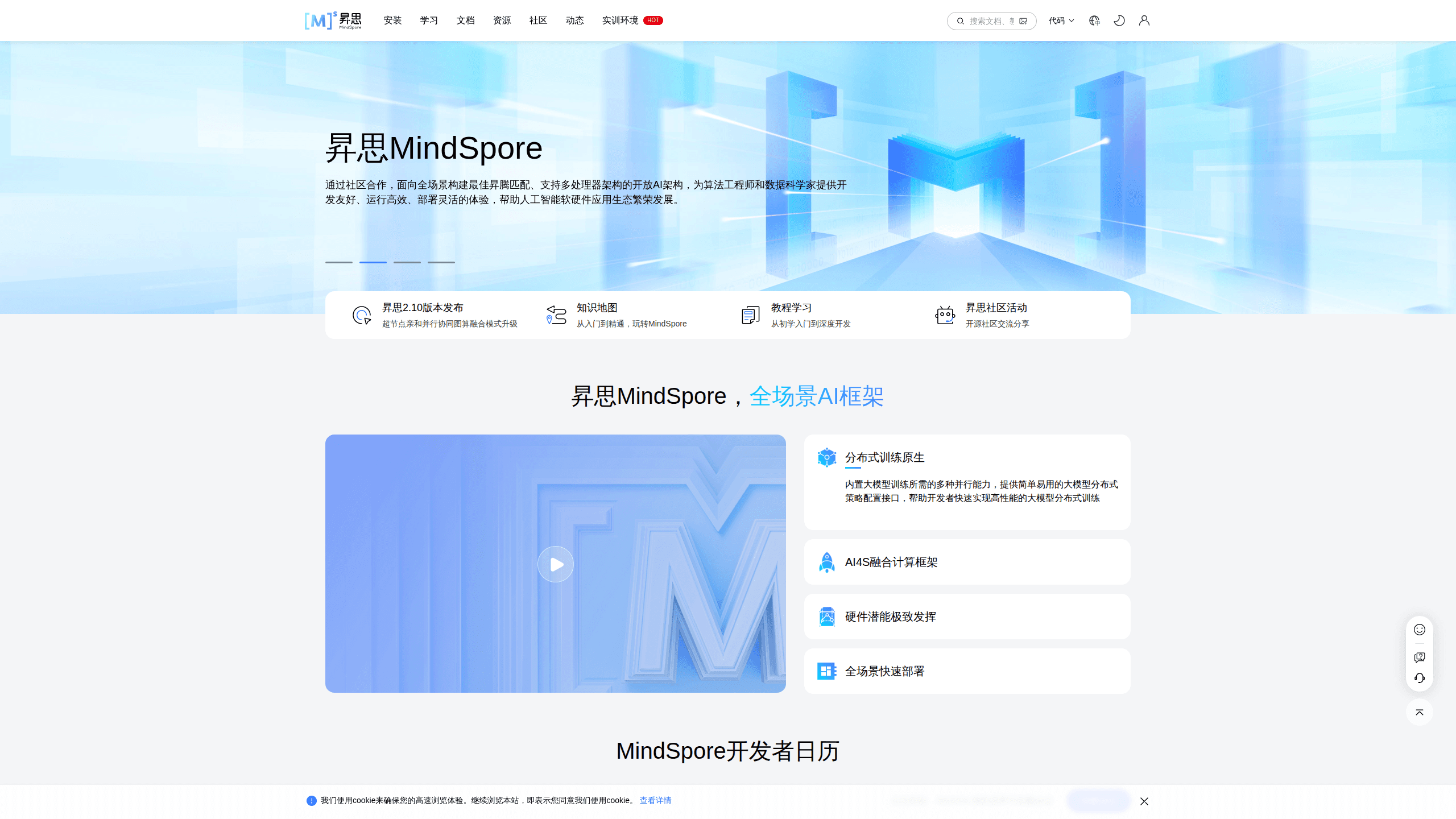
About MindSpore
What Is MindSpore
MindSpore is an open source AI framework that Huawei built to train and deploy models across three places at once: cloud servers, edge gear like base stations, and small devices like phones and IoT sensors. You write models in Python, and the framework handles the hard parts, automatic differentiation, distributed training, and the switch between slower but easier dynamic graphs and faster static graphs.
The pitch is hardware reach. MindSpore is tuned hardest for Huawei's own Ascend processors, the chips in the company's Atlas servers, but the same code also runs on NVIDIA GPUs, Arm CPUs, Qualcomm Snapdragon, and Kirin chips. A companion engine, MindSpore Lite, shrinks models so they can run on-device, which matters if you are shipping AI into an app rather than a data center.
The catch is gravity. MindSpore is the natural pick if you are inside the Huawei and Ascend world, and a harder sell if you have years of PyTorch code and a team that already knows it. The framework has matured fast and ships a large library of pre-built models, but the wider community, tutorials, and answered questions still trail the frameworks that got the head start.
Getting Started
- Install the framework with pip, picking the build that matches your hardware and Python version.
- Set your compute target, such as Ascend, GPU, or CPU, before you run anything.
- Define your model and data pipeline, then train it with either the dynamic or static graph mode.
- Export the trained model to MindIR, the framework's shared format for moving a model between training and deployment.
- Deploy the exported model to the cloud, an edge box, or a phone using MindSpore Lite for on-device inference.
Product Information
A quick look at MindSpore's pricing, supported platforms, and performance.
Best for
The users, tasks, and scenarios where this tool fits best.
Users
- AI researchers
- Developers on Huawei hardware
- Edge and mobile engineers
Tasks
- Training large models
- Running inference on devices
- Porting research code
- Building AI for science
Scenarios
- Standing up a model on Ascend infrastructure
- Shipping an AI feature to a phone app
- Moving a model from a laptop to a cluster
Key features
One Framework Across Cloud, Edge, and Device
MindSpore runs on servers, edge hardware, and small devices from the same codebase, which is the point of Huawei's "all-scenario" framing. That means a team does not have to adopt a separate framework for training and a separate engine for on-device inference. For anyone whose product spans both, that continuity removes a translation layer between two toolchains.
Unified Dynamic and Static Graphs
The framework lets you write in an eager, dynamic style while you debug, then switch the same code to a static graph for speed at run time. Beginners get readable, line-by-line execution; production gets the performance of a compiled graph. Fewer frameworks make that switch painless, and here it is a core design choice rather than a bolt-on.
Simpler Distributed Training
MindSpore builds in parallel strategies for training large models, including data, model, and pipeline parallelism. Configuring how a job spreads across many chips takes an API call instead of handwritten coordination code. Teams training foundation-scale models get the scaling path without maintaining the orchestration themselves.
MindIR, One Format for Train and Deploy
MindIR is the framework's shared intermediate representation, the same format on the training side and the inference side. Export once and the model moves between cloud and device without a second conversion step. That uniformity is what makes the cloud-to-edge story hold together in practice.
MindSpore Lite Engine
MindSpore Lite is a lightweight inference engine for phones and embedded boards, with hardware-focused kernels and quantization to shrink models. It supports iOS, Android, and LiteOS, and reads models from MindSpore as well as TensorFlow Lite, Caffe, and ONNX. For mobile and IoT builders, that is the part that turns a trained file into a running feature.
Large Model and Science Suites
Beyond the core framework, MindSpore ships a large model suite and an AI-for-science suite, each bundling pre-trained models and ready-made interfaces. The intent is to cut the setup work for teams working on foundation models or scientific computing, so they start from usable pieces instead of building them first.
Pros and cons
Pros
- It is fully open source with no license fee, so cost is hardware and time rather than a subscription.
- Runs across cloud, edge, and device from one codebase, which suits products that span a data center and a phone.
- Tuned for Huawei Ascend processors, giving the best performance if that is your hardware.
- MindSpore Lite and MindIR carry a model from training to on-device inference without a second toolchain.
- Python-first APIs and a PyTorch-like feel lower the bar for developers porting existing work.
Cons
- The community, tutorials, and troubleshooting answers are smaller than PyTorch's or TensorFlow's, so you solve more problems alone.
- Best results assume Huawei hardware, and the framework's advantages shrink on other vendors' accelerators.
- The sprawling suite of framework, Lite, MindIR, and domain kits takes real time to learn before you are productive.
Frequently asked questions
MindSpore is used to build, train, and run deep learning models. You write models in Python, train them on servers or Huawei Ascend hardware, and deploy them to the cloud, edge devices, or phones through the framework's unified toolchain.
Related content
Explore related tools, skills, and articles for MindSpore.
MindSpore Alternatives

Base Code
Base44 (Wix) · Coding · ProductivityBase Code is a shared cloud development environment from Base44. Teammates describe changes to an existing GitHub codebase in chat, preview them live and send them back as pull requests.

Google EmbeddingGemma 2
Google DeepMind · Writing · Image · CodingGoogle EmbeddingGemma 2 is a 740M-parameter open model that turns text, code, images, audio, and video frames into vectors in one 768-dimension space, running on phones and laptops.

GitGlow
GitGlow · Coding · ProductivityGitGlow is a local-first desktop Git client that lets independent developers review their own code and their AI agents' changes in one place before shipping.