

Mixpanel
Mixpanel, Inc. · Marketing · Business
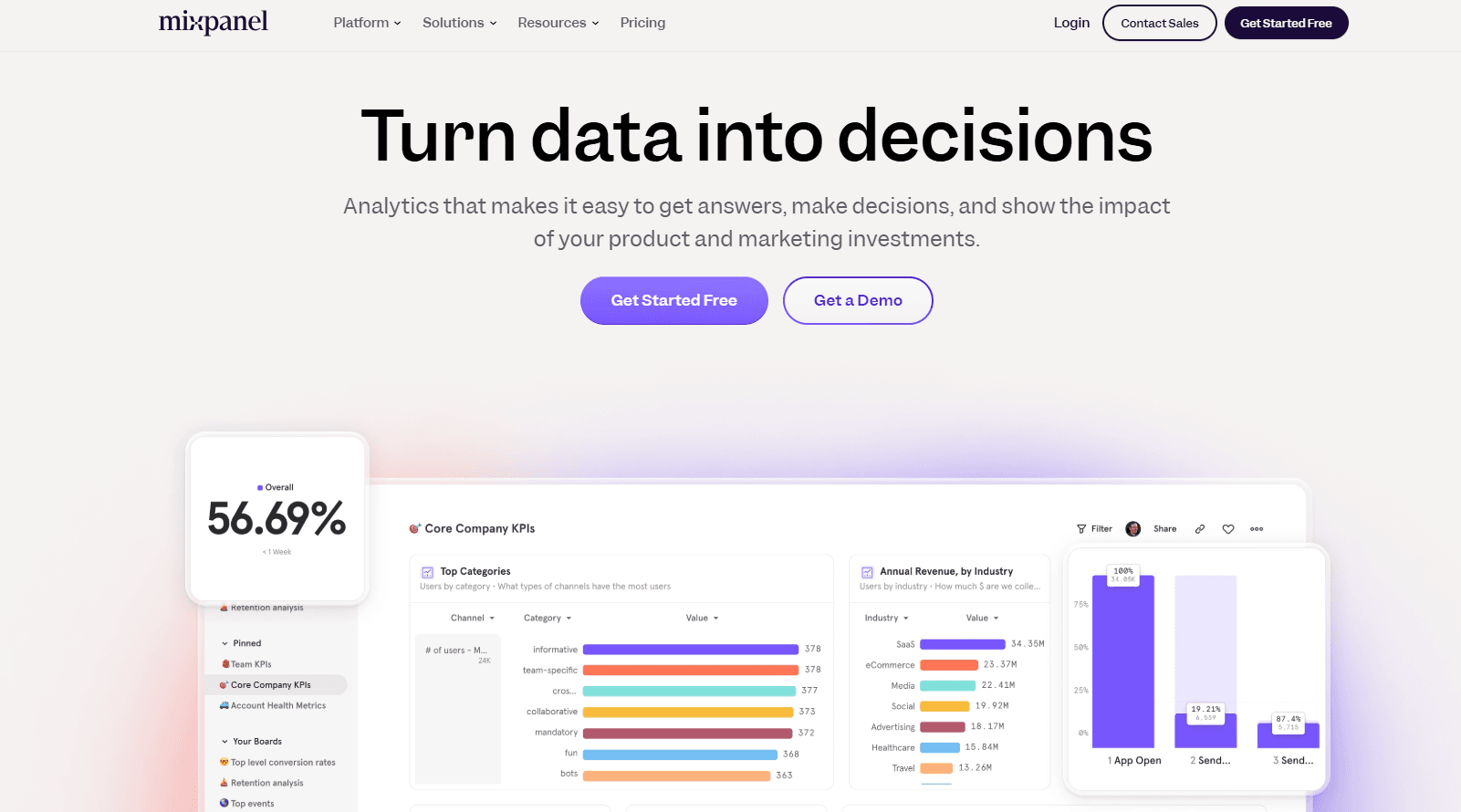
Mixpanel is a product analytics platform that tracks how people use your web and mobile apps. It turns events like signups and clicks into funnels, retention curves and session replays.
About Mixpanel
What Is Mixpanel
Mixpanel is a digital analytics platform that helps teams see what users actually do inside a product. It runs on an event-based data model: every click, signup, purchase or screen view becomes a timestamped event, and those events feed reports on funnels, retention, flows and cohorts. The company sums up the pitch as product intelligence, and it is aimed at product, growth, marketing and data teams rather than BI analysts alone.
This Mixpanel review looks at where it fits and where it strains. The core promise is speed. Non-technical teammates can open a report and answer a question in seconds, without filing a request to a data team. Alongside classic product analytics, the platform now bundles session replay, experiments, feature flags and Metric Trees, so a lot of teams retire a handful of separate tools.
Three things shape the decision. There is a real free plan, but its event ceiling is low enough that growing apps will hit it fast. The AI features, including Mixpanel Agent and an MCP server, are newer and move quickly. And while the free tier is generous on seats, the paid plans are built around event volume, which makes cost hard to predict before you launch.
Getting Started
- Create a free account and open a project to get your project token
- Install the SDK for web, mobile or server side, or connect a data warehouse if you already collect events
- Call
identifyto tie events to real users and set their properties withpeople.set - Send events from your app, then build funnels, retention and cohort reports from the dashboard
- Add session replay, experiments and feature flags as your team needs them
Product Information
A quick look at Mixpanel's pricing, supported platforms, and performance.
Best for
The users, tasks, and scenarios where this tool fits best.
Users
- Product teams
- Growth and marketing teams
- Data analysts and data teams
- Engineering teams
- Early-stage startups
Tasks
- Funnel analysis
- Retention analysis
- User behavior analytics
- Session replay
- A/B testing
- Feature flagging
- Web and mobile analytics
Scenarios
- A signup rate dips overnight
- Onboarding feels weak but you cannot say where
- A new feature ships behind a flag
- A data team is drowning in ad hoc requests
- Cross-platform tracking gets messy
Key features
Event-Based Product Analytics
Everything in Mixpanel starts with events, and the model is built around how people behave rather than rows in a spreadsheet. Insights, funnels, retention and flows reports cover the standard product questions, and custom events, properties and formulas let you shape them to your product. The company's own numbers put Mixpanel customers at an average 19% lift in monthly active users and 18% in retention. Those figures come from customers it selected, so treat them as a vendor claim rather than a benchmark.
Session Replay and Heatmaps
Session replay is baked into the platform rather than sold as a bolt-on. You can move from a report to a recorded session and watch the actual click, rage click or dead click that the chart hinted at. Replays start fully masked by default, so you unmask only what you choose, and heatmaps and clickmaps show where attention lands at scale. Web and mobile replays are both covered.
Experiments and Feature Flags
Mixpanel runs experiments and feature flags inside the same tool as the analytics. Experiments support multiple variants with frequentist and sequential testing, plus CUPED and correction methods to tighten results. Feature flags cover percentage rollouts, multi-environment support, cohort targeting and runtime targeting, with an OpenFeature provider and offline caching for mobile and web.
Metric Trees and Data Governance
Metric Trees let a team lay out its growth strategy as a living map of connected metrics, with owners, goal tracking and a traceable change log. It is the piece that ties day-to-day reports to company goals. Data governance features, including a data dictionary, drop filters, event owners and event approval, plus data quality and volume monitoring, keep the numbers trustworthy as a team grows.
Mixpanel AI, Agent and MCP Server
Mixpanel AI monitors a product continuously and surfaces insights before someone asks. Mixpanel Agent answers product questions in plain language and can spin up experiments, while a Context Engine grounds answers in your verified data rather than a generic model. A Headless Python SDK exposes queries, cohorts, dashboards and experiments as code, and an MCP server brings the same data into tools like Claude, ChatGPT, Cursor and Slack.
Warehouse Connectors and Integrations
Instead of forcing every team onto an SDK, Mixpanel connects to a data warehouse and can mirror it so answers reflect the freshest data. There are 100+ marketing and product integrations, including Segment, mParticle, Stripe, Shopify, Google Tag Manager and Snowplow. This matters for teams that already have events in a warehouse and want analytics on top instead of a second pipeline.
Scale, Security and Data Residency
The platform runs from a free tier up to enterprise plans handling up to a trillion events a month. Security covers native SOC 2 Type II compliance, GDPR and CCPA alignment, and a choice of US or EU data residency. Enterprise plans add SAML-based SSO, SCIM provisioning, project and report roles, an audit log, sensitive data classification and a custom data retention policy.
Pros and cons
Pros
- A genuinely free plan with unlimited seats and up to 1M events a month, so small teams can start without a card
- Analytics, session replay, experiments and feature flags share one platform, which cuts down on separate subscriptions
- Event-based model makes behavior questions fast to answer, and non-technical teammates can self-serve
- Warehouse connectors and 100+ integrations fit teams that already send events elsewhere
- SOC 2 Type II, GDPR and CCPA support plus US or EU data residency answer most security reviews
- The Startup Program gives qualifying young companies the full platform free for a year
Cons
- Paid pricing tracks event volume, so a spike in traffic or logging noise can raise the bill in ways that are hard to predict
- No direct download app: Mixpanel runs in the browser and through SDKs, so there is nothing to install from an app store
- Free tier stops at 1M events a month, which an active mobile app can pass quickly
- The AI features and MCP server are new and changing fast, so what you read today may shift within a release cycle
Frequently asked questions
Mixpanel is a product analytics platform that tracks how users interact with web and mobile apps. It records events like signups, clicks and purchases, then turns them into funnels, retention reports, flows and cohort analysis. Session replay, experiments and feature flags sit on the same platform.
Related content
Explore related tools, skills, and articles for Mixpanel.
Mixpanel Alternatives

ngram 2.0
ngram · Video · Marketingngram 2.0 is an AI video generator for teams. It turns a prompt, a screen recording, or a product URL into a narrated explainer, product demo, or AI avatar video, and every scene stays editable.

shippedit.me
Krawlup · Marketing · Businessshippedit.me now redirects to Krawlup, a web platform that audits SEO, AEO and page speed every week, then hands the fixes to AI coding agents over MCP.

MePersona
MePersona, Inc. · Writing · Productivity · MarketingMePersona is an AI unified inbox for creators. It learns your voice, drafts replies to fan messages from 12 platforms, and sends only what you approve.