

Monid
Monid · Other
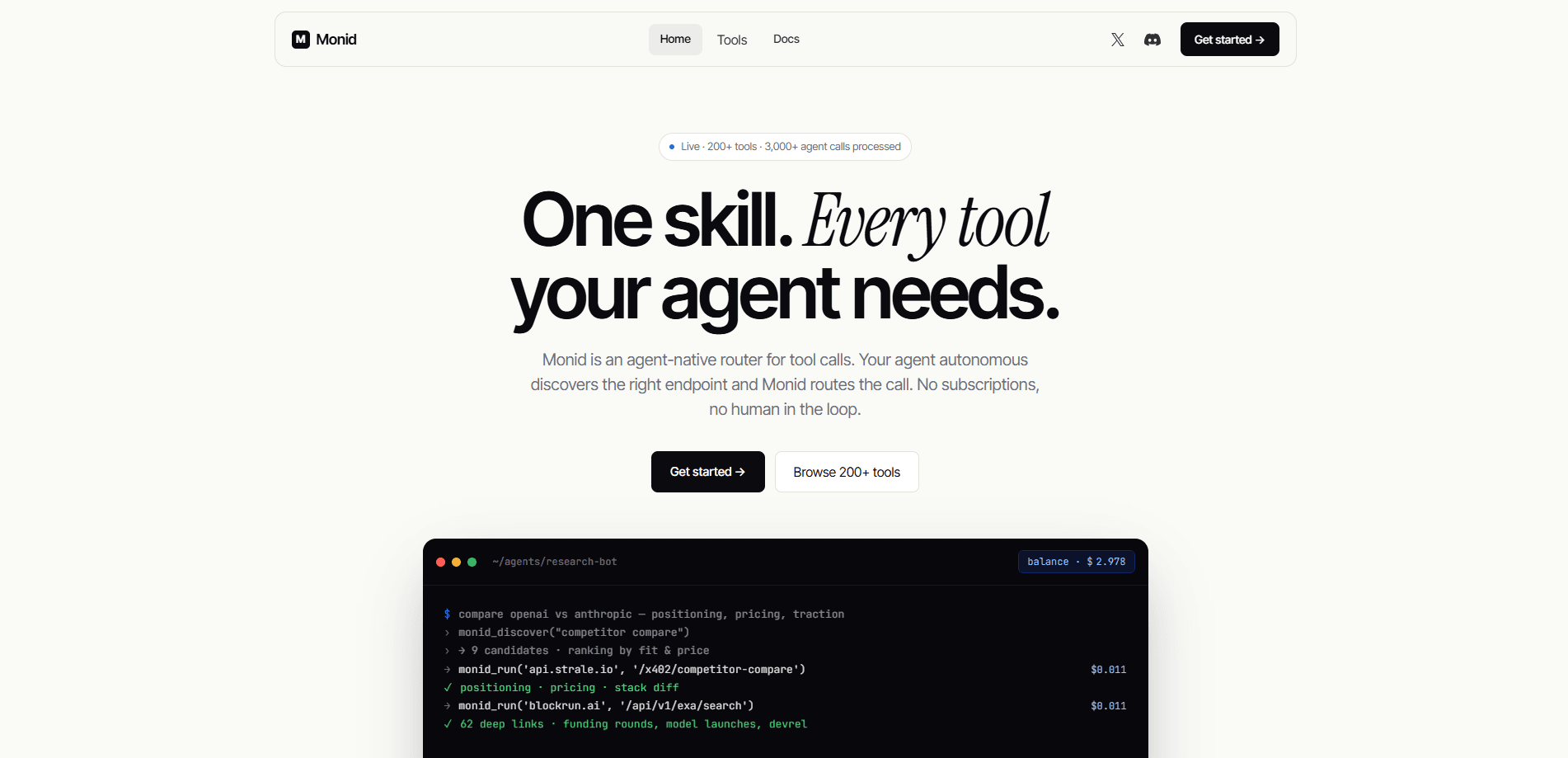
Monid is an AI agent tool router that gives agents access to more than 1,700 data and automation tools from over 55 providers. Instead of wiring up a separate API key, quota, and contract for every service, an agent signs in once, keeps a single balance, and pays only for the calls it makes. The router handles tool discovery for agents, inspection, and execution. Developers can ship agent workflows without pre-loading every endpoint into context.
About Monid
What Is Monid
Monid is an agent-native router. It sits between your AI agent and the wider web of paid data services. When an agent needs something specific, say Twitter posts, Amazon reviews, or a page fetch, it searches Monid's catalog in plain language, checks the input and output schema, and runs the endpoint right away. No sign-up per tool. No subscription stack to manage.
The product solves a practical problem for anyone building agents. The usual setup means juggling dozens of API keys, each with its own pricing model, rate limits, and onboarding flow. It's a mess. Monid collapses that into one unified API and one wallet. Developers get a single interface, and finance gets a single bill.
The main constraint is that Monid is built for developers and agent builders, not for casual users. You need an agent framework or a shell to use it well. Costs accrue per call. Heavy, uncontrolled usage can add up fast. Pricing is metered rather than flat, which rewards teams that know their volume.
Getting Started
- Give your agent the setup command,
set up https://monid.ai/SKILL.md, so it learns the discover, inspect, and run flow. - Create an account at the Monid Dashboard, then generate an API key on the API key management page and hand it to your agent.
- Add credit to your wallet, starting with the $1 in free credit offered on sign-up.
- Ask your agent for the data you want, and let it discover the matching tool, inspect the schema, and run it.
- Check the run response to see the actual cost charged for that call.
Product Information
A quick look at Monid's pricing, supported platforms, and performance.
Best for
The users, tasks, and scenarios where this tool fits best.
Users
- AI agent builders
- Indie developers and small teams
- Technical founders running research workflows
Tasks
- Competitor research
- Review and sentiment analysis
- Lead generation
- Web scraping and automation
Scenarios
- Prototyping a new agent
- Late-stage product work
- Ongoing research pipelines
Key features
Natural-language tool discovery
Your agent describes what it needs in plain words, like "twitter posts" or "amazon reviews," and Monid returns ranked candidates with their prices attached. Prompts stay small. The agent doesn't have to load every possible endpoint into context ahead of time, which keeps it fast.
Unified balance across providers
One wallet covers every tool and every provider. You fund it once, and the router debits each call from that balance. For teams used to a folder full of API keys, this is the feature that removes the most friction.
Pay-per-call pricing
Monid charges per execution, not per month. A pay-per-call API endpoint might cost $0.003 flat, while a per-result endpoint charges a small fee for each item returned, sometimes with a base fee on top. You see the price in discover, inspect, and run responses. No surprises.
Multiple connection methods
The same registry and balance work over MCP, a drop-in Skill, a CLI, and a direct HTTP API. MCP integration covers agents that speak that protocol through their client. Humans who prefer the shell can run the same endpoints from the terminal. Same registry, different doors.
Inspect before you run
Every endpoint exposes its input schema, output shape, and price before execution. Why bother? Because two tools can look identical in a search result and still return different data or cost different amounts. Being able to check the contract first matters when an agent is choosing between them.
Run without sign-up
Tools available through the router can be used right away, without a separate account for each provider. So what does that save you? Time, mostly. An agent can go from discovery to a live call in a single step.
Provider revenue sharing
If you have an API that agents should be calling, you can list it on Monid. The platform routes agent traffic to it, meters every call, and shares the revenue. That gives smaller providers a route to agent users without building their own billing.
Pros and cons
Pros
- One balance and one bill replace dozens of API keys and vendor accounts.
- Pay-per-call model keeps costs tied to real usage rather than fixed subscriptions.
- Discovery flow lets agents find tools at runtime, keeping prompts and context small.
- Four connection paths (MCP, Skill, CLI, API) cover both agent and human workflows.
Cons
- Built for developers; there's no polished point-and-click interface for non-technical users.
- Costs accumulate per call, so unmonitored agent loops can burn through a wallet quickly.
- Prices vary by endpoint, which means you need to check each tool before scaling usage.
Frequently asked questions
It routes AI agents to paid data and automation tools and handles the billing. An agent discovers a tool through Monid, inspects it, runs it, and the cost is debited from a single wallet.
Related content
Explore related tools, skills, and articles for Monid.
Monid Alternatives
BinkBink
BinkBink · OtherBinkBink is a free online game platform and AI game maker that lets anyone turn a short text description into a playable browser game. You can jump into hundreds of community-made games. Or describe your own idea and play it in seconds, then share it with friends. Want to create your own game? You don't need to code. No engine setup, no download, no hassle.

Audiogen
Audiogen Inc. · OtherAudiogen is an AI music generator built by Audiogen Inc., a small research team that spent about 2.5 years training its own generative music model and designing a web interface around it. Instead of a plain text box, this AI music tool turns the timeline into a beginner-friendly Generative Audio Workstation, or GAW, where inpainting, extending, remixing and stem editing work more like painting on a canvas. The product is still in beta, so access runs through a waitlist or an invite. Paid plans aren't published yet.

Aiml API
AIMLAPI OÜ · OtherAiml API is a unified AI model API that puts more than 1000 models from OpenAI, Google, Anthropic, and others behind one endpoint and one bill. You write code against a single OpenAI-compatible schema, then switch between chat, image, video, and audio models by changing a model string. It suits developers and small teams who want multi-model access without juggling a dozen separate provider accounts, and it removes the usual billing headache that comes with testing several vendors. One key covers it all.