

Moodify: Playlists That Fit!
Moodify · Voice & Language
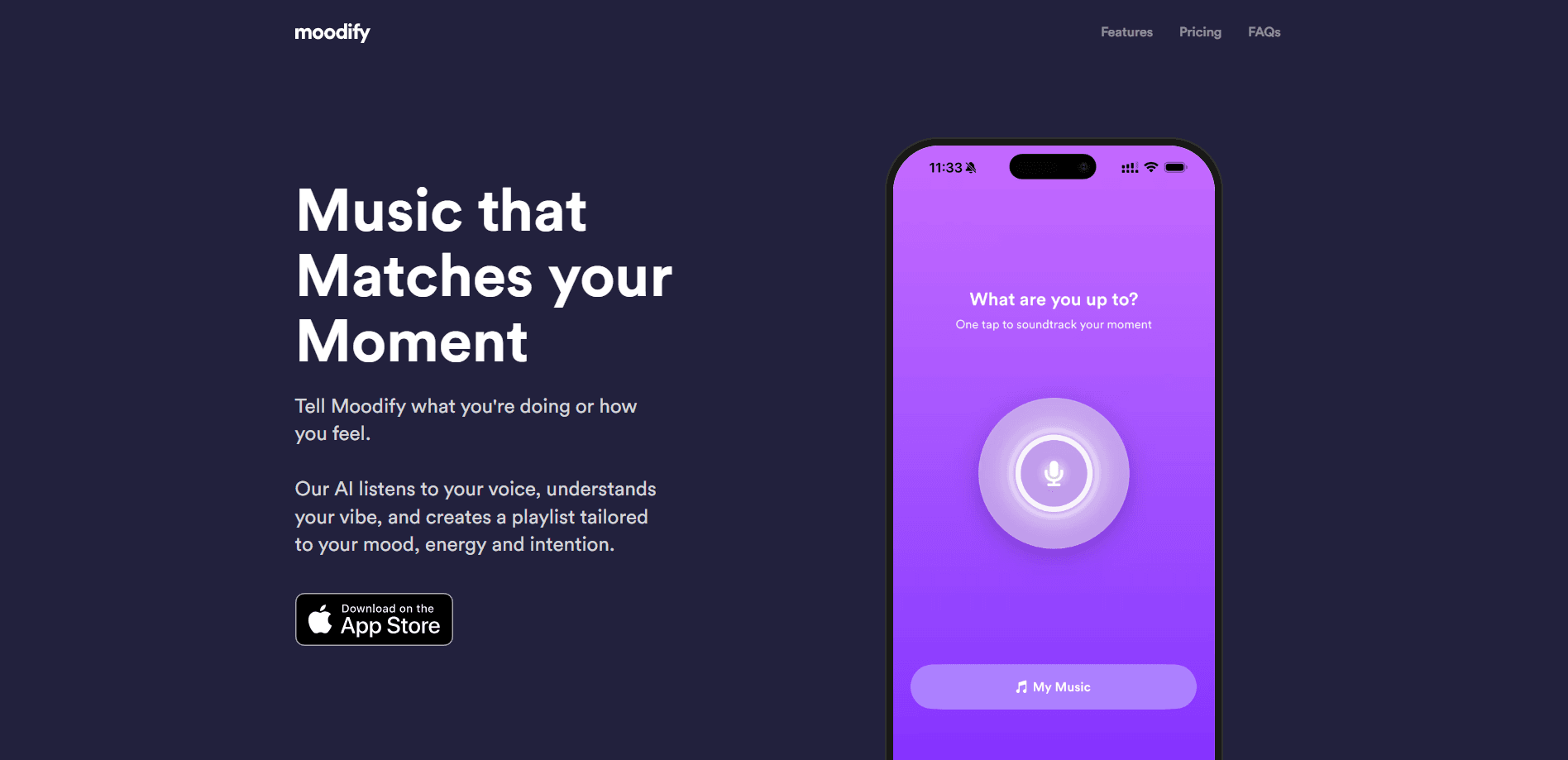
Moodify: Playlists That Fit! is an AI music recommendation app that builds playlists around how you actually feel in the moment. Instead of asking you to pick a genre or an artist, it reads your voice, your mood, and the context around you, then turns that into a playlist that fits. It connects to Spotify and Apple Music, so the music it suggests lands in a service you already pay for.
About Moodify: Playlists That Fit!
What Is Moodify: Playlists That Fit!
Moodify is a music recommendation app built on a simple idea: people rarely know exactly what they want to hear, but they know how they feel. So what if an app could read the mood behind your voice and pick the songs for you? The app uses AI to analyze your voice and the mood behind it, along with the moment you're in, and turns all of that into a playlist.
It pulls tracks through Spotify or Apple Music, so you don't lose your existing library or switch services. Think of it as a friend who reads the room and throws on the right song, except the friend is a model that listens to how you sound before it decides.
The main limitation is reach. Moodify leans on those two streaming services, so if you use YouTube Music, Tidal, or a local file collection, there's nothing for it to connect to. It's also a young product without a live public site, which means some fine print on pricing and platform support isn't published yet.
Getting Started
- Download the Moodify app and create an account.
- Link your Spotify or Apple Music account so the app can access your library and build playlists inside it.
- Tell the app how you feel, either by speaking a short voice clip or describing your mood directly.
- Review the playlist Moodify builds and save it to your connected service, then play it like any other.
Product Information
A quick look at Moodify: Playlists That Fit!'s pricing, supported platforms, and performance.
Best for
The users, tasks, and scenarios where this tool fits best.
Users
- Casual listeners who never know what to play
- Music fans on Spotify or Apple Music
- People who soundtrack their day by feeling
Tasks
- Building a fresh playlist for a specific moment
- Getting out of a listening rut
- Matching music to a task
Scenarios
- A morning commute where you want something that matches your energy, not your usual shuffle.
- A quiet evening at home when you want background music but can't name the vibe you're after.
- A workout or run where tempo and energy matter more than any particular artist.
Key features
Voice and mood analysis
The core of Moodify is reading how you sound, not just what you type. You speak a short clip or describe your mood, and the app interprets the tone and context behind it. That becomes the seed for the whole playlist, which is why the results tend to feel closer to your headspace than a genre filter does.
Personalized playlists that fit the moment
Every playlist is built for the moment you're in rather than a static taste profile. Moodify blends your listening history with the mood signal it just picked up, so the same request on a Monday morning and a Friday night can produce very different lists.
Spotify integration
Moodify builds playlists inside Spotify, which means tracks land in the service your library already lives in. You keep your saved songs, your followed artists, and your existing playlists. Nothing gets exported to a separate walled garden.
Apple Music integration
Apple Music users get the same deal. The app pulls from Apple Music's catalog and saves results to your account, so the recommendation step happens in Moodify while playback stays where you already are. It's a thin layer that sits on top of a service you trust.
Context-aware recommendations
Moodify reads more than mood. It factors in the context around your request, so a playlist for a late-night drive and one for a study session don't come back the same. That's the difference between a mood-based playlist generator and a plain genre filter.
One-tap playlist creation
The flow is short on purpose. Speak or describe, review, save. There's no long setup, no rating fifty songs to calibrate a profile, and no manual curation unless you want to tweak the result yourself.
Pros and cons
Pros
- Turns a vague feeling into a ready playlist in seconds, which beats scrolling through saved songs.
- Works inside Spotify and Apple Music, so you keep your library and playback habits.
- Voice input is quick and natural when you can't name what you want to hear.
- Context awareness makes results feel tailored to the moment, not just your all-time taste.
Cons
- Only supports Spotify and Apple Music. If you use YouTube Music or Tidal, there's nothing to connect to.
- No live public site means pricing details and platform specifics aren't published yet, so you may be guessing before you sign up.
- Heavy reliance on voice input can be awkward in quiet public places where talking to your phone isn't an option.
Frequently asked questions
It's an AI music recommendation app that builds playlists from your voice, mood, and context, then saves them to Spotify or Apple Music. You describe how you feel, and it handles the song selection.
Related content
Explore related tools, skills, and articles for Moodify: Playlists That Fit!.
Moodify: Playlists That Fit! Alternatives

Prosp
Prosp · Writing · Voice & Language · MarketingProsp is an AI LinkedIn outreach tool built for agencies and sales teams, and it writes the message and the voice note in your own voice for each prospect so they actually reply. You connect your accounts, find leads, and let the AI draft and send personalized messages at scale, all from one inbox. It's built for people running outbound at volume. That's the whole pitch. Every touchpoint still has to feel human.

Wordly AI Translation
Wordly · Voice & Language · ProductivityWordly AI Translation is a real-time AI translation and captioning platform built for meetings, conferences, and events. It delivers live translation, captions, transcripts, and summaries in more than 60 languages, and attendees join by scanning a QR code or opening a link instead of using dedicated headsets. The platform works with Zoom, Microsoft Teams, Google Meet, and Webex, and it's designed for organizations that want multilingual access without hiring human interpreters for every session. Simple as that.
Musicful
Musicful AI · Voice & Language · VideoMusicful is an AI music generator and AI music video maker that turns text to music in minutes. Give it a text prompt, a set of lyrics, or a hummed melody and it returns a finished track with vocals and instruments. It also doubles as an AI song generator, produces music videos from the songs you create, and offers an AI cover tool plus a developer API. The platform runs in a web browser and through an Android app, so you can start a song on desktop and pick it up on your phone.