

Mool.AI
Townhall Technologies · Writing
Mool.AI is an AI research platform for investment and strategy teams that turns filings, market data, and private files into analyst-grade reports in minutes.
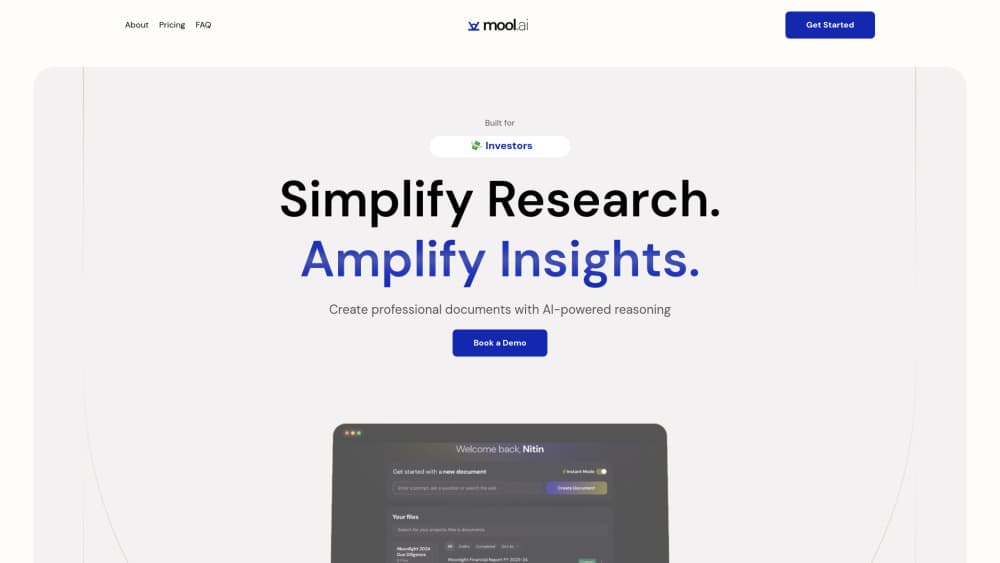
About Mool.AI
What Is Mool.AI
Mool.AI is a research and document platform aimed at people who get paid to know things about companies. Analysts, fund managers, and advisors feed it filings, market data, and their own files, and it drafts the reports, models, and memos that used to eat a week of desk work, which is the entire point of a tool like this. This is investment research software with a narrow job. Townhall Technologies builds it, and the company is a SEBI-registered research analyst in India.
The pitch is narrower than "AI for everything." Mool.AI ships pre-built templates for valuation, due diligence, and peer benchmarking, so output follows the frameworks finance teams already use instead of starting from a blank prompt. It also pulls real-time market data and fundamentals across 200+ exchanges, plus private company profiles and funding rounds in select regions. The company frames this as capital market intelligence. That combination is the main reason teams pick it over a general chatbot.
The limits matter too. Output quality still depends on the sources you connect and the parameters you set. Whatever you generate is a first pass, and a human still has to review it. Nobody should ship an unreviewed draft to a client. That part isn't optional. Full usage terms, seat pricing above the starter tier, and regional data coverage all sit behind a demo or a support call, so budget-conscious buyers who need a firm number before signing anything have some homework to do first, and they should start it early.
Getting Started
- Create an account at app.mool.ai, or book a walkthrough with the Mool.AI team if you want enterprise seats.
- Pick a template that matches the job, such as a valuation, a due diligence pack, or a peer benchmark.
- Connect your sources: choose from built-in market data, or upload private files through the data room.
- Set the objective and key messages, then let Mool.AI draft the sections page by page.
- Review, refine the direction, and export to Office formats or your firm's own layout.
Product Information
A quick look at Mool.AI's pricing, supported platforms, and performance.
Best for
The users, tasks, and scenarios where this tool fits best.
Users
- Investment analysts
- Fund and portfolio managers
- Advisors and wealth managers
Tasks
- Equity research and valuation
- Due diligence
- Peer benchmarking
- Client memos and presentations
Scenarios
- Reviewing an unfamiliar company before an investment call
- Quarterly portfolio reviews
- Early deal screening
- Preparing client discussions
Key features
Analyst-Grade Document Drafting
Mool.AI drafts reports, memos, and presentations section by section instead of dumping one giant block of text. You steer the objective and the key messages, and it handles the research, structuring, and assembly for every section you approve. That keeps you in charge. When a section reads wrong, you adjust the direction and it updates that part rather than the whole document.
Deep Research on Financial Documents
The platform reads 10-Ks, prospectuses, credit agreements, and data-room files, then extracts structured data from them. It knows the difference between revenue recognition methods, not just revenue figures. That matters more than it sounds. A tool that can't tell deferred revenue from booked revenue will quietly get the valuation wrong, and you'll only notice when a client asks a hard question you can't answer without reopening the filing and redoing the whole model from scratch.
Template and Playbook Library
Pre-built modules cover valuation, due diligence, peer benchmarking, and strategic analysis. Templates adapt to your firm's format and tone, and you can save custom playbooks for recurring projects. That makes the platform a practical AI due diligence tool for teams that run the same review every quarter, because the framework is already loaded before you type anything into the box. So the template library does most of the heavy lifting before you write a word.
Real-Time Market and Private Market Data
Market data, fundamentals, and ratings span 200+ exchanges and 90+ countries. Mool.AI is unusual in covering private companies too, with profiles, funding rounds, and financials in select geographies, which matters if your mandate reaches beyond listed names. That coverage is rare. So it works as a broad financial analysis platform, not just an equity screening tool, and the private-market side is the part most competitors either skip entirely or charge extra for as an add-on module. For teams that track early-stage or under-covered names, that gap alone is a reason to look.
Native Format Matching and Exports
Outputs land in your internal or client templates, and you can export drafts to Office apps or other tools. No reformatting. For a team with a house style, this removes the reformatting step that usually eats an afternoon.
Institutional Security and Data Handling
Private files auto-delete when a task finishes, and confidential data isn't used to train models. Mool.AI says it holds SOC Type II and ISO 27001 certifications and uses AES 256-grade encryption with audit trails. Compliance teams ask about all of it, and for good reason: a research tool that touches deal data has to survive a security review before anyone signs a contract. For firms with formal reviews, these are table stakes.
Pros and cons
Pros
- Purpose-built for finance, with templates for valuation, due diligence, and peer benchmarking instead of a blank prompt
- Handles equity research automation well enough that a first draft takes minutes, not days
- Covers private markets, including company profiles and funding rounds that general tools skip
- Real-time data across 200+ exchanges and 90+ countries, with no separate data bill
- Exports into Office formats and your firm's own layout, so cleanup is minimal
- Security posture (SOC Type II, ISO 27001) suits firms that face compliance reviews
Cons
- Full seat pricing above the $499 starter tier sits behind a demo, which slows budgeting
- Mool.AI pricing on the enterprise tier isn't public at all
- Output quality tracks the source documents you feed it, so messy files mean weaker drafts and more manual cleanup before anything reaches a client
- Private-market coverage is limited to select geographies, so check your target markets before committing
- No public API, which rules out teams that want to embed the analysis in their own systems
Frequently asked questions
It's an AI research platform that turns financial documents, market data, and private files into reports, models, memos, and presentations. It's built for investment and strategy work rather than general-purpose writing. Think analyst prep, not chat. A general assistant can draft a paragraph about a stock, but it won't know the filing it came from.
Related content
Explore related tools, skills, and articles for Mool.AI.
Mool.AI Alternatives

Google EmbeddingGemma 2
Google DeepMind · Writing · Image · CodingGoogle EmbeddingGemma 2 is a 740M-parameter open model that turns text, code, images, audio, and video frames into vectors in one 768-dimension space, running on phones and laptops.

MePersona
MePersona, Inc. · Writing · Productivity · MarketingMePersona is an AI unified inbox for creators. It learns your voice, drafts replies to fan messages from 12 platforms, and sends only what you approve.

Fluence
Yay Software (Yannick Huchard) · Writing · Voice & Language · ProductivityFluence is an Android app that reads PDFs, EPUBs, Word files and web articles aloud, follows each sentence as it speaks, and answers questions about the text on the phone itself.