

Morphik
Morphik · Coding
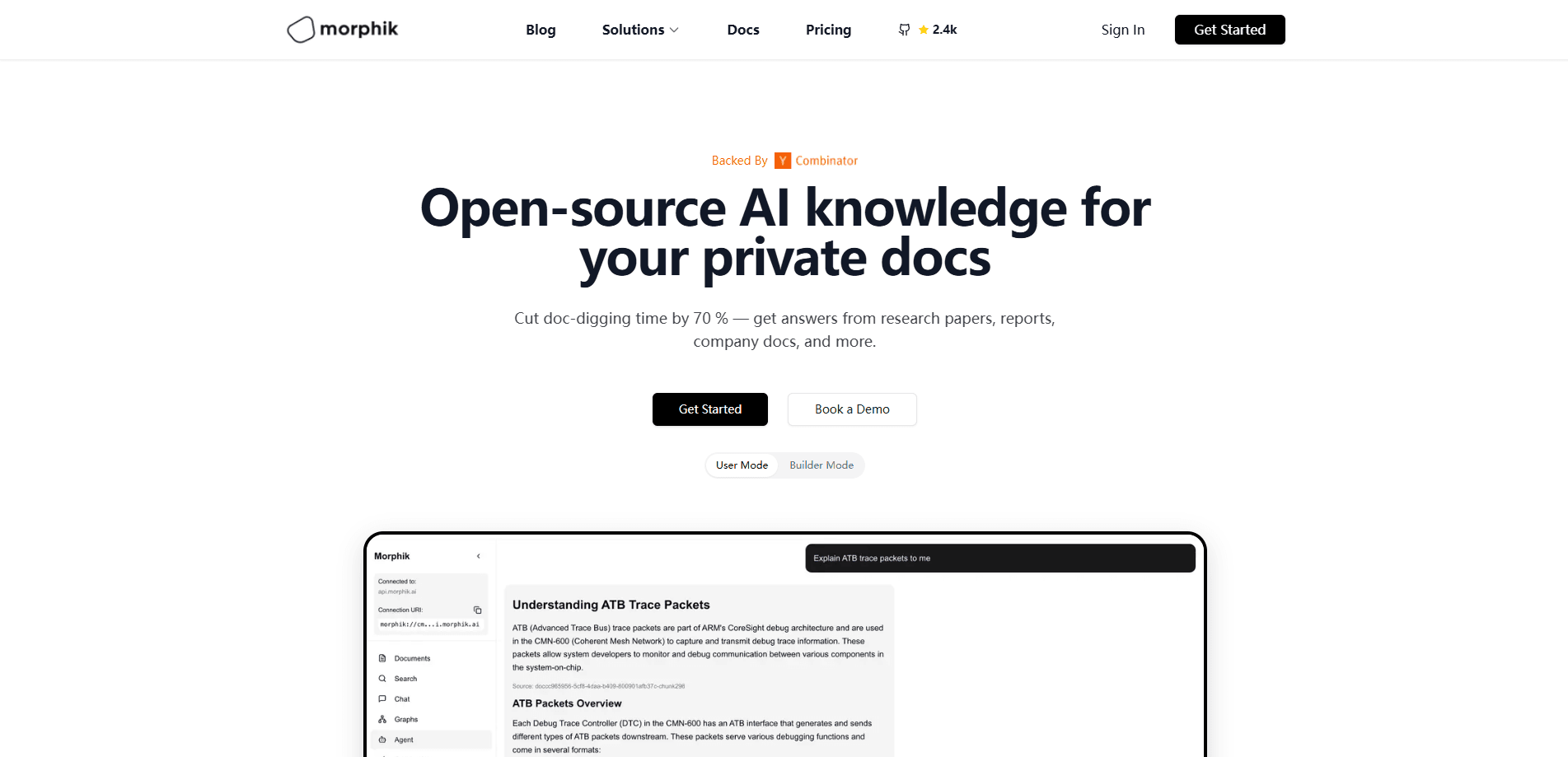
Morphik is an open-source multimodal retrieval engine that ingests text, images, PDFs, and videos, then serves them to AI apps through visual search, metadata extraction, and a Python SDK.
About Morphik
What Is Morphik
Morphik is a retrieval engine built for AI applications that have to work with messy, visually rich documents. It runs the storage and search layer behind a RAG system, so instead of wiring together an OCR tool, an embedding model, and a vector store by hand, you point one platform at your files and query them.
The product started as the engine inside Morphik's own back-office automation, and the team now ships it as a standalone developer platform. You can sign up for the hosted version or self-host the code.
The catch is scope. Morphik expects you to be comfortable with code. There's a console you can click through, but the real value shows up in the Python SDK, the REST API, and the MCP server. A non-technical user looking for a drag-and-drop document chat tool will find it heavier than needed.
Getting Started
- Sign up for a free account at dev.morphik.ai, or pull the source from GitHub if you plan to self-host.
- Create an app and copy your connection URI and API key from the console.
- Install the Python SDK, then point it at your URI with a single line.
- Ingest your files with ingest_file, or upload them through the console.
- Ask questions with a query call, or connect the MCP server to your editor and chat with the data there.
Product Information
A quick look at Morphik's pricing, supported platforms, and performance.
Best for
The users, tasks, and scenarios where this tool fits best.
Users
- Developers building RAG features
- Small AI teams without a search engineer
- Data and knowledge teams
Tasks
- Searching visually rich PDFs
- Building document chat
- Automating metadata tagging
Scenarios
- Early product research
- On-prem deployments
- Mixed-format knowledge bases
Key features
Multimodal Search with ColPali
Most retrieval systems convert a page to text first, which wrecks diagrams and layout-heavy tables. Morphik embeds pages as images using techniques such as ColPali, so search understands the visual content of a document. You can query images, PDFs, and videos through a single endpoint.
Fast Metadata Extraction
Morphik extracts metadata from documents as they land, including bounding boxes, labels, and classifications. Teams use these rules to sort and tag incoming files automatically instead of reading each one. This matters most when a backlog is too large to handle by hand.
Shallow and Deep Retrieval
The engine supports both quick keyword-style lookups and deeper semantic retrieval over the same dataset. You pick the mode that fits the question, from a fast lookup to a reasoning-heavy search across a long manual.
Knowledge Graph and Multiple Representational Formats
Morphik stores data in more than one representational format and builds knowledge graphs over it. Connecting facts across documents helps answer questions that a flat vector index misses, such as linking a spec to the contract that references it.
Developer Tooling: Python SDK, REST API, and MCP
A Python SDK, a REST API, and a Model Context Protocol server cover the common ways developers work. Ingesting a file is a single SDK call, and the MCP server lets compatible AI assistants query your data directly.
Integrations with Existing Tools
Morphik connects to tools teams already run, including Google Suite, Slack, and Confluence. Pulling documents from where work already happens saves the manual upload step and keeps a search index closer to current.
Pros and cons
Pros
- Multimodal search keeps charts, tables, and layout intact instead of flattening them to text
- Open-source code, so self-hosting and inspection are possible, with a free tier to test first
- One platform covers ingestion, metadata, search, and knowledge graphs, which removes pipeline glue code
- Python SDK, REST API, and MCP server fit how developers already build
- Transparent compute-based pricing with an overage rate of $0.03 per page on paid tiers
Cons
- It's a developer tool, so non-technical users face a steep start and no drag-and-drop path
- Self-hosted deployments come without guaranteed support, only a guide and a Discord community
- The free tier caps at 200 pages and 3 Research-Agent calls per month, which limits real testing
- Commercial production use above $2,000 per month in gross revenue needs a paid commercial key
Frequently asked questions
Morphik stores and searches documents for AI applications. It ingests text, images, PDFs, and videos, then returns relevant content to your LLM so an app can answer questions grounded in your own files.
Related content
Explore related tools, skills, and articles for Morphik.
Morphik Alternatives

Base Code
Base44 (Wix) · Coding · ProductivityBase Code is a shared cloud development environment from Base44. Teammates describe changes to an existing GitHub codebase in chat, preview them live and send them back as pull requests.

Google EmbeddingGemma 2
Google DeepMind · Writing · Image · CodingGoogle EmbeddingGemma 2 is a 740M-parameter open model that turns text, code, images, audio, and video frames into vectors in one 768-dimension space, running on phones and laptops.

GitGlow
GitGlow · Coding · ProductivityGitGlow is a local-first desktop Git client that lets independent developers review their own code and their AI agents' changes in one place before shipping.