

Morsa Signals
Morsa Labs · Marketing · Business
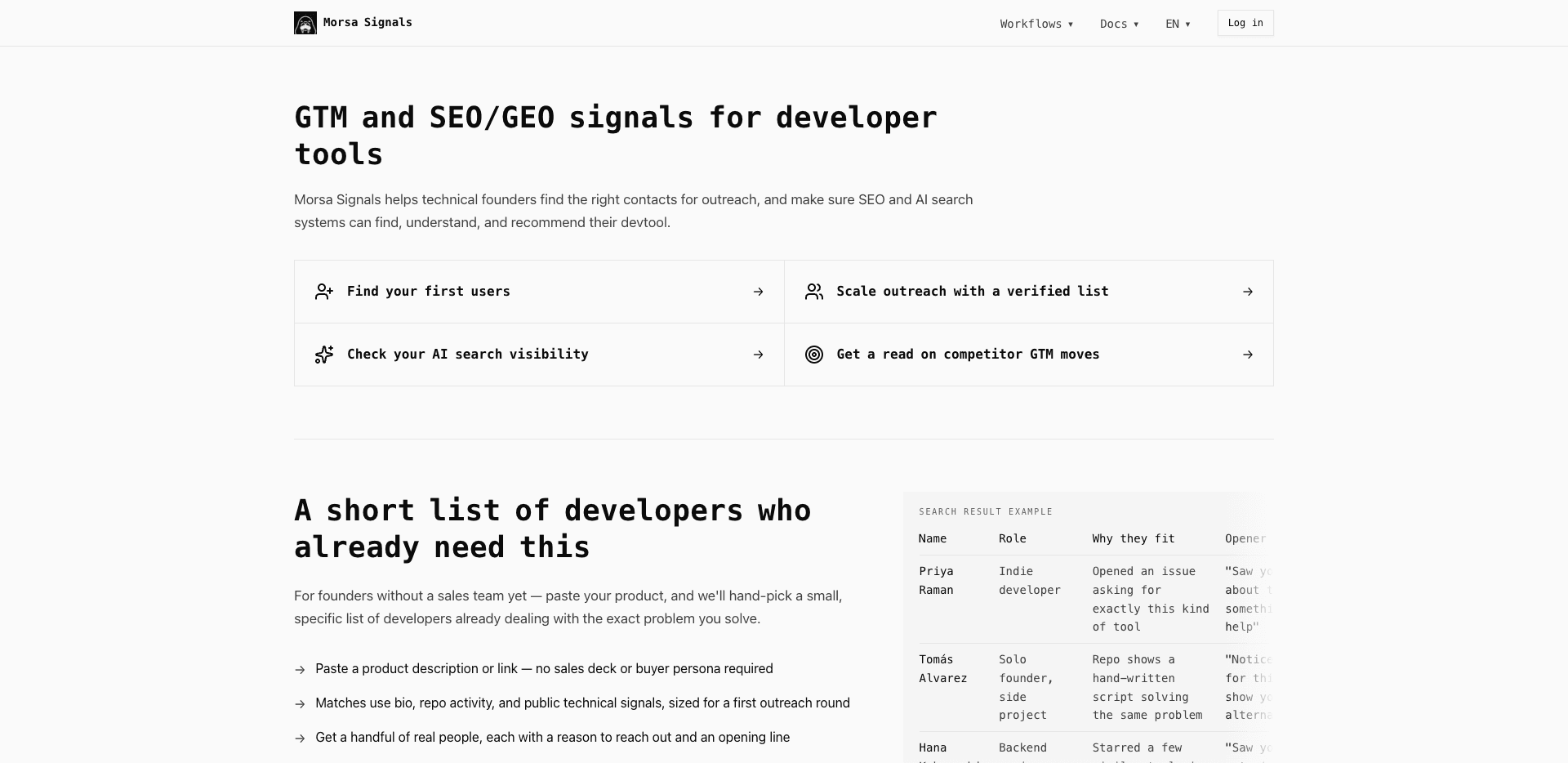
Morsa Signals is a set of GTM workflows built for people selling developer tools. It does two main jobs: find specific developers who already have the problem your product solves, and check whether AI search and chat systems can actually understand and recommend your tool. The contact search pulls from GitHub and other public technical sources, while the AI visibility audit grades how well ChatGPT, Perplexity, Claude, and Google AI Overviews can classify your product. It's made for technical founders who don't have a sales team yet and want a short, hand-picked list instead of a bulk email dump.
About Morsa Signals
What Is Morsa Signals
Morsa Signals is a web tool from Morsa Labs, a small independent software studio, that handles the messy front end of developer-tool marketing. Instead of asking you to build a buyer persona, it works from what your product actually does. You paste a product description or a link, and it turns that into search angles, then looks across GitHub and other public developer sources for people showing that exact pain.
The second half is about search. AI chat tools and AI Overviews now answer plenty of "best tool for X" questions, and they only recommend products they can classify and compare. So why does the audit matter? Miss the context and you miss the recommendation. Morsa Signals scores your technical readiness, positioning, and public footprint, then flags the gaps that make an AI system skip your product or file it in the wrong category. For a devtool, that's often the difference between getting mentioned and getting ignored.
It isn't a self-serve automation play. Every list is hand-reviewed before it goes out, and the company says it never posts or replies on your behalf. The scope is narrow on purpose, which keeps the output specific rather than broad. Treat it as a developer outreach tool, not a full sales platform.
Getting Started
- Open signals.morsa.io and pick the workflow you need, like contact search or the AI visibility audit.
- Paste a page that explains what your devtool does. You can use a product description or a link.
- Let the tool pull out the product summary and audience options, then confirm the audience you want.
- For contact search, request a shortlist and wait for it to arrive by email once it's ready.
- Compare the reply rate against whatever source you're using now before deciding to switch.
Product Information
A quick look at Morsa Signals's pricing, supported platforms, and performance.
Best for
The users, tasks, and scenarios where this tool fits best.
Users
- Technical founders without a sales team
- Solo devtool marketers
- Teams already running outreach
Tasks
- Finding outreach contacts
- Running devtool GTM
- Finding developers for outreach
- Auditing AI visibility
- Tracking competitor moves
Scenarios
- Launching a new devtool where you have zero idea who to email first.
- Noticing your product never turns up when buyers ask an AI tool for recommendations.
- Planning a positioning rewrite before a funding round or a big release.
Key features
Developer Contact Search
The contact search is the entry point most people start with. It's the fastest way to find developers for outreach. You paste a product description, and Morsa Signals builds custom search angles from it, then searches GitHub and other public technical sources for developers already dealing with that exact problem. Each result comes with the specific reason the person fits and a personalized opener. It weighs bio, repository activity, and public technical signals together rather than matching on keywords alone. The output is a small list sized for a first outreach round, not a scraped database.
AI Visibility Audit
This checks whether AI search and chat systems have enough product context to classify, compare, and recommend your tool in the right situations. It scores technical readiness, positioning, and public footprint, then points to the gaps that make an AI system skip, flatten, or misclassify your product. Each gap maps to a workflow that closes it. If you've ever wondered why ChatGPT recommends a competitor instead of you, this is the part that answers it. So how bad can the gap get? A missing category statement is enough to sink you.
Positioning Workflow
Writing a category statement that AI and buyers can repeat back correctly is harder than it looks. This workflow helps you spell out the category, ideal customer profile, buyer context, workflow, and proof clearly enough that both AI systems and humans can restate it with confidence. It pressure-tests your category and ICP against how buyers actually search, and rewrites vague product language into something specific. Hand-reviewed for your actual product.
Competitor GTM Read
Share your product and get a read on how comparable devtools are really moving. Morsa Signals flags the competitors worth watching based on GitHub activity, releases, pricing changes, and launches on Reddit, Hacker News, and Product Hunt. You get a free first read on each one plus what to check for signs of momentum, and you can request the full brief by email. It's a way to spot who's gaining ground without scanning every channel yourself. Worth a look before any positioning rewrite.
Opportunity Monitoring
A workflow that watches GitHub, Reddit, Hacker News, and other developer channels for questions, complaints, and launches worth showing up for. It tracks the channels relevant to your category, surfaces the moments worth a response, and ranks opportunities by fit so you spend time on the right ones. The company states it surfaces conversations worth joining but never posts or replies on your behalf, so the accounts stay in your hands.
Pros and cons
Pros
- Works from a product description, so you don't need to build a buyer persona first.
- Every contact comes with a reason they fit and a personalized opener, not just a name.
- The AI visibility audit names the specific gaps that hurt how AI systems classify your product.
- Contact packs are one-time purchases, which suits early teams testing an approach.
- Lists are hand-reviewed before delivery, cutting down on low-quality matches.
Cons
- Narrow scope means it won't manage a full outreach campaign for you.
- The search leans on GitHub and public technical sources, so it suits devtools better than general consumer products.
- Pricing is per pack rather than a subscription, so heavy volume users pay closer to $0.10-$0.30 per contact.
Frequently asked questions
It runs GTM workflows for developer tools. The two biggest are a contact search that finds developers with a documented reason to hear from you, and an AI visibility audit that grades how well AI search and chat systems can classify and recommend your product. Other workflows cover positioning, competitor tracking, and opportunity monitoring.
Related content
Explore related tools, skills, and articles for Morsa Signals.
Morsa Signals Alternatives

Emailwritr
Emailwritr · Writing · MarketingEmailwritr is an AI email copywriting tool built for affiliates, course creators, and online businesses that want more revenue from the list they already own. Instead of blank pages or generic chatbot prompts, this AI email writer generates welcome sequences, launch campaigns, cart recovery emails, and promo series from frameworks modeled on well-known direct-response copywriters. You connect your autoresponder, answer a few questions about your offer, and it writes the copy for you.

Prosp
Prosp · Writing · Voice & Language · MarketingProsp is an AI LinkedIn outreach tool built for agencies and sales teams, and it writes the message and the voice note in your own voice for each prospect so they actually reply. You connect your accounts, find leads, and let the AI draft and send personalized messages at scale, all from one inbox. It's built for people running outbound at volume. That's the whole pitch. Every touchpoint still has to feel human.

On Model
On Model · Image · MarketingOn Model is an AI fashion model tool that places your clothing on virtual models so online stores can get on-model product photos without booking a photoshoot. It runs as a Shopify app, letting you swap the model in an existing image, change backgrounds, and generate faces for cropped or headless shots. The goal is simple: match your product photos to your customers and stand out from competitors using the same supplier images.