

MultiLipi
MultiLipi · Writing · Marketing
MultiLipi translates and optimizes websites for multilingual SEO and AI search. It adds language versions, injects structured data and tracks AI citations.
About MultiLipi
What Is MultiLipi
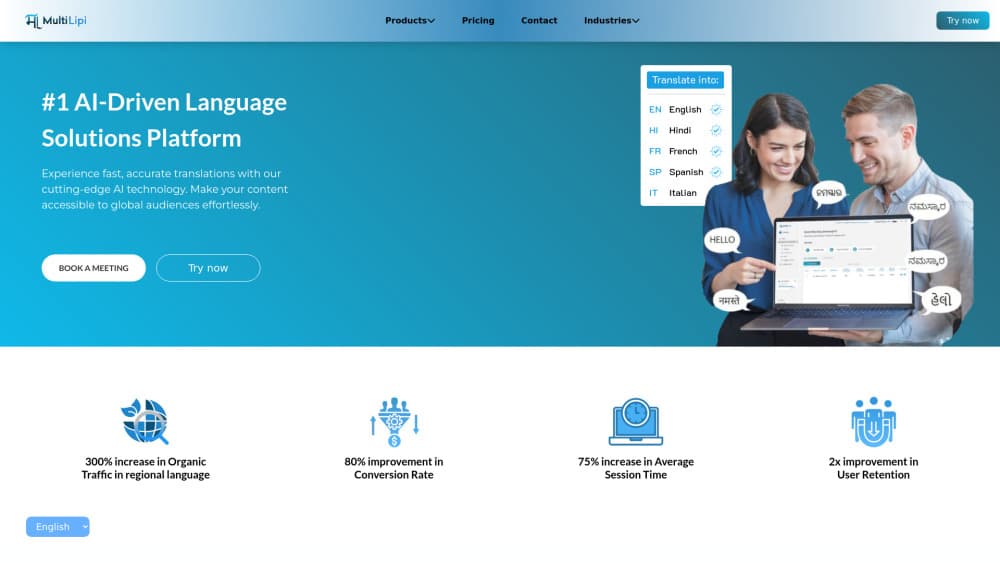
MultiLipi is a platform that translates a website into new languages and then optimizes each version for both Google rankings and AI search engines. The company describes it as a multilingual SEO and generative engine optimization platform, and it sells the product to eCommerce stores, marketing teams, web agencies and government sites that want more than a plain translation plugin.
The idea behind it is that translation alone no longer wins traffic. A translated page can rank in local search, yet the same page often fails to get cited when someone asks ChatGPT, Gemini or Perplexity a question. MultiLipi adds a second layer on top of translation: it injects JSON-LD schema and entity tags so language models read the page as a known entity instead of guessing at it. Co-founders Dewang Bhardwaj and Kunal Singh Shekhawat built the product in India, and the marketing leans on the claim of 120+ languages and a G2 rating of 4.9.
Two things matter before you buy. The free tier is real and the paid plans start at $19 per month, so testing costs you nothing but time and a script tag. And the whole product is no-code: it installs as a script or through native WordPress, Shopify, Webflow and Wix integrations, so you do not rebuild your site or migrate content.
Getting Started
- Create a free account and connect your site, either by pasting one script line or by installing the native plugin for WordPress, Shopify, Webflow or Wix
- Pick the languages you want to add from the dashboard, and set a subdirectory or subdomain URL structure
- Review the machine translation, lock your brand terms in the glossary and edit anything the AI gets wrong in the visual editor
- Turn on structured data and hreflang injection, then watch rankings and AI citations in the analytics dashboard
Product Information
A quick look at MultiLipi's pricing, supported platforms, and performance.
Best for
The users, tasks, and scenarios where this tool fits best.
Users
- eCommerce stores selling abroad
- Marketing teams entering new markets
- Web agencies and freelancers
- Government and public-sector sites
Tasks
- Website translation
- Multilingual SEO
- Generative engine optimization
- AI citation tracking
- Translation management
Scenarios
- A Shopify store opens in three new countries
- An agency onboards a client site
- A blog wants AI visibility
- A company relaunches a site
- A team tracks ROI
Key features
AI Website Translation With Context
MultiLipi translates whole pages, not strings, and it works from meaning rather than word swaps. The engine combines neural machine translation from Google, Microsoft or DeepL with large language models like Gemini, and the company bundles those API costs into the subscription so there are no separate translation bills. Brand term locking keeps product names intact, slang detection avoids awkward literal output, and tone adjustment lets you set how formal a language version reads. You review the result in a visual editor and fine-tune anything that drifts.
Multilingual SEO Automation
Translation is only useful if search engines find it. MultiLipi handles the technical side: language URLs on a subdirectory or subdomain structure, automatic hreflang tags, per-language sitemaps, canonical tags and localized metadata. Each language version gets its own indexable page, so local queries can surface it. This is the part most plugins leave to you, and MultiLipi includes it on every plan, including the free tier, rather than gating it behind an upgrade.
Generative Engine Optimization
This is the feature the company promotes hardest. MultiLipi injects JSON-LD schema and Knowledge Graph entity tags into every translated page, so language models read a product as the same entity across languages. The pitch is that structure prevents hallucination and makes your content the cited answer when someone asks an AI question. The dashboard then reports AI citations from ChatGPT, Gemini and Perplexity, which the company calls Share of Model tracking. Whether that drives real revenue is still an open question, but the tracking gives you data to judge it.
Native CMS and eCommerce Integrations
The platform runs natively on WordPress, Shopify, Webflow, Wix and WooCommerce, and it also supports custom stacks through a script tag or a reverse proxy. Install time is quoted at about 15 minutes, with no migration and no code changes to your existing structure. For agencies, that matters: you can add multilingual support to a client site without touching the theme or rebuilding templates. An API is available for teams that want to wire translation into their own workflow.
Speed and Edge Delivery
A common complaint about translation plugins is that they slow a site down by injecting everything in the browser. MultiLipi instead serves translated pages from an edge network, with Anycast IP routing, intelligent edge caching, Brotli and Gzip compression, and HTTP/3 support. It also bundles managed SSL, origin shielding and health monitoring. The company claims a 100 performance score, and because the pages are pre-rendered rather than patched client-side, the speed argument holds up better than a typical widget-based setup.
Translation Control Tools
Not every translated word should stay as the AI left it. MultiLipi ships a visual editor, draft mode, a glossary for rules and a translation memory that reuses approved phrasing across new content. It also offers slug translation so URLs read naturally, 25+ language switcher designs, media translation and RTL support for Arabic and Hebrew. Visitor language redirection sends people to the right version based on their browser setting, which cuts the friction of a manual language pick.
Analytics, Security and Plans
The analytics dashboard covers translation requests, page views and AI citation share, plus an AI SEO analyzer and a vulnerability scanner on the SEO side. On security, the platform lists encryption in transit and at rest, two-factor authentication, OAuth with Google, a web application firewall, DDoS mitigation, bot management and IP filtering. Enterprise adds SAML single sign-on, a custom reverse proxy, SLA, MSA and DPA. The free tier gives 10k translated words and one language, and paid tiers scale from Starter at $19 per month to Extended at $499, with annual billing saving 20%.
Pros and cons
Pros
- Free plan with 10k translated words, one language and SEO features included, so you can test before paying
- Translation API costs from Google, Microsoft, DeepL and Gemini are bundled into the subscription
- Native integrations for WordPress, Shopify, Webflow, Wix and WooCommerce with no migration or code changes
- GEO and structured data injection go beyond translation and target AI citation, not just Google rankings
- Edge delivery and pre-rendered pages keep the speed cost lower than client-side translation widgets
Cons
- AI citation tracking is a young metric, and the link between Share of Model and real revenue is still unproven
- Word-count billing multiplies fast, since a 1,000-word page in five languages counts as 5,000 translated words
- Deeper control over custom stacks still needs a developer for the reverse proxy or API path
- Reviews note occasional trouble with mixed-language pages, so heavy bilingual content can need manual cleanup
Frequently asked questions
MultiLipi translates a website into other languages and optimizes each version for multilingual SEO and AI search. It generates hreflang tags, localized URLs and metadata, injects JSON-LD schema and entity data, and tracks how often AI models like ChatGPT and Gemini cite your content.
Related content
Explore related tools, skills, and articles for MultiLipi.
MultiLipi Alternatives

Google EmbeddingGemma 2
Google DeepMind · Writing · Image · CodingGoogle EmbeddingGemma 2 is a 740M-parameter open model that turns text, code, images, audio, and video frames into vectors in one 768-dimension space, running on phones and laptops.

MePersona
MePersona, Inc. · Writing · Productivity · MarketingMePersona is an AI unified inbox for creators. It learns your voice, drafts replies to fan messages from 12 platforms, and sends only what you approve.

Fluence
Yay Software (Yannick Huchard) · Writing · Voice & Language · ProductivityFluence is an Android app that reads PDFs, EPUBs, Word files and web articles aloud, follows each sentence as it speaks, and answers questions about the text on the phone itself.