

MVPfy
MVPfy · AI Assistant · Business
MVPfy is a product development firm that builds minimum viable products for startups and founders, turning raw ideas into working apps fast.
About MVPfy
What Is MVPfy
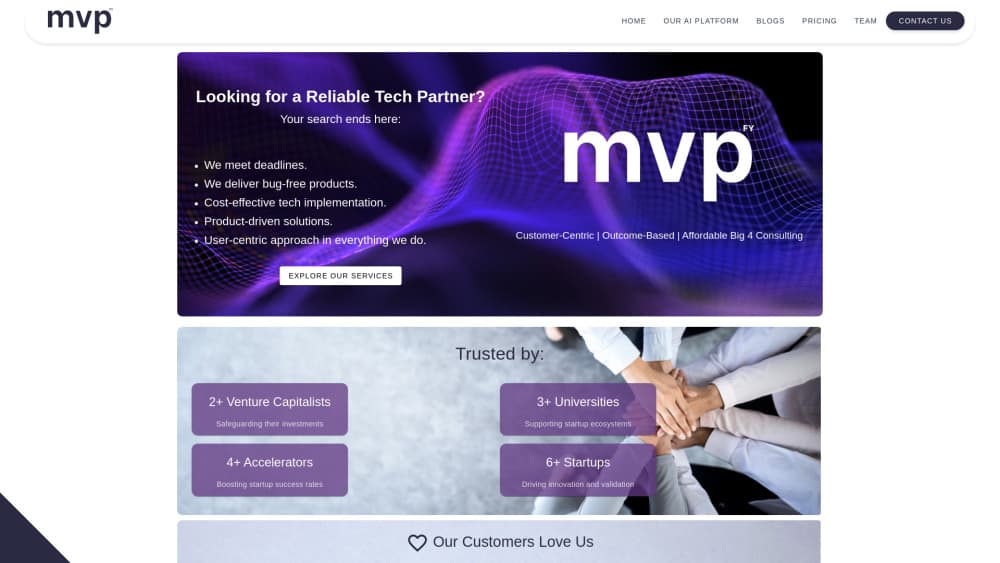
MVPfy is a build-first product studio for founders who have an idea and need something real to show for it. As an MVP development company, it doesn't sell you a full custom software project. It scopes down to the minimum viable product: the smallest working version that proves whether people actually want what you're making. You get a functional app, not a slide deck. No code, no problem.
The problem it targets is the gap between an idea and evidence. Founders spend months writing specs, hiring, and building features nobody asked for, then run out of money before they learn anything useful. MVPfy flips that. Build the core, put it in front of real users, and let their behavior tell you what to do next. Its site pitches exactly this: validate assumptions, attract users, and prove market demand with minimal risk.
Who's it for? Early-stage founders, solo builders, and small teams who need a working product to test the market or show investors without burning a year on development. It's less useful if you already have a live product and want incremental feature work, or if you need a large enterprise system built to a fixed spec. And as a minimum viable product service, the value comes from what you leave out, not what you cram in.
The honest limits: an MVP is by definition incomplete, so it won't be your final product. You're paying for speed and focus, which means some features get deliberately left out. That's the trade. And because it's a service rather than a self-serve tool, your results depend on how well the scope is defined up front. Come in with a clear problem and you'll get far more out of it.
Getting Started
- Reach out through the MVPfy site and describe the idea you want to bring to market.
- Work with the team to define your MVP scope, the few features that actually prove the concept.
- Review the user flow and design so the build matches what your target users expect.
- Let the team develop and test the product, then launch it to real users for feedback.
Product Information
A quick look at MVPfy's pricing, supported platforms, and performance.
Best for
The users, tasks, and scenarios where this tool fits best.
Users
- First-time founders
- Solo builders with limited runway
- Small startup teams preparing for a funding round
Tasks
- Building a first MVP from a rough concept
- Testing market demand before committing
- Preparing an investor-ready MVP demo
Scenarios
- A non-technical founder with a validated problem but no code
- A team that keeps adding features and never launches
- Pre-seed fundraising where a live product strengthens the pitch
Key features
Lean, Feature-Focused Scoping
The core promise is restraint. MVPfy helps you identify and build only what matters for launch, which cuts the feature bloat that eats budgets and delays releases. For a founder, that translates into a smaller bill and a faster path to real user feedback. Less is more here. The whole model assumes that most features in a first version are guesses, so you test the important ones before committing to the rest rather than building everything at once and hoping.
Fast Build and Launch Cycle
Speed is the point of an MVP, and MVPfy positions quick turnaround as a main selling point. You get a working product sooner, so you can onboard early users and start learning while competitors are still in planning. Time is money. Slow development is expensive in a way founders feel directly: every extra month burns runway you can't get back. A short cycle keeps the experiment cheap and lets you react to what users tell you.
User-Centric Design
The company builds each MVP around real users, with an emphasis on clean UI and intuitive UX. That matters more than it sounds. Early products live or die on whether someone can figure them out in the first few minutes, and a confusing interface kills engagement before you learn anything useful. Users don't read manuals. Good design here isn't decoration. It's what makes the validation data trustworthy, because users who can actually use the product will tell you something real about demand.
Investor-Ready Architecture That Grows
MVPfy builds on modern foundations designed to grow, rather than throwaway prototypes. The practical benefit is that you can iterate, add features, and expand without rebuilding from scratch later. Founders often get burned by cheap prototypes that collapse the moment real traffic shows up. Building on a base that can handle growth means the MVP is a genuine starting point for a company, not a demo you throw away after the pitch.
Idea, Build and Validate Process
The service wraps development in a broader loop: idea, build, validate. That framing keeps every decision pointed at learning rather than simply shipping code. For a founder, it means the engagement doesn't end at launch. Simple as that. You get a product built specifically to answer the question that matters most early on, which is whether anyone wants what you've made. Validation, not volume, is the goal.
Pros and cons
Pros
- Focuses the build on core features, which keeps costs and timelines down for founders with tight budgets.
- Fast turnaround gets a testable product in front of users sooner.
- Clean UX work makes early user feedback more trustworthy.
- Modern foundations mean less risk of a full rebuild once the product grows.
Cons
- It's a service, not a self-serve tool, so pricing and timelines depend on a custom scoping conversation.
- An MVP is deliberately incomplete, so it won't cover every feature you might want on day one.
- Results hinge on how clearly you define the problem up front, and a vague idea leads to a vague build.
Frequently asked questions
It builds minimum viable products for startups and founders. You bring an idea, the team scopes it down to the core features, and you get a working product you can put in front of real users to test demand. It's a development service, so the work is done for you rather than through a tool you operate yourself. It's that simple.
Related content
Explore related tools, skills, and articles for MVPfy.
MVPfy Alternatives

Iplan AI
Iplan AI · Productivity · AI AssistantIplan AI is an AI travel planner that turns a few trip details into a full day-by-day itinerary in seconds. You answer questions about your destination, interests, budget, and travel companions, and the tool builds a plan you can edit, share, and carry with you on any device. It targets travelers who want a solid draft without spending hours in spreadsheets and browser tabs. Think of it as an itinerary generator that does the tedious part for you.

Screenhelp
Screenhelp · Productivity · AI AssistantScreenhelp is an AI screen assistant that turns a single keyboard shortcut into real-time help. You press Ctrl+Shift+Space, it captures what's on your screen, and it streams an answer into a private panel in about two seconds. Think of it as an AI screenshot helper you trigger on demand. It runs on Mac, Windows, and the web, starts free with 30 answers a month, and stays invisible during screen sharing on Zoom, Teams, and Google Meet.

Rainbow
Rainbow · AI AssistantRainbow is an AI weather forecast app built around short-term precipitation nowcasting. Its engine pushes min-by-min rain and snow predictions up to four hours ahead, blending live satellite and radar feeds into hyperlocal forecasts. The app adds live rain radar, a seven-day outlook, precipitation alerts, home-screen widgets, and a hurricane tracker, and it runs on both Android and iOS with a free tier plus paid upgrades.