
MyScale
MOQI SINGAPORE PTE. LTD. · Coding
MyScale is a SQL vector database built on ClickHouse. It runs vector search, full-text search, and analytics in one engine you query with plain SQL, which suits RAG and AI apps.
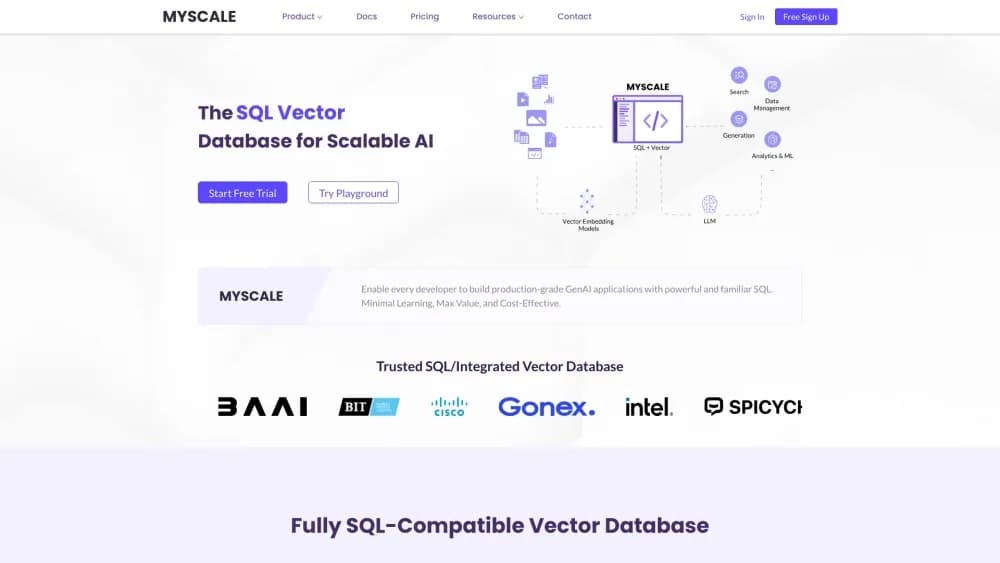
About MyScale
What Is MyScale
MyScale is a cloud database aimed at AI applications, and it's built on the open-source ClickHouse engine. The idea is simple: you keep structured data, vectors, and text in one system, then query all of it with SQL you already know. Its engine, called MSTG, is tuned for vector search at billion-scale, and the company claims it beats dedicated vector databases by 4x to 10x in both speed and cost. Treat that figure as the vendor's own claim until your workload proves it.
The problem it solves is tool sprawl. A typical RAG stack bolts a vector store onto a relational database and a search engine, then you maintain three systems and three query languages. MyScale folds those into one, so a single query can filter on metadata and rank by vector similarity at the same time. A developer keeps their SQL skills instead of learning a custom vector API.
The tradeoff is that MyScaleDB is young and narrower than ClickHouse itself. It forks ClickHouse and changes the storage and execution engine for vector work, so it may lag the upstream release. There's an open-source build you can self-host under Apache 2.0, but the polished experience, including the MSTG engine, comes through MyScale Cloud.
Getting Started
- Sign up at myscale.com and launch a cluster from the Clusters page.
- Grab the host, username, and password from Connection Details, then connect with the Python client, Node.js, Go, JDBC, or HTTPS.
- Create a table, insert your rows, and add a vector index to the vector column with a metric like cosine.
- Run a vector search in SQL, using ORDER BY distance plus LIMIT, or filter rows first with WHERE.
- Link it into your stack through the OpenAI, LangChain, or LlamaIndex integrations, then ship.
Product Information
A quick look at MyScale's pricing, supported platforms, and performance.
Best for
The users, tasks, and scenarios where this tool fits best.
Users
- Backend and AI developers
- RAG builders
- Data teams
Tasks
- Powering RAG retrieval
- Hybrid search
- Filtered vector search
- Adding semantic search to an app
Scenarios
- A team shipping its first RAG feature
- A startup replacing a multi-database stack
- An AI app with growing data
Key features
SQL Vector Queries
MyScale treats vector search as a SQL operation. You add a vector index to a column, then rank rows with a distance function inside ORDER BY, mixed freely with WHERE, JOIN, and GROUP BY. If you know SQL, you already know how to query a vector database here.
MSTG Vector Engine
The MSTG engine is MyScale's own indexing algorithm, and it uses NVMe SSDs to pack in more data per node. The company says this lets it hold roughly 10x the data density of standard setups and outperform specialized vector databases on cost. That's the vendor's benchmark, so test it against your own vectors before committing.
Full-Text and Hybrid Search
Alongside vectors, MyScale ships a BM25 full-text index with configurable tokenizers for different languages. You can run text search on its own or blend it with vector results in a hybrid query. For RAG, that mix often retrieves better passages than either method alone.
Filtered Search at Any Ratio
Filtered search is where many vector databases fall short. MyScale applies the metadata filter first, then searches the remaining rows, so accuracy holds even when a filter keeps only a tiny slice of a billion-row table. In practice, that's the difference between a clean result and a slow, fuzzy one.
Unified Data Management
Storage isn't limited to vectors. MyScale handles structured columns, JSON, text, geospatial, and time-series data in the same table. A product, its embedding, and its sales history sit side by side, so a single query can join AI features with business data.
Integrations and Clients
MyScale connects to OpenAI, LangChain, LangChain JS/TS, and LlamaIndex, and ships Python, Node.js, Go, and JDBC clients plus an HTTPS interface. Most teams wire it into an existing pipeline rather than starting from scratch, which keeps migration short.
MyScale Telemetry
Telemetry gives you observability for LLM systems, so you can trace prompts, responses, and retrieval steps in one place. Debugging a RAG pipeline without it means guessing where a bad answer came from; with it, you can see the retrieval that fed the model.
Security and Access Control
MyScale offers SQL-based role-based access control and states compliance with SOC 2 and ISO 27001. For teams that handle sensitive data, that gives a path to grant limited access without exposing the whole cluster.
Pros and cons
Pros
- Because it's fully SQL-compatible, a developer with SQL skills can run vector search without learning a custom API or a new query language.
- Vector search, full-text search, and analytics share one engine, which removes the extra services a typical RAG stack needs.
- The MSTG engine targets billion-scale vectors on disk, so large collections don't have to live entirely in memory.
- Filtered search applies metadata filters before ranking, which keeps results accurate on selective queries.
- The free pod for 5M 768D vectors and the OpenAI, LangChain, and LlamaIndex integrations make it quick to test.
Cons
- The performance and cost claims of 4x to 10x come from the vendor's own benchmark, so you'll want to reproduce them on your data before relying on them.
- As a ClickHouse fork, MyScaleDB may trail the upstream engine and its broader feature set, which matters if you need bleeding-edge ClickHouse features.
- The strongest features, including the MSTG engine, live in MyScale Cloud, so self-hosting the open-source build gives you a less complete product.
- There's no broad mobile or desktop app, so it fits server and pipeline work rather than end-user tools.
Frequently asked questions
MyScale stores and queries the data behind AI apps, mainly for retrieval in RAG systems and semantic search. You keep vectors, text, and structured rows together, then query them with SQL.
Related content
Explore related tools, skills, and articles for MyScale.
MyScale Alternatives

Base Code
Base44 (Wix) · Coding · ProductivityBase Code is a shared cloud development environment from Base44. Teammates describe changes to an existing GitHub codebase in chat, preview them live and send them back as pull requests.

Google EmbeddingGemma 2
Google DeepMind · Writing · Image · CodingGoogle EmbeddingGemma 2 is a 740M-parameter open model that turns text, code, images, audio, and video frames into vectors in one 768-dimension space, running on phones and laptops.

GitGlow
GitGlow · Coding · ProductivityGitGlow is a local-first desktop Git client that lets independent developers review their own code and their AI agents' changes in one place before shipping.