

Nanonets
Nanonets · Coding · Productivity
Nanonets is an AI document processing platform that pulls structured data out of invoices, forms, and contracts, then routes it through automated workflows your team can run without code.
About Nanonets
What Is Nanonets
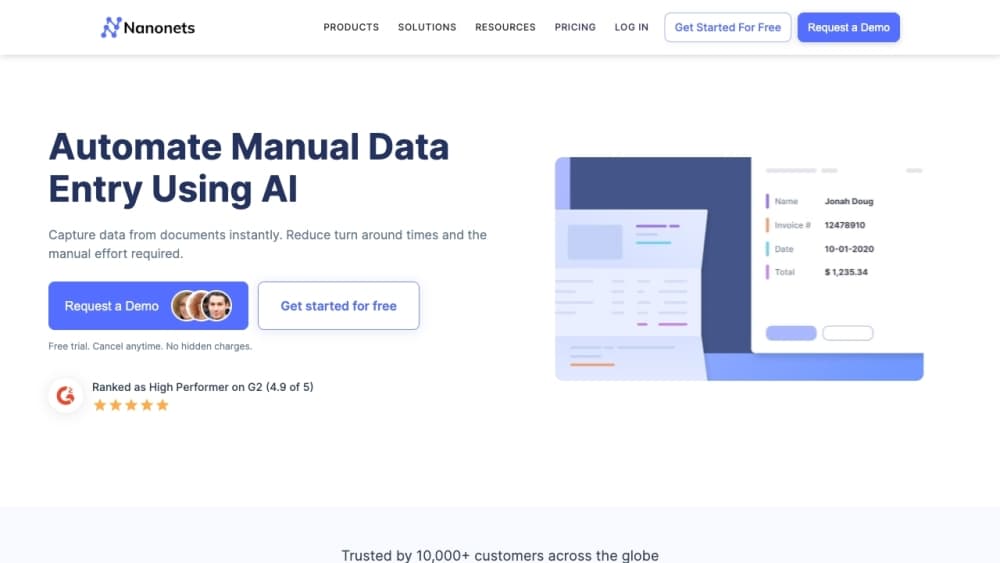
Nanonets is an intelligent document processing platform built for teams that drown in paperwork. You feed it invoices, purchase orders, receipts, IDs, or contracts, and it reads the fields you care about, then hands back clean data you can push into a spreadsheet, a database, or an ERP. The pitch is simple: stop typing numbers off a PDF by hand.
What separates it from a plain OCR tool is what happens after document data extraction. Nanonets chains steps into workflows, and each step is a block, such as extract, classify, validate, or post to an integration. A typical invoice job runs four to six blocks per document, and the platform tracks each run so you know what a document actually cost to process.
The limits are worth knowing up front. Nanonets is aimed at business document workflows rather than casual scanning, so the free tier is capped by credits rather than unlimited, and the higher-tier features like custom Python blocks, ERP connectors, and private deployment sit behind sales conversations. It's a tool for people with a recurring paper problem, not a one-off PDF converter.
Getting Started
- Sign up at nanonets.com and pick a prebuilt agent or start a blank workflow for your document type.
- Upload sample documents, such as a batch of invoices, so the model learns the fields you need to extract.
- Add blocks to the workflow to classify, validate, or format the data, then connect an export target like Google Sheets, an email inbox, or your ERP.
- Test the workflow on real files, correct any wrong fields, and let the self-learning loop fold your corrections back in.
- Turn the workflow on and route incoming documents to it by email, API, or cloud storage.
Product Information
A quick look at Nanonets's pricing, supported platforms, and performance.
Best for
The users, tasks, and scenarios where this tool fits best.
Users
- Finance and accounts payable teams
- Operations managers
- Back-office and shared-service teams
- Developers building document pipelines
Tasks
- Extracting fields from invoices
- Classifying mixed documents
- Validating and formatting data
- Posting data into business systems
- Detecting barcodes and signatures
Scenarios
- Month-end invoice backlog
- High-volume data entry that keeps coming back
- A paper process you want to audit
- Testing a document type before committing
Key features
Prebuilt agents for common documents
Nanonets ships ready-made agents for invoice processing, contract review, freight audit, KYC review, and other recurring processes. You start from a working template instead of a blank canvas, then adjust the fields and rules to match how your team actually handles each document.
Workflow blocks and per-run pricing
Every step in a workflow is a block, and each block has a price based on complexity. Simple operations run at $0.02 per run, standard AI classification and validation at $0.10, and complex extraction or generative AI at $0.30. That structure lets a team with a simple routing job pay far less than one running heavy extraction across thousands of pages.
Self-learning loop
When a person corrects a wrong field, the correction feeds back into the model so the share of documents the agent closes on its own keeps rising. This matters for teams processing the same document type repeatedly, because accuracy compounds instead of staying flat.
Trail context graph
Trail converts policies, procedures, and internal knowledge into a governed graph the agents can reference. Each rule is tied to the document it came from, so an agent deciding whether to accept a late return can cite the policy, the order record, and the prior promise, not just a hunch.
OCR-3 extraction model
Nanonets built OCR-3 as its own extraction model, and the company says it leads on complex, constraint-heavy documents ahead of general models. The practical point is that a cleaner first pass on hard documents keeps bad data from breaking every step that follows.
Enterprise controls
The platform covers SAML SSO and SCIM provisioning, role-based access, audit logs that stream to a SIEM, and encryption at rest and in transit. Larger buyers can also pin data to US, EU, or APAC regions, or run the whole thing in a private cloud or on-prem.
Integrations and connectors
Nanonets connects to email, cloud storage, databases, and business systems, with ERP connectors like Salesforce, SAP, and Oracle on higher plans. Custom Python blocks let a team insert its own logic into a workflow when the built-in blocks don't cover a step.
Pros and cons
Pros
- Free trial with $50 in credits and no card required, so you can test real documents before paying anything.
- Per-run block pricing makes costs track actual usage instead of a flat seat fee.
- Self-learning loop improves accuracy over time on repeated document types.
- Broad enterprise controls including SSO, RBAC, audit logs, and regional data residency on higher plans.
- API access on the entry paid plan means document processing can be wired into your own software.
Cons
- The Starter plan caps you at 3 users, so small teams hit the limit fast once more people need access.
- Key features like custom Python blocks, ERP connectors, and private deployment sit behind a sales call, not a public price.
- Complex verification and setup mean the platform rewards teams with a steady document volume, and it's overkill for occasional scanning.
- Pricing is usage-based and can be hard to predict if document volume swings month to month.
Frequently asked questions
Nanonets reads business documents like invoices, forms, and contracts, extracts the fields you need, and routes that data through automated workflows. It's built for teams that process the same document types over and over and want to cut manual data entry.
Related content
Explore related tools, skills, and articles for Nanonets.
Nanonets Alternatives

Base Code
Base44 (Wix) · Coding · ProductivityBase Code is a shared cloud development environment from Base44. Teammates describe changes to an existing GitHub codebase in chat, preview them live and send them back as pull requests.

Google EmbeddingGemma 2
Google DeepMind · Writing · Image · CodingGoogle EmbeddingGemma 2 is a 740M-parameter open model that turns text, code, images, audio, and video frames into vectors in one 768-dimension space, running on phones and laptops.

GitGlow
GitGlow · Coding · ProductivityGitGlow is a local-first desktop Git client that lets independent developers review their own code and their AI agents' changes in one place before shipping.