

Neoform AI
Neoform AI · Voice & Language
Neoform AI builds speech, translation, and learning models for Nigerian languages, and Nawazobia is its voice-first assistant for Yoruba, Hausa, Igbo, Pidgin, and English.
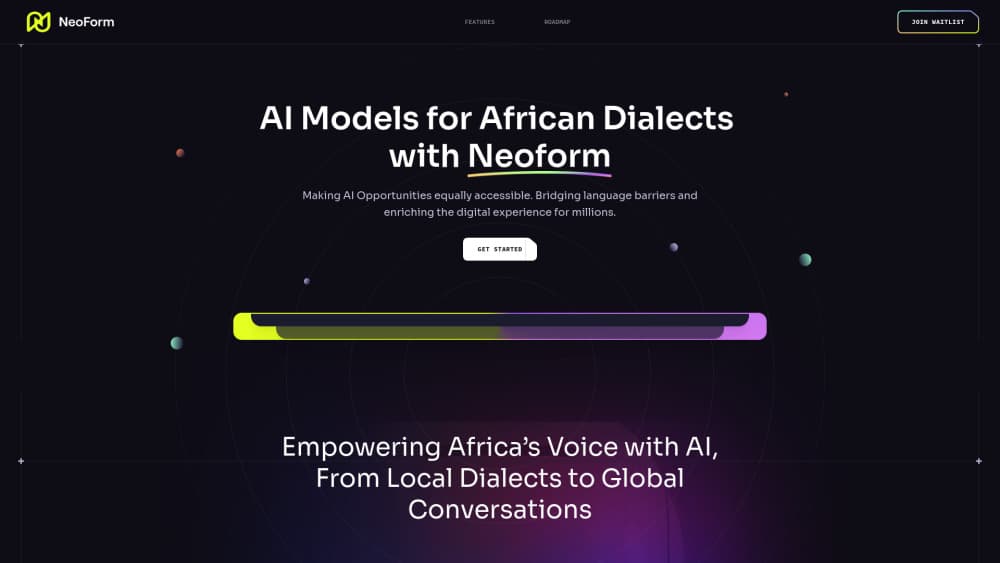
About Neoform AI
What Is Neoform AI
Neoform AI is a language technology company that builds speech and translation tools for African languages, starting with the ones spoken in Nigeria. Its flagship product, Nawazobia, is a voice-first assistant. You talk or type in Yoruba, Hausa, Igbo, Nigerian Pidgin, or English, and it answers out loud while showing the numbers, sources, and links on screen.
The gap it aims at is easy to see. Nigerian language AI has mostly meant an English assistant with a token nod to local speech, which leaves out millions of people who think and search in Yoruba or Pidgin. Neoform AI takes a different route. One multilingual backbone is fine-tuned across 22 Nigerian languages, then wrapped in products people can actually use, from a consumer assistant to a translation API for African languages.
Two limits matter before you ask for access. Sign-ups run through a beta invite list, and there's no published price sheet, so cost depends on a conversation with the team. Nawazobia also speaks five languages today while the model card lists 22+, and the company is upfront that other African markets sit on the roadmap rather than in the product.
Getting Started
- Request a beta invite at neoformai.com, or open Nawazobia and ask for an access code.
- Choose your language from the Yoruba, Hausa, Igbo, Pidgin, or English options.
- Ask by voice or type your question. The app shows what it heard, so you can fix a misheard word before the answer lands.
- Read the reply. You get a short spoken answer plus the figures, sources, and links on screen.
- For product work, email [email protected] about API or SDK access and the languages you need covered.
Product Information
A quick look at Neoform AI's pricing, supported platforms, and performance.
Best for
The users, tasks, and scenarios where this tool fits best.
Users
- Community and NGO teams
- Telecom, banking, and insurance support leads
- Teachers and language learners
Tasks
- Running an IVR line in a local language
- Transcribing research interviews
- Grounding answers in a document
- Checking a price or a route
Scenarios
- A customer calls a Lagos call center in Pidgin and every agent line is busy.
- A clinic in Kano needs the same triage script in Hausa and in English.
- A publisher wants a reading app that pronounces Yoruba with the right tones.
Key features
Nawazobia Voice Assistant
Nawazobia answers in speech and on screen at the same time. The pairing matters in noisy places: you can listen while walking, then check the exact figure or street when you stop. It covers Yoruba, Hausa, Igbo, Nigerian Pidgin, and English, and it echoes back what it heard so a bad transcript doesn't quietly turn into a bad answer.
22+ Nigerian Languages On One Backbone
The company runs a single fine-tuned multilingual backbone instead of one model per language. The published list spans Yoruba, Igbo, Ijebu Yoruba, Hausa, Ebira, Izon, Edo, Ibibio, Fulfulde, Efik, Kanuri, Tiv, Nupe, Igala, Gbagyi, Urhobo, Bariba, Jukun, Margi, Nigerian Pidgin, Tangale, and Idoma. A shared backbone keeps latency low on ordinary phones, and that decides whether a voice app is usable on a mid-range Android device.
Answers Grounded In Sources
Ask about a passport renewal, a mobile money setup, or a school application and the reply walks you through the steps. Ask about a price and it checks Jumia and Konga, flagging deals that look too cheap to be real. Send a photo of a receipt, a road sign, or a form and the answer stays inside what the image shows. That restraint is what separates a useful assistant from a confident guess.
Translation And Transcription API
Neoform offers a translation API for African languages along with transcription, built for teams adding a language to an existing product. Voice assistants and IVR runs share the same backend, so a call center flow and a chat flow don't need separate stacks. SDKs ship alongside the API, and the company names on-device, edge, and cloud as the three deployment routes.
Native Speaker Datasets
Accuracy in African speech recognition rises or falls on the data underneath it. Neoform AI curates text and audio datasets that native speakers and language specialists build and validate, then sells access to that data next to the models. For a team training its own system, clean local audio is usually harder to source than compute.
A Paid Translator Program
Neoform runs a translation portal where native speakers translate sentences and get paid for the work. Translators apply through the site, agree on payment, then work inside the portal in their own language. It's a supply-side move: the data pipeline improves as more speakers join, and the people whose language is being modeled get paid for the contribution.
Pros and cons
Pros
- Covers languages that mainstream assistants skip or handle badly, with 22 listed for the model and five live in Nawazobia.
- Spoken and on-screen answers arrive together, so the output works for listeners and for anyone who has to verify a figure.
- Deployment includes on-device and edge, which matters where mobile data is expensive or patchy.
- Answers stay tied to documents, photos, and live price checks instead of free-floating guesses.
- A paid translator program puts native speakers inside the data loop rather than outsourcing review.
Cons
- Beta invite only, with no published pricing, so you can't budget from the site alone.
- Nawazobia speaks five languages while the model advertises 22+, and the rest sit on a roadmap.
- The focus is Nigeria. Teams in Kenya, Ghana, or South Africa will find little built for them yet.
- No public accuracy benchmarks or error rates, which makes procurement comparisons hard.
- API documentation isn't public, so developers have to ask before they can scope a build.
Frequently asked questions
It's a language technology company building speech, translation, and learning tools for African languages, with Nigeria as the first market. Nawazobia, its voice-first assistant, is the product most people can try today.
Related content
Explore related tools, skills, and articles for Neoform AI.
Neoform AI Alternatives

Off the Record
Weird Machines · Voice & Language · ProductivityOff the Record is a macOS app from Weird Machines that reshapes your voice in real time to block AI transcription, so people hear you normally and notetakers get nothing usable.
Cekura Bench
Cekura · Voice & Language · BusinessCekura Bench is a public benchmark that runs speech-to-speech models and deployed voice agents through 82 simulated phone calls, three times each, then publishes pass rates, latency and cost.
Griffin by Tavus
Tavus · Voice & Language · Video · ChatbotGriffin by Tavus is the first Human Interaction Model: a full-duplex, video-to-video system that watches, listens, and answers during a live video call in real time.