

Neurelo
Neurelo, Inc. · Coding
Neurelo is a cloud data API platform that turns PostgreSQL, MySQL, and MongoDB schemas into documented REST and GraphQL endpoints, with AI-assisted custom queries.
About Neurelo
What Is Neurelo
Neurelo is a database API generator for teams that would rather call an endpoint than write driver code. You point it at a PostgreSQL, MySQL, or MongoDB database, describe the tables and their relationships in a definition, and it publishes endpoints for every table along with the joins between them. The company behind it, Neurelo, Inc., came out of stealth with a $5 million seed round in January 2024.
The scope is narrow and clear. Neurelo sits between your application and your database and removes the layer you would normally assemble from an ORM, hand-written query strings, and a separate docs site. Change the schema, commit it, and the API reference moves with it. Teams that revise their data model every few weeks get the most out of that loop, because one commit updates endpoints instead of a folder of controllers.
The limits matter as much as the features. Only three database engines are supported, migrations stayed in preview, and the hosted console was unreachable when we checked in October 2026, even with the documentation still online.
Getting Started
- Create an account and a project for the application you're building.
- Add a data source with connection details for PostgreSQL, MySQL, or MongoDB, including managed instances such as Amazon RDS or MongoDB Atlas.
- Build the definition in the visual schema builder or edit the JSON/YAML file, then commit it.
- Create an environment, generate an API key, and start the runners for that environment.
- Call the endpoints from the API Playground, from cURL, or from the TypeScript, Go, or Python SDK.
Product Information
A quick look at Neurelo's pricing, supported platforms, and performance.
Best for
The users, tasks, and scenarios where this tool fits best.
Users
- Backend developers on small teams
- Full-stack developers without a database specialist
- Platform teams standardizing how services reach data
- Developers wiring databases into AI agents
Tasks
- Turning an existing schema into endpoints
- Writing a multi-table report
- Shipping a schema change through staging
- Filling a test database
Scenarios
- A working demo inside a week
- Three environments, one schema
- Internal dashboards on a production replica
Key features
Auto-Generated REST and GraphQL APIs
Every table or collection in the schema gets create, read, update, and delete endpoints, and the same definition also produces join reads and writes across related entities. Both formats ship together, so a mobile client can use a REST and GraphQL API from the same source of truth. The reference documentation is generated at the same time, and calls authenticate with an API key in the X-API-KEY header.
Custom Query Endpoints With AI Assist
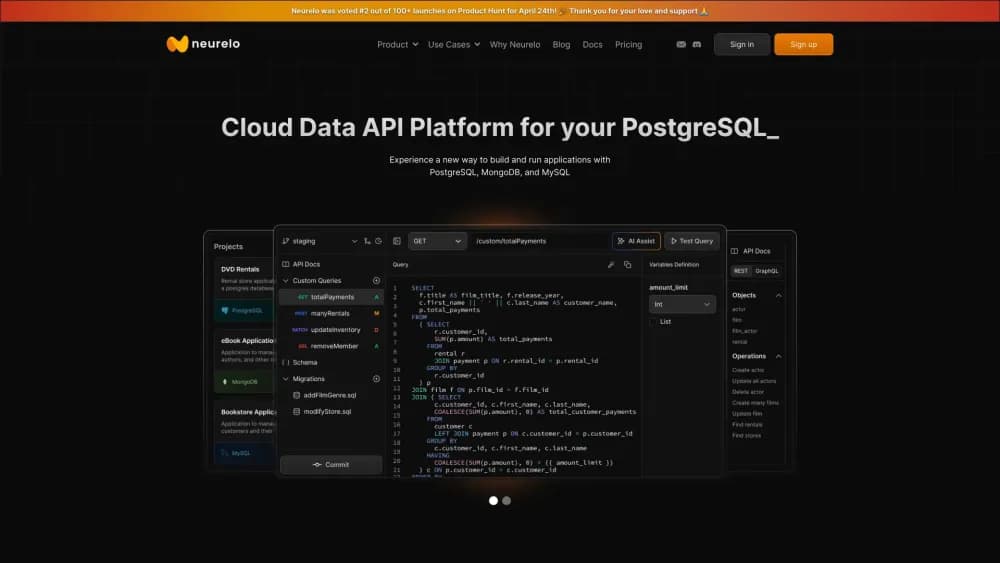
Some questions don't fit a CRUD route. The custom query editor lets you write SQL or MQL, run it against the data source, and publish it as its own endpoint with variables for filters. An AI query assistant takes a plain-language prompt and drafts the query using your schema as context. Neurelo says the output is usually right but not always, so the draft still needs a read-through before you deploy it.
Schema-as-Code With Git-Style Branches
Definitions live in JSON or YAML, which means they can be reviewed like any other source file. The visual Schema Builder writes the same file, and an entity-relationship diagram shows how tables connect. Branches and commits work the way developers expect, and a project can sync definitions with a remote Git repository, so schema changes arrive through the same review process as application code.
Environments and Hosted Runners
Each environment pins a commit to a data source, which is how a team runs an untested branch against a staging copy while production stays on the last release. Runners execute the API calls, and they run on Neurelo's cloud rather than on your servers. An environment with no traffic for seven days is stopped automatically, and core settings stay locked while runners are active.
Query Observability per Endpoint
Once observability is switched on for an environment, the dashboard records every API call and reports the slowest operations, response codes, total call volume, and usage trends by hour, day, week, or month. That's enough to spot an endpoint that started timing out after a schema change without bolting on a separate monitoring stack. Metrics stay per environment, so a test run doesn't muddy production numbers.
Migrations and Mock Data
Schema migrations generate the SQL needed to move a database from one commit to the next, and they can be applied from the console or handed off to your own pipeline. The feature only covers PostgreSQL and MySQL, ships as a preview, and has to be enabled when the project is created. A separate generator fills an environment with mock rows at three sizes: about 10, 100, or 1,000 records per table.
SDKs, MCP Server, and API Playground
Client libraries for TypeScript/JavaScript, Go, and Python wrap the generated endpoints with typed methods, so app code doesn't hand-build URLs. A published MCP server exposes schema lookups and SQL execution to Claude Desktop and other MCP clients. The API Playground inside an environment sends test calls to the live endpoints and shows the raw response before you write any integration code.
Pros and cons
Pros
- One schema produces both API formats, including join reads and writes, so there's no ORM layer to maintain.
- Custom queries can be tested against real data and shipped as endpoints with variables.
- Branches, commits, and remote Git sync make schema changes reviewable like application code.
- Per-endpoint observability shows slow operations and error codes without extra tooling.
- Typed SDKs for TypeScript, Go, and Python plus an MCP server cover both app code and AI clients.
Cons
- The vendor site and console were offline when we checked in October 2026, so starting a new project isn't something you can count on today.
- Only PostgreSQL, MySQL, and MongoDB are supported, which rules out SQL Server, Oracle, and SQLite estates.
- Migrations remain a preview feature and can only be enabled at project creation, so existing projects can't add it later.
- Runners are hosted by Neurelo, so every query passes through a third party, and there's no documented self-hosted option.
Frequently asked questions
Neurelo generates REST and GraphQL endpoints from a database schema so an application can read and write data without an ORM or hand-written queries. It also adds version control for the schema, per-endpoint metrics, and custom query endpoints for reports that don't fit standard CRUD.
Related content
Explore related tools, skills, and articles for Neurelo.
Neurelo Alternatives

Base Code
Base44 (Wix) · Coding · ProductivityBase Code is a shared cloud development environment from Base44. Teammates describe changes to an existing GitHub codebase in chat, preview them live and send them back as pull requests.

Google EmbeddingGemma 2
Google DeepMind · Writing · Image · CodingGoogle EmbeddingGemma 2 is a 740M-parameter open model that turns text, code, images, audio, and video frames into vectors in one 768-dimension space, running on phones and laptops.

GitGlow
GitGlow · Coding · ProductivityGitGlow is a local-first desktop Git client that lets independent developers review their own code and their AI agents' changes in one place before shipping.