

neuroflash
neuroflash · AI Detection
neuroflash combines AI content creation with Digital Twins, synthetic audience profiles built from over a million real surveys. Test copy and ideas before you publish them.
About neuroflash
What Is neuroflash
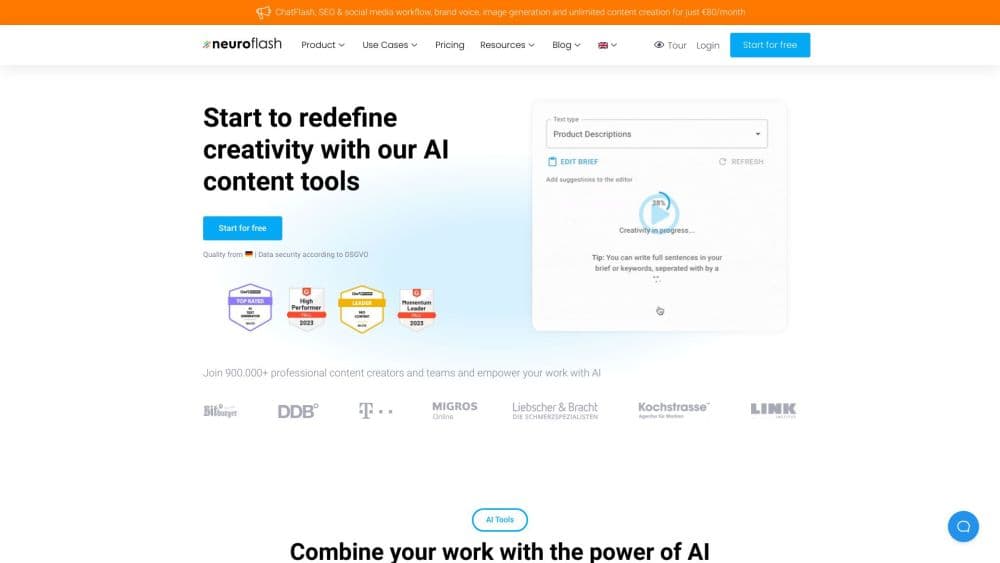
neuroflash is an AI writing assistant and audience intelligence platform that runs both jobs in one place. On the writing side, it works as an AI copywriting tool, drafting blog posts, ad copy, and social captions in your brand voice, and it generates images to match. On the research side, it builds Digital Twins: AI models of real consumers, trained on survey data rather than invented by a language model. You can hand a headline or a product concept to a Twin and get a reaction in seconds.
The idea is to close the gap between making content and knowing whether it works. Most teams write something, ship it, and find out from the metrics weeks later. neuroflash lets you ask a simulated audience first.
Two things shape when it fits. The Twins are only as good as the survey data behind them, and that data centers on European and German-speaking markets, so coverage elsewhere is thinner. And the platform assumes you'll use AI for a lot of content work, which won't suit teams that want a human-written draft first.
Getting Started
- Sign up at neuroflash.com and log in. Digital Twins and the editor are ready immediately, with no setup.
- Set up your brand. Add a Brand Voice so generated copy sounds like you, and train the AI on your own documents if you have reference material.
- Create content. Open the editor or ChatFlash, pick from over 90 templates or write your own prompt, and generate text or images.
- Test it with your audience. Send the draft to a Digital Twin and read the feedback, then adjust.
- Publish and review. Export the finished content, or connect the API and MCP to pull neuroflash into the tools you already use.
Product Information
A quick look at neuroflash's pricing, supported platforms, and performance.
Best for
The users, tasks, and scenarios where this tool fits best.
Users
- Marketing teams
- Copywriters and content managers
- Product and strategy teams
Tasks
- Testing a headline or ad before launch
- Writing blog posts and SEO content
- Keeping copy on brand
- Generating campaign visuals
Scenarios
- Validating a message before a paid campaign
- Running content at volume without adding headcount
- Working inside an existing tool stack
Key features
Digital Twins
Digital Twins are AI representations of real people, built from up to 255 data points each across more than a million surveys collected since 2017. You ask them questions the way you'd ask a focus group. The claim that matters here is accuracy: neuroflash reports 85 to 98 percent alignment with real human responses in its testing, and because the Twins are grounded in survey data rather than a language model, they don't fabricate opinions the way a plain persona prompt can. Feedback arrives in around 20 seconds.
Content Creation and ChatFlash
ChatFlash and the editor handle the writing. You get over 90 pre-trained content templates, prompt templates, and quick actions like rewrite and summarize, plus a chat interface for open-ended work. An SEO research mode and an SEO blog workflow sit inside the same tool, so you don't leave to plan keywords. The editor is built for finished documents, not just fragments.
Brand Voice and Brand Hub
The Brand Hub lets you build a Brand Voice that generated text follows, and train the AI on your own documents so it matches your material. This is what keeps output from reading like generic AI copy across a whole team. You can also define custom tones when a project needs a different register.
AI Image Generation
Image generation runs in the same workflow as the text tools. You can pick from a range of image models depending on your plan, from a lightweight model up to advanced options, and generate on-brand visuals without opening a separate design app. It covers the everyday cases: social graphics, simple campaign visuals, supporting images for articles.
API and MCP Access
The API lets you integrate Digital Twins and content creation into your own product, and neuroflash documents it for enterprise use. The MCP server takes a different route: it brings the Twins and the editor into Claude, Cursor, and other MCP clients, so you can query a simulated audience without leaving the tool you're working in. Both are aimed at teams that want the research inside an existing workflow rather than in a separate tab.
Compliance and Governance
neuroflash runs its servers in Germany and states GDPR compliance, with what it calls a compliance-ready environment and European security standards. For European brands, that matters more than feature parity: it means the audience data and generated content sit inside a legal framework the team already answers to.
Pros and cons
Pros
- Digital Twins give audience feedback in seconds, which is far faster than a traditional study cycle.
- The Twins are grounded in real survey data, so they respond like people rather than improvising.
- Content creation and audience testing share one platform, so research and writing don't live in separate tools.
- The API and MCP bring the Twins into existing workflows, including Claude and Cursor.
- Brand Voice keeps generated copy consistent across a team and across channels.
Cons
- There's no free plan, only a 7-day trial, so you can't run it indefinitely at no cost before deciding.
- The Twin data leans on European and German-speaking audiences, which means weaker coverage for other markets.
- The value depends on how well your audience profiles match your real customers. A poorly set up Twin gives misleading feedback.
- Pricing is quoted per user on higher tiers, so a growing team gets expensive quickly.
Frequently asked questions
neuroflash does two things: it creates text and images with AI, and it tests that content against Digital Twins, which are simulated audience profiles. Teams use it to draft marketing copy and to check how a specific audience reacts before publishing.
Related content
Explore related tools, skills, and articles for neuroflash.
neuroflash Alternatives
Isgen AI
Isgen · AI DetectionIsgen AI is a web-based AI detector that scores text for machine authorship and shows you which sentences and phrases push the number up. It's built for teachers, editors, students, and writers. Their question is simple: did this draft come from ChatGPT, GPT-5, Claude, Gemini, DeepSeek, or another model? You paste or upload content, run a scan, and get a Human, AI, and Mixed breakdown in seconds. There's also a companion editor that scores text while you write it.
Humanizeai Tools
Humanizeai Tools · Writing · AI DetectionHumanizeai Tools is a web-based AI humanizer that rewrites machine-generated text so it sounds like a person wrote it, which is the whole point of the category it belongs to. Paste a draft from ChatGPT, Claude, or Gemini, run it through the tool, and it swaps out the phrases and sentence patterns that AI detectors flag. If your goal is to make AI text sound human before you publish it, this is the kind of tool built for exactly that. It suits students, bloggers, and marketers who need copy that reads naturally and clears tools like GPTZero, Copyleaks, and Winston AI after a single pass.

Hidemyai
Hidemyai · Writing · AI DetectionHidemyai is an AI content humanizer. It rewrites text from ChatGPT, Jasper, and similar tools so the result reads like a person wrote it. You paste your draft, pick a document type and tone, and the service returns a version meant to bypass AI detectors such as Originality.ai, Turnitin, and ZeroGPT. It targets writers, marketers, and students who lean on AI drafts but can't ship copy that sounds robotic. The promise is simple: make AI content undetectable.