

Notewand
Notewand · Writing · Voice & Language · Productivity · AI Assistant
Notewand is an AI medical scribe that listens to patient visits and drafts clinical notes in real time. It ships with a free plan and HIPAA-compliant security.
About Notewand
What Is Notewand
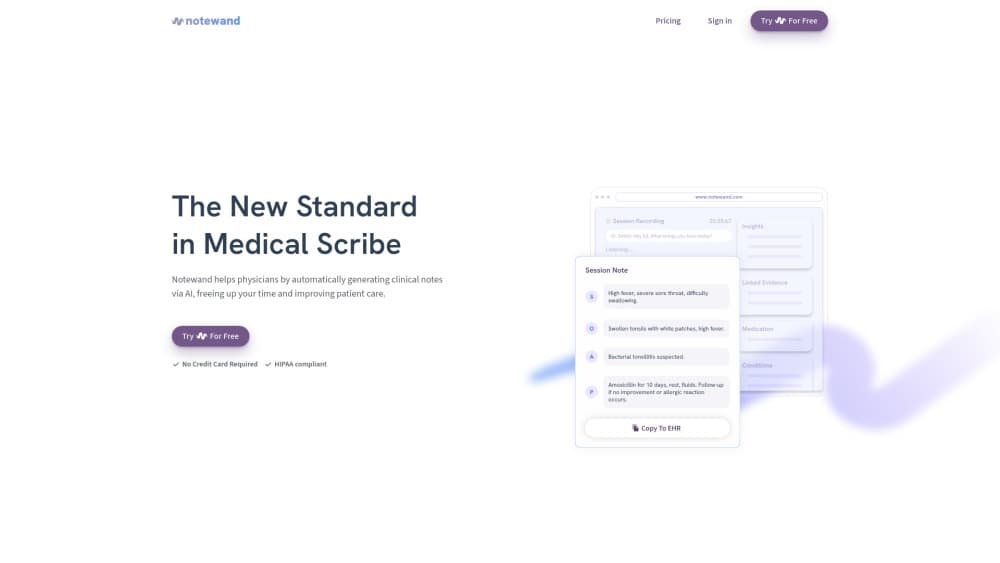
Notewand is an AI medical scribe built for clinicians. It listens during a patient visit, transcribes the conversation, and writes the clinical note while the appointment is still running. The pitch is narrow and honest: physicians lose a large slice of the day to documentation, and Notewand wants to take that typing off their hands.
The company says the model was tested on more than 100,000 real doctor-patient conversations. That tuning shows up in how the tool handles medical vocabulary and the shape of a consultation, from the opening complaint to the plan. It also builds a patient-friendly version of the note you can share in one click, so the chart copy and the summary a patient reads come from the same visit.
The wrinkle is scope. Notewand is a web app with no published EHR integration and no public API, so the finished note still moves into your charting system by hand or through whatever export your practice already runs. Pricing is per seat too, which is worth checking before you roll it out across a clinic.
Getting Started
- Create an account at app.notewand.com with an email address. No credit card is needed to start.
- Pick a plan. The free tier covers 10 sessions, and Premium covers 200 sessions a month for $99.
- Choose a note template that fits your specialty, or keep the default real-time format.
- Start a session when the visit begins and let Notewand listen and transcribe the conversation.
- Review the generated note, fix anything the model misheard, then save it or share the patient-friendly version.
Product Information
A quick look at Notewand's pricing, supported platforms, and performance.
Best for
The users, tasks, and scenarios where this tool fits best.
Users
- Solo clinicians and small practices
- Outpatient physicians in busy clinics
- Hospitals and multi-provider teams
- Nurse practitioners and physician assistants
Tasks
- Drafting clinical notes during a visit instead of after it, so the charting happens while the details are still fresh.
- Writing patient-friendly summaries that explain the visit in plain language, ready to hand over at check-out.
- Cutting after-hours documentation, since the note is produced in the room rather than at the end of the day.
- Building a reusable note structure with specialty templates and shared medical insights, so a team writes in a consistent format.
Scenarios
- A packed clinic morning
- Telehealth calls
- A small practice adopting medical note taking software for the first time, where the free plan lets the team try the workflow before paying per seat.
Key features
Real-Time Note Generation
Notewand writes the note as the visit happens, not minutes or hours after it ends. That timing matters because the clinician can glance at the draft, catch a gap, and ask a follow-up question while the patient is still in the room. The company builds on this idea directly, noting that real-time output removes the usual wait after an appointment.
Ambient Listening and Transcription
The scribe listens in the background and turns the spoken conversation into structured text. Ambient clinical documentation of this kind is meant to keep the clinician's eyes on the patient rather than on a keyboard, and the transcript becomes the raw material for the final note. Because it runs in a browser, there is no separate recorder or dongle to manage.
One-Click Patient-Friendly Notes
Alongside the clinical copy, Notewand produces a version written for the patient. You share it in a single click, which is useful at check-out when someone wants a plain-language recap of what was discussed and what comes next. Keeping both versions tied to one visit saves the extra step of writing a summary by hand.
HIPAA and GDPR Security
The tool is pitched as a HIPAA-compliant AI scribe, and the company states that protected health information stays secure and that the system follows both HIPAA and GDPR. For a product that records clinical conversations, that claim is the one to verify with your compliance officer before you switch it on, since it decides whether the tool is even an option.
Templates and Medical Insights
Premium and Enterprise plans add advanced and personalized templates plus medical insights. Templates let a specialty keep its own note structure, while medical insights surface patterns the model notices in the visit. Both are aimed at teams that want consistency across providers rather than a different format each time.
Analytics and Team Controls
Every plan includes an analytics dashboard, and Enterprise layers on team analytics, permission scopes, security configuration, and single sign-on. That combination is what turns a single-user scribe into something a hospital can run at scale, where access rules and oversight matter as much as the notes themselves.
Pros and cons
Pros
- Real-time notes mean the draft exists before the patient leaves, which cuts the after-hours charting that drives so much of the documentation load.
- A free plan with 10 sessions lets a clinician test the AI medical scribe on real visits without a demo or a card.
- Clear published pricing: Premium is $99 a month for 200 sessions, so a solo provider can budget without a quote.
- Security is stated up front as HIPAA and GDPR aligned, which is the first question any practice will ask.
- The patient-friendly note ships with the clinical one, saving a separate writing step at check-out.
Cons
- No published EHR integration means notes are copied into your charting system by hand, which is the gap that costs the most time.
- The 200-session Premium cap will not cover a provider seeing more than roughly ten patients a day on the same seat.
- API availability isn't documented publicly, so any custom workflow or automation depends on asking the vendor first.
- Enterprise pricing is custom only, which leaves hospitals guessing until they talk to sales.
Frequently asked questions
Notewand is an AI medical scribe that listens to a patient visit and writes the clinical note in real time. It also produces a patient-friendly summary you can share in one click.
Related content
Explore related tools, skills, and articles for Notewand.
Notewand Alternatives

Claude for Google Workspace
Anthropic · Writing · Productivity · BusinessClaude for Google Workspace puts Claude in a sidebar inside Google Docs, Sheets, and Slides, where it reads the file you have open and edits it in place.

Claude Haiku 5.5
Anthropic · Writing · Coding · ChatbotClaude Haiku 5.5 is Anthropic's fastest and cheapest small model, built for high volume tasks at $0.10 per million input tokens with a 1M token context window.
NoteWorthy
Suman Hansada · Writing · Productivity · AI AssistantNoteWorthy is a notes app for iPhone, iPad and Mac that writes titles, tidies formatting, summarizes long notes and files each one with on-device AI. No account, no upload, no network requests.