

NovaSynth by Noveum
Noveum · Voice & Language · Coding
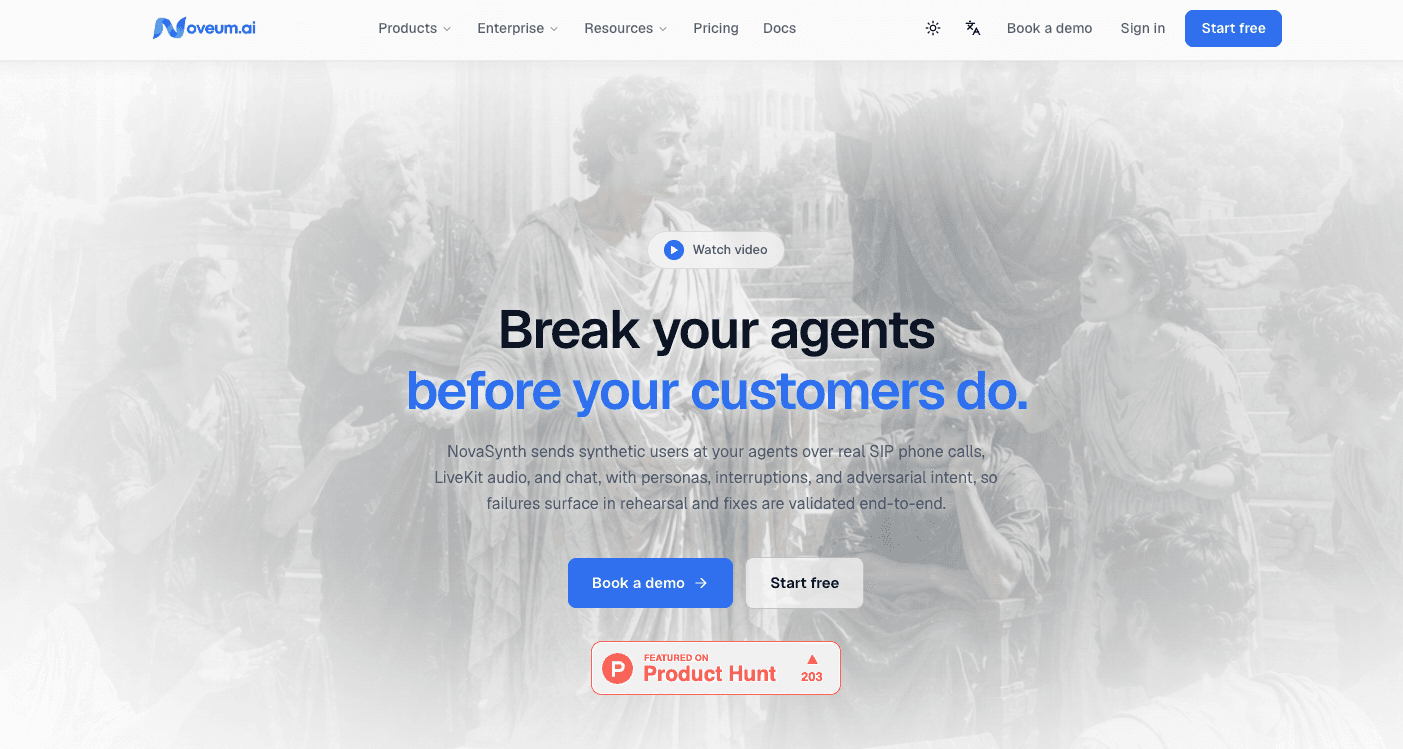
NovaSynth by Noveum is a pre-production testing platform for AI voice and chat agents. It sends synthetic users at your agent over real SIP calls, LiveKit audio, and chat, complete with personas, interruptions, accents, and adversarial intent. The point is simple: find the failures in rehearsal, before a real caller finds them in production. Every run is captured as a full trace and scored against 30+ voice AI metrics. Agent simulation here means real telephony, not mocked transcripts.
About NovaSynth by Noveum
What Is NovaSynth by Noveum
NovaSynth by Noveum is a testing environment for teams that ship voice and text agents. Instead of hand-writing a few happy-path scripts and hoping for the best, you point NovaSynth at your agent and let it generate hundreds of synthetic callers, each with a goal, a mood, and an accent. Those callers dial in over real telephony or connect through LiveKit and chat, so your agent faces the messy parts of real conversations: interruptions, barge-in, silence, topic switches, and prompt-injection probes.
The product sits in the pre-production stage, not in your live system. NovaSynth calls the agent you point it at, typically a test number or staging endpoint. It never touches your production traffic. That matters if you're wary of synthetic load hitting real customers. Reads get replayed and writes get sandboxed, so a changed decision can be exercised end-to-end while writes never reach production systems.
So what does that buy you? Confidence before a launch. Not a dashboard.
The biggest limit is the scope of what it tests. NovaSynth evaluates conversational agents: voice and text. If your product has no conversational surface, there's little here for you. It's also a credit-metered platform, so heavy load testing and long voice runs consume credits quickly. Big runs cost real money. You'll want to tell the team before a load run so they can provision phone lines.
Getting Started
- Sign up at noveum.ai and use the free plan, which starts with 2,500 credits a month and needs no credit card.
- Point NovaSynth at the agent you want to test, whether that's a SIP number through Twilio, Plivo, or Vobiz, a LiveKit or Pipecat endpoint, or a custom agent wired up through the SDK.
- Generate personas and scenarios from your agent context, such as its prompt, PRD, workflows, and docs, or submit your own scenarios and let the system run them.
- Launch a batch matrix of personas times scenarios under a shared batch id, then raise concurrency when you want to see how many calls your agent can hold at once.
- Review the captured traces and the 30+ voice AI scores, fix what broke, and re-run to confirm the fix end-to-end.
Product Information
A quick look at NovaSynth by Noveum's pricing, supported platforms, and performance.
Best for
The users, tasks, and scenarios where this tool fits best.
Users
- Voice agent developers
- QA and reliability engineers
- Product teams shipping chat assistants
Tasks
- Voice agent testing
- Load testing
- Regression checks after a prompt change
Scenarios
- Validating a new voice agent before launch
- Red-teaming for prompt injection
- Capacity planning for a launch
Key features
Synthetic persona and scenario generation
NovaSynth generates personas with goals, moods, and accents, then pairs them with scenarios. That's how you get frustrated repeat callers, non-native speakers, and prompt-injection probes without authoring each one by hand. The system drafts from your agent context, such as its prompt, PRD, workflows, and docs. It also suggests edge cases you might have missed. You can submit your own scenarios too and watch them run.
Real SIP voice and LiveKit audio
The calls are real. NovaSynth dials over SIP through Twilio, Plivo, or Vobiz, connects through LiveKit and Pipecat, and drives agents built on LangChain, LangGraph, the OpenAI and Anthropic SDKs, or custom stacks. SIP call testing at this level means real telephony, real audio, and real latency. No mocked transcript. That's the whole point, because a fake transcript hides the problems you're trying to catch.
Batch matrix runs
You run the full matrix of personas times scenarios under a shared batch id, which gives you coverage across the combinatorial space instead of a handful of spot checks. Results are grouped and comparable in one place, so a regression in one persona doesn't get lost in a sea of separate runs.
Concurrency and load testing
Raise concurrency to see how many calls your agent can hold at once, up to 2,000 concurrent lines for load testing. Keep it low for ordinary functional runs. If you're planning a big load run, tell the team in advance so they can provision phone lines. Not ideal, but it's how the platform stays stable under stress.
Tool virtualization
Reads are replayed and writes are sandboxed, so a changed decision gets exercised end-to-end while writes never hit production systems. This lets you test agents that touch real data without risking real data, which is usually the first thing that stops teams from testing aggressively.
Captured traces and voice AI scoring
Every synthetic call is captured as a full trace and scored with 30+ voice AI metrics. The audio counts as one of them. That matters because a transcript-only view can't tell you whether your agent sounded hesitant, talked over the caller, or cut off mid-sentence.
Pros and cons
Pros
- Tests real telephony and audio over SIP, LiveKit, and chat, so results reflect actual call conditions rather than mocked transcripts.
- Pre-production by design: it calls a test endpoint you choose and never touches live traffic.
- Personas and scenarios come from your agent context automatically. That cuts the manual scripting that goes stale after prompt changes.
- Tool virtualization replays reads and sandboxes writes, letting you test data-touching agents safely.
- Free plan with 2,500 credits a month and no credit card makes it cheap to try.
Cons
- Focused on conversational agents only, so it's little use if your product has no voice or chat surface.
- Credit-metered: voice runs cost 25 credits a minute and text conversations 10 each, so heavy load testing drains a plan fast.
- Large load runs need advance coordination with the team to provision phone lines, which rules out truly spontaneous stress tests.
Frequently asked questions
It tests your AI voice and chat agents before launch by sending synthetic users at them over real SIP phone calls, LiveKit audio, and chat. You get captured traces and scores across 30+ voice AI metrics, so you can fix failures in rehearsal instead of after customers hit them.
Related content
Explore related tools, skills, and articles for NovaSynth by Noveum.
NovaSynth by Noveum Alternatives

Prosp
Prosp · Writing · Voice & Language · MarketingProsp is an AI LinkedIn outreach tool built for agencies and sales teams, and it writes the message and the voice note in your own voice for each prospect so they actually reply. You connect your accounts, find leads, and let the AI draft and send personalized messages at scale, all from one inbox. It's built for people running outbound at volume. That's the whole pitch. Every touchpoint still has to feel human.

Wordly AI Translation
Wordly · Voice & Language · ProductivityWordly AI Translation is a real-time AI translation and captioning platform built for meetings, conferences, and events. It delivers live translation, captions, transcripts, and summaries in more than 60 languages, and attendees join by scanning a QR code or opening a link instead of using dedicated headsets. The platform works with Zoom, Microsoft Teams, Google Meet, and Webex, and it's designed for organizations that want multilingual access without hiring human interpreters for every session. Simple as that.
Musicful
Musicful AI · Voice & Language · VideoMusicful is an AI music generator and AI music video maker that turns text to music in minutes. Give it a text prompt, a set of lyrics, or a hummed melody and it returns a finished track with vocals and instruments. It also doubles as an AI song generator, produces music videos from the songs you create, and offers an AI cover tool plus a developer API. The platform runs in a web browser and through an Android app, so you can start a song on desktop and pick it up on your phone.