

novita.ai
Novita AI · Coding · Other
Novita AI is an AI and agent cloud platform that gives developers over 200 models through one API, plus GPU instances, serverless GPU, and agent sandboxes.
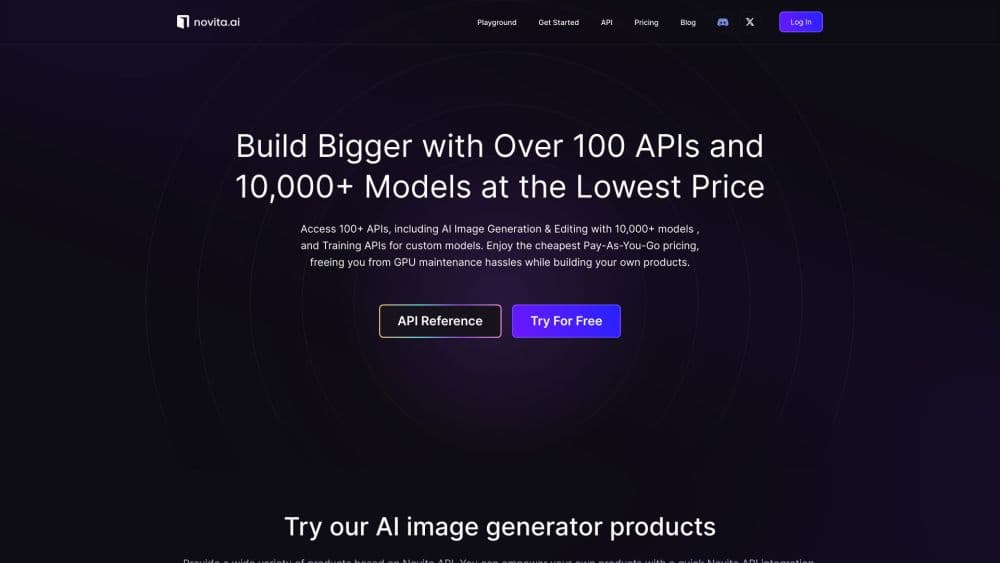
About novita.ai
What Is Novita AI
Novita AI is a cloud platform built for people shipping AI products, not for casual tinkerers. It wraps four things into one account: a serverless model API, GPU instances, serverless GPU jobs, and isolated agent sandboxes. Instead of stitching together a model provider, a compute host, and a runtime for your agent, you sign up once and call what you need.
The pitch is developer convenience at a startup price. Models are billed by the token rather than by the hour, so a slow week costs less than a busy one. GPUs bill by the second, which matters when you spin up a machine to run a fine-tune and shut it down. The company says latency runs around 200ms with 99.5% uptime, and lists Hugging Face, Quora, and OpenRouter among teams using it.
The catch is scope. This is infrastructure, not a no-code studio, so you need to be comfortable with API keys and code. Documentation, rate limits, and quotas are your responsibility to read. If you want a drag-and-drop builder, look elsewhere. If you want raw models and GPUs on demand, it fits.
Getting Started
- Create an account at novita.ai and grab an API key from the dashboard. New accounts get starter credits to test calls before you add a card.
- Pick a model from the catalog, or deploy your own. Copy the base URL and drop your key into the request, since the endpoint is OpenAI-compatible for most text models.
- Send your first call. Test chat, image, audio, or video generation with a small request to confirm billing and latency suit your workload.
- Scale up when it works. Switch to a dedicated endpoint for steady throughput, or launch a GPU instance when you need to train or self-host.
- Watch usage in the billing panel. Token and second-based charges show up per key, so you can route spend to the right project.
Product Information
A quick look at novita.ai's pricing, supported platforms, and performance.
Best for
The users, tasks, and scenarios where this tool fits best.
Users
- Indie developers and small startups
- Machine learning engineers
- Teams building AI agents
Tasks
- Calling frontier language models
- Generating images and video from prompts
- Training or fine-tuning a model
- Running untrusted agent code
Scenarios
- Prototyping an AI feature on a tight budget
- Handling spiky production traffic
- Evaluating open models before you commit
Key features
Serverless Model API
More than 200 models sit behind one endpoint, spanning language, image, audio, video, and vision. You call the model and Novita runs it, so there is no infrastructure to manage and no idle GPU billing between requests. Billing is per token, which keeps the cost tied to actual use rather than to a machine sitting warm.
OpenAI-Compatible Endpoints
Most text models accept the same request shape as OpenAI, so an app already built against that format can point at Novita by changing the base URL. That compatibility is the feature that saves the most time, since you are not learning a new SDK for every model you try.
Dedicated Endpoints
When shared capacity is not enough, you can spin up a private endpoint with isolated resources for consistent latency at any throughput. The company frames this around production, where a retry budget does not cover a slow response. You trade higher cost for predictable speed and no noisy neighbors.
GPU Cloud and Serverless GPU
Rent a full GPU machine with root access for training, inference, or deployment, billed by the second with no shared resources. Or submit a job to serverless GPU and let Novita handle provisioning, which suits batch work that does not need a machine staying up. Both options target teams that need real compute without a data center.
Agent Sandbox
The sandbox is a secure, isolated runtime built for agents that actually do things: run a test suite, patch code, read a repository, call models. Each task gets a clean environment rather than a notebook or a container you configured yourself. The company says startup is around 200ms and billing is per second.
Multi-Modal Generation Coverage
Text, image, audio, and video models live in one catalog under one key. A team building a product that writes copy, generates a thumbnail, and dubs a clip does not juggle three vendors or three invoices. That breadth is what turns the platform into a single billing line instead of a stack of subscriptions.
Pros and cons
Pros
- Over 200 models across text, image, audio, video, and vision under a single API key, which cuts vendor sprawl for multi-modal products.
- Token and per-second billing keeps costs tied to usage, so idle time does not inflate the bill the way hourly GPU rentals can.
- OpenAI-compatible endpoints mean existing code ports by changing the base URL rather than rewriting the integration.
- GPU instances, serverless jobs, and agent sandboxes share one account, so compute and models stay on one dashboard and one invoice.
Cons
- It is developer-first infrastructure with no no-code interface, so non-technical users cannot build here without writing code.
- The model catalog turns over quickly, and older models get retired, so a pinned model may need replacing on short notice.
- Costs scale with usage rather than being flat, and heavy image or video generation can run up a bill faster than text calls, so you need to watch spend.
- Understanding limits, quotas, and regional availability takes reading the docs, and there is no hand-holding for newcomers.
Frequently asked questions
Novita AI is a cloud platform for running AI models and compute. Developers use it to call language, image, audio, and video models through one API, rent GPUs for training or inference, and run AI agents in isolated sandboxes.
Related content
Explore related tools, skills, and articles for novita.ai.
novita.ai Alternatives

Base Code
Base44 (Wix) · Coding · ProductivityBase Code is a shared cloud development environment from Base44. Teammates describe changes to an existing GitHub codebase in chat, preview them live and send them back as pull requests.

Google EmbeddingGemma 2
Google DeepMind · Writing · Image · CodingGoogle EmbeddingGemma 2 is a 740M-parameter open model that turns text, code, images, audio, and video frames into vectors in one 768-dimension space, running on phones and laptops.

GitGlow
GitGlow · Coding · ProductivityGitGlow is a local-first desktop Git client that lets independent developers review their own code and their AI agents' changes in one place before shipping.