

NuMind
NuMind · Other
NuMind builds NuExtract, a vision language model that turns invoices, forms and scans into structured JSON or clean Markdown, offered through an API or private deployment.
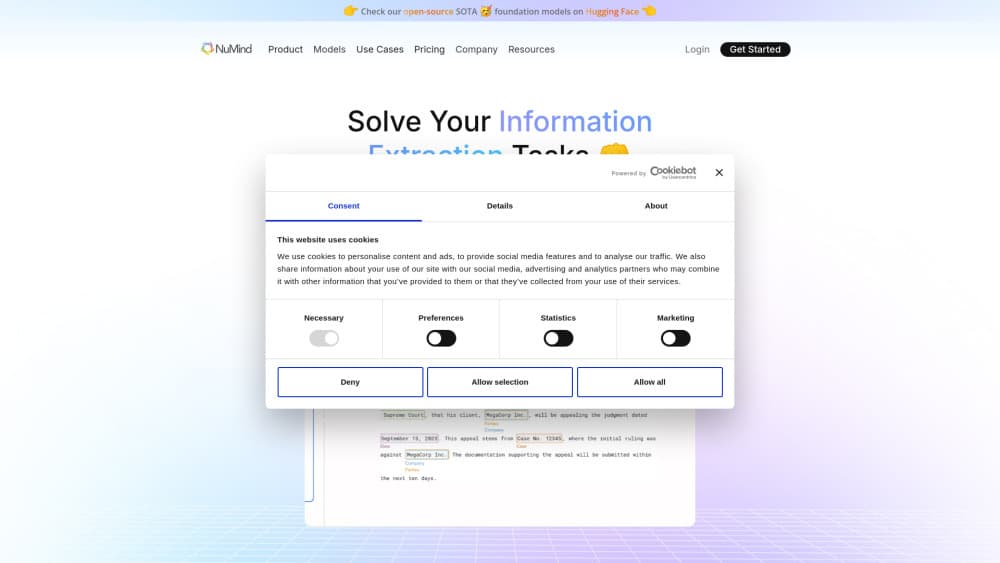
About NuMind
What Is NuMind
NuMind is a research company that builds specialized AI models for document understanding, and NuExtract is the product that packages those models for real work. The pitch is narrow on purpose. Instead of a general chatbot, you get a system that reads a pay slip, a claim form or a lab report and hands back machine-readable output.
The company started with structured data extraction, then added OCR with its NuMarkdown line, and merged both into NuExtract3 in May 2026. That model is open source under Apache 2.0, so the same engine behind the paid platform can also run on your own hardware. NuMind says its models have passed 5 million downloads on Hugging Face.
The limit worth knowing up front: NuExtract is built for documents, not for chat. It won't draft emails or answer general questions, and the hardest layouts still need a human spot check on the first few hundred pages.
Getting Started
- Create an account at nuextract.ai and open the console.
- Write a template describing the fields you want, or start from a sample for invoices, receipts and payslips.
- Upload a PDF, scan or image, then run the extraction and review the JSON in the side-by-side viewer.
- Move the same template into the NuExtract API for bulk processing, or export the results to your database.
Product Information
A quick look at NuMind's pricing, supported platforms, and performance.
Best for
The users, tasks, and scenarios where this tool fits best.
Users
- Operations teams in insurance and banking
- Back office staff in healthcare
- Developers building document AI features
Tasks
- Turning invoices into line-item JSON
- Converting scanned PDFs into Markdown for RAG
- Pulling totals and dates from receipts
Scenarios
- Month-end invoice processing
- Building a searchable archive of contracts
- Prototyping an internal extraction tool
Key features
Template Driven JSON Extraction
You describe the output shape as a JSON template, and the model fills it from the document. Nested objects, arrays of line items and verbatim strings all work, which matters when a field has to match the source wording exactly. Change the template and the same document yields a different structure without retraining.
Switchable Reasoning Mode
NuExtract3 was trained with reinforcement learning to think through a document before answering, and you can turn that off. Reasoning helps with merged table cells, split rows and overlapping text in messy scans. Leaving it off keeps latency and token spend down on clean, digitally native files.
OCR and Markdown Output
The same weights handle content extraction, which means a full page becomes clean Markdown with headings, lists and tables intact. Teams use this to make legacy PDFs usable for LLM assistants and retrieval systems. It works on scans and on digital documents alike.
Twenty Field Types and Freeform Instructions
Templates support 20 field types, including dates, currency, country codes and booleans, so the output arrives typed rather than as loose strings. Freeform instructions and in-context examples let you steer edge cases without building a custom model.
NuExtract API for Production Workloads
The API charges $1 per million input tokens and $5 per million output tokens, with no onboarding delay. Volume discounts and batching bring the per-page number down for high-volume accounts. A text page runs about 1,000 tokens, while a scanned A4 page at 115 dpi lands near 1,500.
Private Deployment for Regulated Workflows
Enterprise customers can run NuExtract inside their own cloud or on-premises, with fine-tuning as an option. That matters for insurers and hospitals that cannot send documents to a third-party service. NuMind lists AXA, Crédit Mutuel, Cleareye.ai and BCA Expertise among its users.
Open Source Models on Hugging Face
NuExtract3 is a 4B model released under Apache 2.0, and earlier releases such as NuMarkdown-Thinking-8B are public too. You can inspect the weights, run them on your own GPUs and fine-tune without asking permission. The research behind the entity recognition model, NuNER, was published at EMNLP 2024.
Pros and cons
Pros
- Accuracy on structured fields is the whole point, and NuMind reports 65.2 on its internal extraction benchmark against 53.8 for the next similarly sized model.
- Open weights under Apache 2.0 make vendor lock-in easy to avoid if you have GPU capacity.
- One model covers both JSON extraction and OCR, which cuts the number of services in a pipeline.
- Pricing scales with tokens instead of seats, so a small pilot costs cents rather than a contract.
Cons
- The benchmark is NuMind's own internal test set, so independent numbers are still thin.
- Document AI needs a template per document type, and tuning that template takes real effort on unusual layouts.
- The API only ships one model family, so you cannot pick a cheaper tier for simple receipts and a stronger one for dense tables.
- Chat style interfaces are absent, which means non-technical users need someone to set up the flow first.
Frequently asked questions
NuMind sells NuExtract, a document extraction service with two delivery options: a usage-based API and a privately deployed enterprise version. The underlying models are also published as open weights.
Related content
Explore related tools, skills, and articles for NuMind.
NuMind Alternatives

Odyssey 3
Odyssey · OtherOdyssey-3 is Odyssey's foundation world model. It simulates physics in real time, turns a prompt into an interactive environment, and adapts to robots, cars and games.

JarvisCore
Prescott Data · Coding · Productivity · OtherJarvisCore is an open source Python runtime where AI agents work as equal peers on an agent mesh, claim tasks from a shared ledger, and reach external services through a zero-trust broker.
Clef
Cloudflare · Business · OtherClef is Cloudflare's open-source decision model for Workers AI. It returns calibrated probabilities for typed questions, not generated text, so agents can classify, route, and act fast.