

nventr
nventr · Coding · Marketing
nventr is an enterprise AI platform that ties agents, ML models and document workflows into one stack, with a no-code builder, a full IDE and on-premise options.
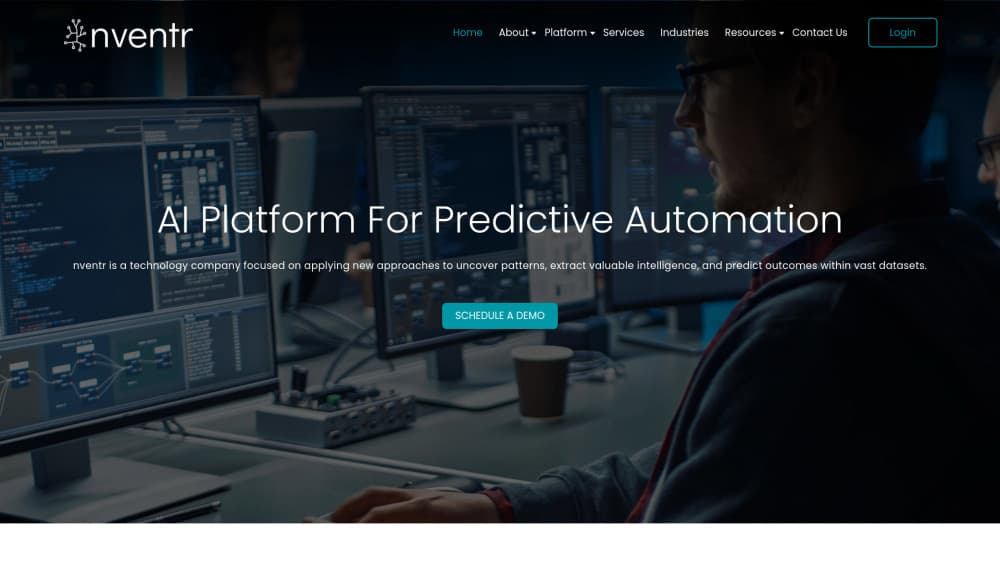
About nventr
What Is nventr
nventr is an enterprise AI platform built for companies that have pilots scattered across departments and no clean way to run them in production. The official pitch is orchestration: models, agents and business systems share one pipeline instead of living in separate tools. The company calls it AI agent orchestration, and the site at nventr.ai reports 391 clients running more than 60 million transactions a month. That covers a workflow that reads invoices, a support agent that answers with company data, or a model that scores risk in real time.
The product ships as modules rather than a single app. Agent IO handles agents for knowledge workers, nQube builds and runs AI workflows, nventr Agent powers conversational interactions, Athena visualizes the data behind them, and Development Studio plus the NRG Stack cover the coding and cross-platform build side. You can adopt one piece or wire several together.
The platform is aimed at organizations with compliance constraints. It runs cloud-native but supports on-premise deployment for teams that can't send documents to a public cloud. Pricing is public and low for a platform of this type, which makes it testable without a sales call. The catch is scale: the entry trial holds one agent and 5 MB of storage, which is a demo, not a pilot.
Getting Started
- Create an account from the pricing page and pick the trial plan if you want to test before committing.
- Open nQube or Agent IO and choose a starting point: a blank workflow, a prebuilt connector, or a template for document processing.
- Connect the data your workflow needs. Docs, images, databases, APIs and memory modules can all be attached, and the agent reasons over whatever you plug in.
- Deploy to the channel where work happens, which can be a web app, Slack, an API endpoint or an embedded widget, then watch actions in the monitoring view.
Product Information
A quick look at nventr's pricing, supported platforms, and performance.
Best for
The users, tasks, and scenarios where this tool fits best.
Users
- Automation and IT operations leads
- Data and ML teams
- Department managers in contact centers and finance
Tasks
- Invoice and claims processing
- Agent-assisted support
- Multi-step workflow automation
- Deploying one workflow to several channels
Scenarios
- A regulated company that must keep documents on its own servers
- A pilot that needs to reach production in weeks
- Teams replacing spreadsheets of manual checks
Key features
Agent IO for the Agentic Workforce
Agent IO is the module most buyers start with. You define a goal, break it into tasks, and attach tools, then the agent acts inside your systems instead of just answering questions. Agents can be assembled with drag and drop or with code, and they deploy to web, Slack, API or an embedded surface. nventr reports 65% faster task completion and a 50% drop in manual workload for Agent IO customers, figures the company publishes itself.
nQube AI Workflow Builder
nQube is the AI workflow builder for the technical side. It fuses agentic actions, ML models and neural networks into one workflow, and it accepts no-code, low-code and full-code entry points so analysts and engineers work in the same place. The visualizer shows production volume, component status and queue feedback down to the microservice level, and you can set memory allocation and parallelization per component.
Intelligent Document Processing
Document handling runs on pretrained neural network workflows built for cross-domain paperwork, which means a model trained on invoices can be adapted to claims without starting over. The pipeline captures, extracts and validates fields, then flags what falls below threshold. Accuracy holds at volume, which is the part most in-house scripts lose first.
Athena Data Visualization
Athena turns the output of a workflow into something a manager can read. It offers real-time charts, drill-down on any data point, and an interactive view of the workflow itself, so a stalled queue is visible as a number rather than a complaint. Analysts can explore data without exporting it to a separate BI tool.
Development Studio and NRG Stack
Development Studio is a cloud IDE with collaborative editing and code sharing, aimed at teams building applications on top of the platform. The NRG Stack compiles one codebase for web and native targets, which cuts the rebuild work when a workflow needs a front end. Dev Ops Manager sits alongside both for deployment and system health.
Cloud or On-Premise Deployment
The same platform runs in nventr's cloud or inside your own data center. Horizontal scaling adds servers to spread load, vertical scaling adds resources to one server, and the deployment pipeline is built to move a model from bench to production with minimal downtime. For banks, insurers and public sector buyers, that choice is often the deciding factor.
Pros and cons
Pros
- One platform covers agents, document processing, workflow building and deployment, which removes the integration work between separate tools.
- Public pricing from $0.99 to $65 per month means you can test the real product without a procurement cycle.
- On-premise deployment keeps sensitive documents inside your network while the feature set stays the same as the cloud version.
- The builder accepts no-code and full-code, so business analysts and engineers can share one workflow instead of handing files back and forth.
Cons
- The trial plan caps you at one agent and 5 MB of storage, so it proves the interface, not the workload. A real pilot needs the $35 tier at minimum.
- The module split, Agent IO, nQube, Athena, Studio, NRG Stack, is a lot to absorb, and documentation for each piece is thinner than the marketing pages suggest.
- Performance numbers on the site are vendor-published, with no independent benchmark behind the 65% and 50% claims, so treat them as targets rather than results.
Frequently asked questions
nventr is an enterprise AI platform for orchestration. It connects AI agents, machine learning models and business systems into workflows you can deploy and monitor, with document processing and data visualization built in.
Related content
Explore related tools, skills, and articles for nventr.
nventr Alternatives

Base Code
Base44 (Wix) · Coding · ProductivityBase Code is a shared cloud development environment from Base44. Teammates describe changes to an existing GitHub codebase in chat, preview them live and send them back as pull requests.

Google EmbeddingGemma 2
Google DeepMind · Writing · Image · CodingGoogle EmbeddingGemma 2 is a 740M-parameter open model that turns text, code, images, audio, and video frames into vectors in one 768-dimension space, running on phones and laptops.

GitGlow
GitGlow · Coding · ProductivityGitGlow is a local-first desktop Git client that lets independent developers review their own code and their AI agents' changes in one place before shipping.