
OctoAI
OctoAI (formerly OctoML, now part of NVIDIA) · Coding
OctoAI was a cloud AI inference API that ran open models such as Llama, Mistral, and Stable Diffusion through an OpenAI-compatible API. NVIDIA bought it in 2024.
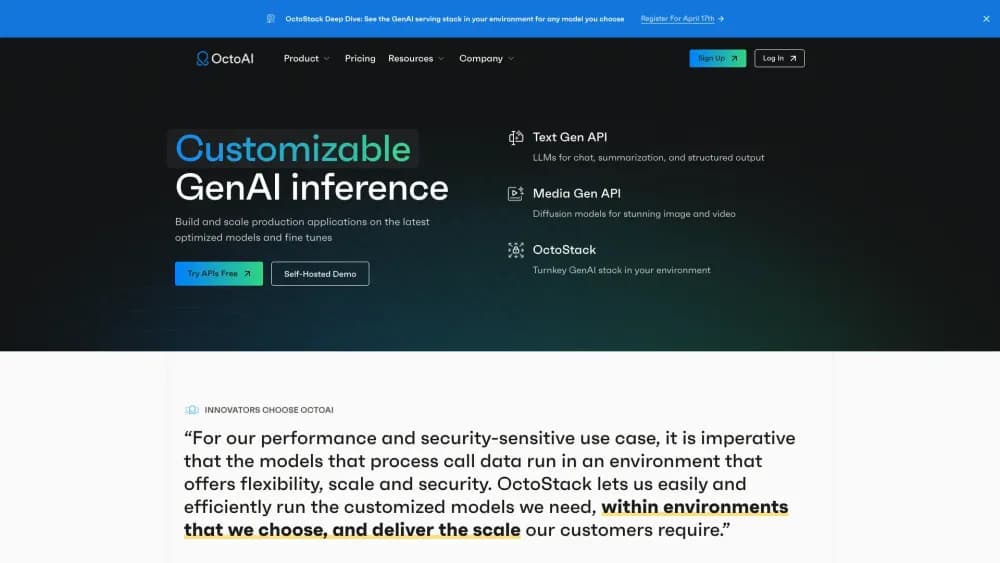
About OctoAI
What Is OctoAI
OctoAI was a Seattle company that sold fast, cheap access to open-source models, which made it an inference platform for app builders rather than a model lab. You sent a request to its API, picked a model from its catalog, and got text or an image back. The draw was speed: the company tuned each model to squeeze more out of the same GPU, so responses came back quicker and cost less than a plain cloud deployment.
The team got there by way of compilers, not chatbots. OctoAI started in 2019 as OctoML, a spinout from the University of Washington built around Apache TVM, an open-source compiler that rewrites a model so it runs well on whatever chip you own. That compiler work later got packaged into open-source model hosting aimed at app developers who wanted Llama or Stable Diffusion in a product without hiring a machine learning infrastructure team.
That service no longer exists. NVIDIA acquired OctoAI in September 2024, and the company told customers that access to every OctoAI service would end on October 31, 2024. Accounts were deactivated and the API went dark. The team moved into NVIDIA's software group. Anyone researching OctoAI today is looking at a closed chapter, and the practical question is what replaced it.
Getting Started
There's no sign-up path left to walk through, since the platform is retired. What follows is how it worked while it was live, useful if you're reading old tutorials or planning a migration.
- Create an account on the OctoAI platform and generate an API token from the console.
- Pick a model from the catalog, such as Llama, Mistral, or Stable Diffusion XL, or upload a fine-tuned model you own.
- Point your code at the OpenAI-compatible endpoint, which let most existing client libraries work after a base URL swap.
- Send a request and read the response, whether that's generated text, an image, or a JSON payload.
- For private deployment, run OctoStack inside your own cloud account or on-premises to keep traffic off shared infrastructure.
Product Information
A quick look at OctoAI's pricing, supported platforms, and performance.
Best for
The users, tasks, and scenarios where this tool fits best.
Users
- Developers building on open-source models
- Teams migrating off OctoAI
- Enterprises in regulated industries
Tasks
- Serving text generation at production scale
- Generating images with Stable Diffusion XL
- Hosting a fine-tuned model
- Auditing an old dependency
Scenarios
- A prototype that leaned on OctoAI
- A procurement review of inference vendors
- Reading a 2024 tutorial
Key features
OpenAI-Compatible Text Generation
OctoAI served Llama 2 in 7B, 13B, and 70B sizes along with chat variants, Code Llama, and Mistral 7B. The API followed OpenAI's request format, so teams already using that standard could switch providers with a base URL change. That compatibility cut the work of testing a new host down to a few lines of config.
Stable Diffusion XL Image API
The image side ran Stable Diffusion XL and let you attach custom LoRA adapters through an API call. A game studio or a marketing team could generate art in a house style without training a foundation model of its own. Requests came back as images rather than a queue ticket you had to poll.
Hardware-Agnostic Optimization
The company's edge came from Apache TVM, a compiler that converts a model into code tuned for a specific chip. OctoAI applied that tuning on its own servers, so the speed gains showed up in the API response time instead of in a package you installed. Support spanned NVIDIA GPUs, AMD hardware, Intel CPUs, and AWS Inferentia chips. That portability mattered little once most of the market settled on NVIDIA.
OctoStack for Private Deployment
OctoStack, launched in April 2024, let enterprises run the same inference stack inside their own environment, whether that was AWS, Google Cloud, Azure, CoreWeave, Lambda Labs, or a data center they owned. The pitch was privacy and control: healthcare, finance, and government teams could use the models without sending data to OctoAI's servers. The company claimed 4x better GPU utilization and 50% lower operating costs than a do-it-yourself setup.
Bring Your Own Model
Beyond the catalog, you could host a fine-tuned Llama 2 variant on the platform and call it like any other endpoint. That saved teams from building their own serving layer for a custom model. You still had to produce and test the fine-tune somewhere else.
Usage-Based Pricing
OctoAI charged by consumption rather than a flat subscription, with a free trial tier and per-token rates for text, per-image rates for SDXL, and hourly compute for custom endpoints. The biggest saving came from the tuned models, which the company claimed ran up to 10x faster than an unoptimized deployment.
Pros and cons
Pros
- The API spoke OpenAI's format, so moving an existing app over meant changing a base URL and an API key
- Tuned models returned faster responses and cost less per token than raw cloud GPU deployments
- Custom LoRA adapters let teams give image generation a consistent house style without training a model
- OctoStack gave regulated industries a way to keep data inside their own cloud account
- A free trial tier let developers test latency and quality before committing budget
Cons
- The whole platform went offline on October 31, 2024, about five weeks after NVIDIA announced the acquisition
- No NVIDIA product took on the same workload, so customers had to rebuild on a competing inference service
- Model coverage lagged the fastest movers, leaving newer open models to rivals for weeks or months
- The cross-hardware pitch lost value as the market consolidated on NVIDIA GPUs, which narrowed the reason to choose OctoAI
- Custom endpoint pricing was harder to forecast than a flat per-token rate, which complicated budgeting for teams with spiky traffic
Frequently asked questions
NVIDIA acquired OctoAI in September 2024, and the company shut down all commercial services on October 31, 2024. The team, led by CEO Luis Ceze, joined NVIDIA, and the API and platform no longer accept traffic.
Related content
Explore related tools, skills, and articles for OctoAI.
OctoAI Alternatives

Base Code
Base44 (Wix) · Coding · ProductivityBase Code is a shared cloud development environment from Base44. Teammates describe changes to an existing GitHub codebase in chat, preview them live and send them back as pull requests.

Google EmbeddingGemma 2
Google DeepMind · Writing · Image · CodingGoogle EmbeddingGemma 2 is a 740M-parameter open model that turns text, code, images, audio, and video frames into vectors in one 768-dimension space, running on phones and laptops.

GitGlow
GitGlow · Coding · ProductivityGitGlow is a local-first desktop Git client that lets independent developers review their own code and their AI agents' changes in one place before shipping.