

Octri.dev
Octri, LLC · Coding
Octri.dev turns one OpenAPI spec into a documentation site, client SDKs in ten languages, an MCP server for AI agents and production monitoring for those SDKs.
About Octri.dev
What Is Octri.dev
Octri.dev is a platform for teams that publish an API and want the docs, the client libraries and the agent tooling to come from the same document. You upload an OpenAPI file, or point Octri at a GitHub repo, and it produces four things: a hosted API docs platform on your own domain, SDKs in ten programming languages, an MCP server that exposes your endpoints as tools, and monitoring that reports errors from inside the SDKs you ship.
The reason to care is drift. Most teams generate a client once, then maintain it by hand while the spec moves on. Octri regenerates on every spec change, and a deprecation in the docs also marks the SDK method and removes the tool from the agent's list. The OpenAPI to SDK step stops being a one-time export.
What it doesn't do: it doesn't repair a vague spec for you. The audit will score the gaps, and an endpoint without a declared response schema still produces an untyped method. The company is also new. Octri, LLC launched publicly on 1 October 2026, runs a team of two to ten people and has no outside funding, so you're buying into an early product.
Getting Started
- Upload your spec or link the GitHub repository that holds it. Octri accepts OpenAPI 3.0 and 3.1, Swagger 2.0, Postman collections and AsyncAPI, in JSON or YAML, and normalizes everything to OpenAPI 3.1.
- Review the generated reference. AI writes a description for every endpoint and every field, and you edit the draft on the published page before it goes live.
- Pick SDK languages, set method naming and folder layout, then build. Linked registries can publish each release for you.
- Turn on monitoring per project. The SDK ships with reporting off, and each developer using your client chooses whether to send error data.
- Connect the repository so the next spec change reruns the whole pipeline.
Product Information
A quick look at Octri.dev's pricing, supported platforms, and performance.
Best for
The users, tasks, and scenarios where this tool fits best.
Users
- API platform teams of one or two engineers
- Developer tooling startups
- Teams already generating clients with an open source generator
Tasks
- Publishing API reference docs
- Shipping and maintaining client libraries
- Giving coding agents a reliable map of your API
- Finding integration bugs in production
Scenarios
- A public API launch where docs and SDKs have to land the same week
- A breaking change you need to roll out safely
- A small team without a developer relations hire
Key features
Documentation generated from the spec, edited on the page
The docs half works as an OpenAPI documentation generator: every endpoint gets a reference page with a schema tree, error responses by status code and a try-it console that uses the reader's own key. AI writes the first draft of each description, including fields the spec left blank. Guides and quickstarts live in MDX beside the reference, and the whole portal publishes to a custom domain on every plan, Free included.
SDKs in ten languages with registry publishing
Octri generates TypeScript, Python, Go, Java, Kotlin, Ruby, PHP, Swift, Dart and Rust clients from the same document. Retries, pagination and typed errors come built in, auth is wired from your security schemes, and you can rename methods or exclude endpoints per language. Each release can publish itself to npm, PyPI, Maven Central, RubyGems, crates.io, pub.dev, Packagist or a git tag, and every regeneration arrives as a pull request.
MCP server without hosting
Running npx @octri/mcp gives Claude, Cursor, VS Code or any MCP client a server built from your spec. It ships seven documentation tools for search and navigation plus one callable tool per endpoint, so an agent can list real operations and call them instead of guessing at parameter names. Tool lists export in MCP, OpenAI and Anthropic formats for other agent frameworks.
SDK error tracking and API monitoring
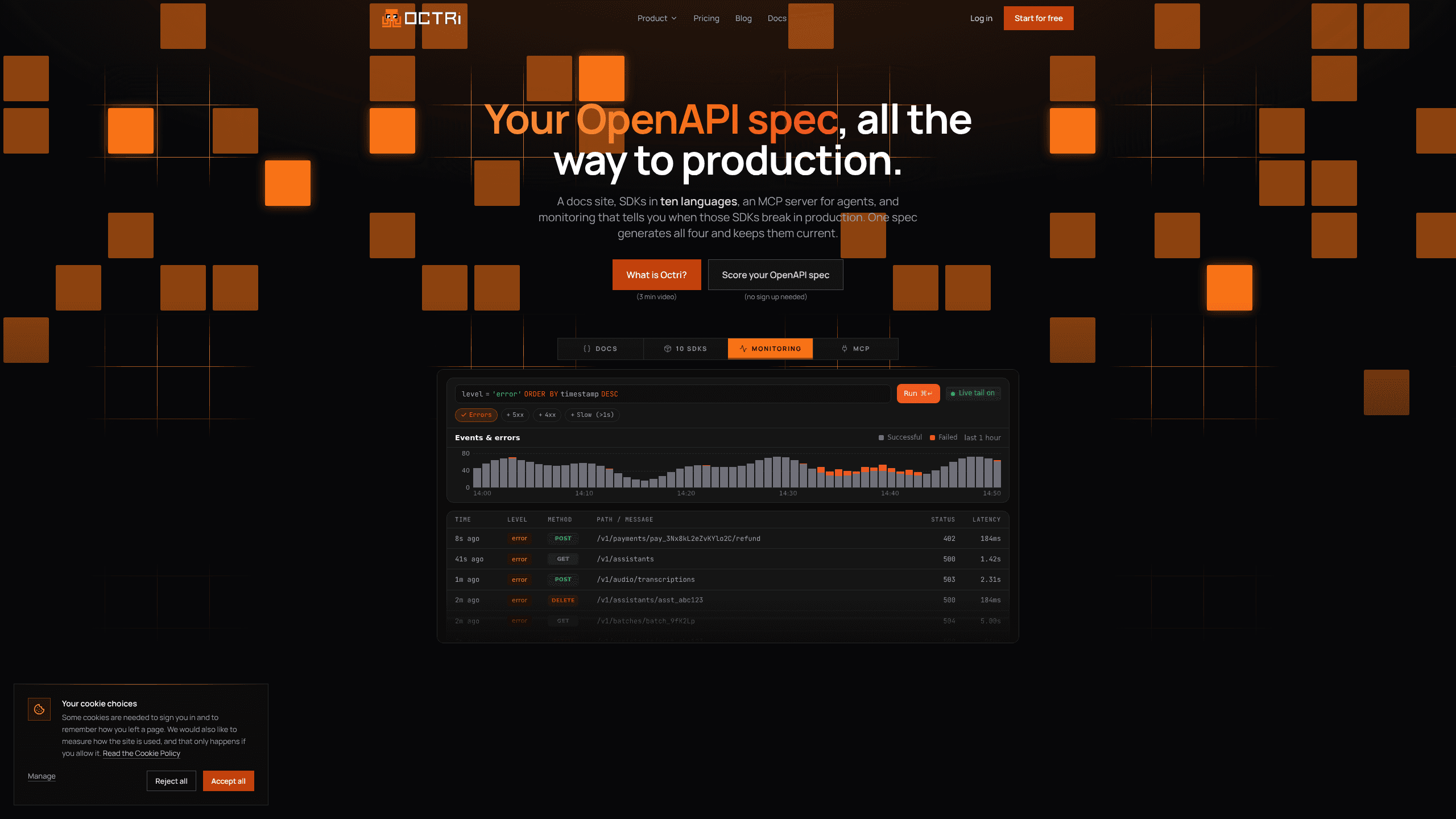
The generated clients carry an error reporter that stays off until a developer opts in. Once enabled, Octri collects errors, structured logs, traces and uptime checks, groups issues by fingerprint and resolves stack frames through source maps. Tokens, email, phone and IP are redacted in the client before an event leaves the process, and again at ingest.
One spec change updates all four surfaces
Deprecate an endpoint in the docs and the SDK marks the method, the MCP server stops offering it as a tool, and monitoring shows which callers still hit it. The same happens when you add a language, cut a release or push a new spec. There's one source under all four outputs, so there's no second place to update.
Spec audit before you generate anything
The audit scores a spec out of 10 against fourteen rules and names the endpoints that will produce weak clients. It runs without an account and doesn't keep the file. Three rules carry up to six of the ten points: declared response schemas, shared models in components, and public names that don't collide.
Pros and cons
Pros
- One document feeds docs, SDKs, agent tools and monitoring, which removes the usual drift between them.
- Ten SDK languages with automated publishing to the registries developers already use.
- Error tracking runs inside the client, where an API provider normally has no visibility.
- The free plan includes a custom domain and one SDK language, enough to test the output on a real API.
- The MCP server installs with one command and needs no infrastructure.
Cons
- Public launch was 1 October 2026, so there's little track record for teams that need a vendor with years of uptime behind it.
- AI credits are metered at one credit per endpoint written or chat answer, and the free plan's 100 credits run out on a large spec.
- Extra SDK languages cost $50 per month each, and all ten are included only on the $249 Business plan.
- Monitoring depends on each SDK user opting in, so coverage is partial on APIs with many small integrators.
Frequently asked questions
Four outputs from one OpenAPI document: a hosted documentation site, client SDKs in ten languages, an MCP server for AI agents, and monitoring for the SDKs once they're in use. Each can run on its own.
Related content
Explore related tools, skills, and articles for Octri.dev.
Octri.dev Alternatives

Base Code
Base44 (Wix) · Coding · ProductivityBase Code is a shared cloud development environment from Base44. Teammates describe changes to an existing GitHub codebase in chat, preview them live and send them back as pull requests.

Google EmbeddingGemma 2
Google DeepMind · Writing · Image · CodingGoogle EmbeddingGemma 2 is a 740M-parameter open model that turns text, code, images, audio, and video frames into vectors in one 768-dimension space, running on phones and laptops.

GitGlow
GitGlow · Coding · ProductivityGitGlow is a local-first desktop Git client that lets independent developers review their own code and their AI agents' changes in one place before shipping.