

OETStudy
OETStudy · Voice & Language
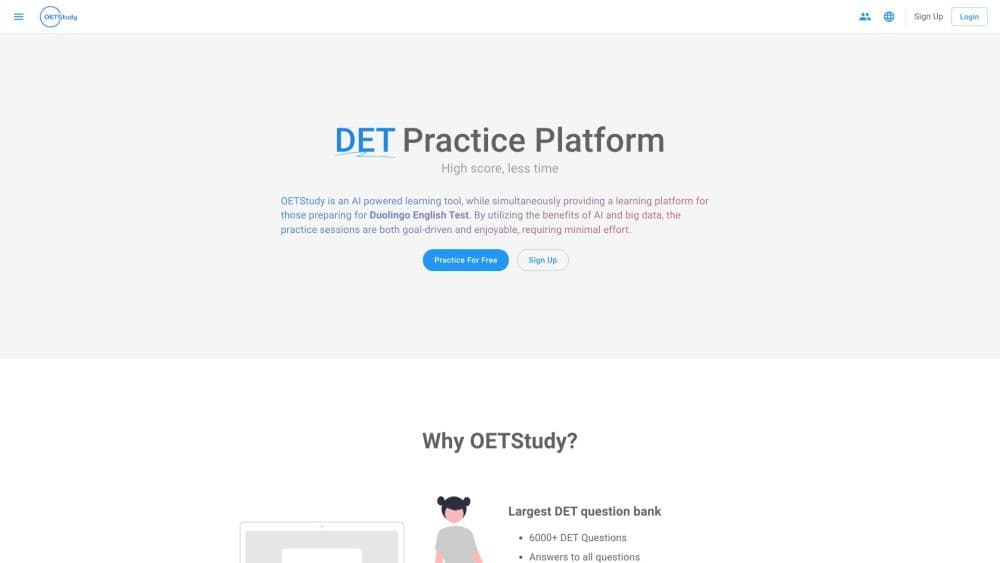
OETStudy is a DET practice platform for the Duolingo English Test. It pairs a 15,000 question bank with AI scores for speaking and writing, plus CEFR checks and progress tracking.
About OETStudy
What Is OETStudy
OETStudy is a web based study site for people preparing for the Duolingo English Test, usually shortened to DET. The DET is a computer adaptive online English test taken at home and accepted by a large number of universities. OETStudy covers the four skills that test measures: reading, writing, listening and speaking, and it structures practice around the question types the exam actually uses.
The AI part is the hook. You record a spoken answer or type a written one, and the platform returns a score with notes on pronunciation, fluency, grammar, vocabulary and structure. The company says the scoring model was trained on real exam responses. Treat that claim as the vendor's own framing rather than a fact you can verify from outside.
Two limits matter more than the feature list. The platform is a practice tool, not an official score, and no AI estimate replaces a real test result. Prepare for a gap: a practice score that reads 130 tells you how you did on one task under OETStudy's rubric, not what Duolingo will hand you on test day. The site also states plainly that it is not endorsed by Duolingo.
Getting Started
- Create a free account at oetstudy.com. No card is needed to start, and the free tier opens on sign up. Your Duolingo English Test preparation begins with a level check.
- Pick a section or a question type. The library is split by skill, so you can drill speaking on its own if that is where your weak spot sits.
- Work through tasks at your own pace. Free accounts get 100 questions a day; VIP accounts unlock the full 15,000 question set.
- Submit speaking and writing answers for AI scoring. Free accounts get 3 scoring quotas, VIP accounts get unlimited scoring.
- Review the feedback, the vocabulary list and the practice statistics, then repeat on the question types that keep dragging your score down.
Product Information
A quick look at OETStudy's pricing, supported platforms, and performance.
Best for
The users, tasks, and scenarios where this tool fits best.
Users
- Students applying to universities that accept the DET
- Test takers on a tight budget
- Repeat test takers stuck on one section
- Self directed learners who do not want a live class
Tasks
- Drilling a single question type
- Checking a draft answer before test day
- Building a vocabulary list from your own mistakes
- Tracking progress over a week or a month
- Estimating your CEFR level
Scenarios
- A short runway before a booked test date
- Preparing while working full time
- A first attempt where you have no idea what the exam looks like
- Retaking after a score that missed the requirement
Key features
AI Speaking Scoring
Record an answer and the system rates pronunciation, fluency and grammatical accuracy, then writes out what to change. The check runs against a single response rather than a full test, so you can iterate quickly on one task type. Free accounts get three scoring quotas; VIP accounts get unlimited scoring on the newer model version.
AI Writing Scoring
Written responses come back with a breakdown of content, structure and language use. That three part split is more useful than a single number, because a response can be well organised and still weak on grammar, or fluent but off topic. You see which of the three is holding the score down before you rewrite.
15,000 Question Bank
This DET question bank covers the question types used across reading, writing, listening and speaking, with difficulty grades so you can move up as accuracy improves. Free accounts see 100 questions a day, VIP accounts see the whole set. The company says the bank receives continuous updates, but the pace is not published.
CEFR Checker
The checker takes a sample of your English and places it on the Common European Framework scale, from A1 through C2. Free accounts get word level analysis, VIP accounts get word and sentence level. It is a rough gauge of overall level rather than a substitute for a scored section, but it tells you whether your vocabulary is the bottleneck.
Vocabulary Lists and Notebook
Vocabulary is grouped by question type and by your own practice data, so the list reflects words you missed rather than a generic word list. The notebook keeps those words in one place for revision. This is the part of the platform that pays off over weeks, when the same gaps keep resurfacing.
Practice Statistics and Score Analysis
Every session is logged. Statistics show volume and accuracy over time; score analysis breaks down where the points are going. Read together, they answer a narrow question well: which question type is costing you the most marks per hour of practice.
AI Mentor
The AI Mentor is in beta and comes in two versions, a junior mentor on VIP and a senior mentor on SVIP. It is positioned as a study companion that answers questions and suggests what to work on next. Since it is still beta, treat it as an extra rather than the reason to buy.
Pros and cons
Pros
- The price is low for what you get. VIP 10 days costs $10.99 and VIP 90 days costs $39.99, which undercuts most tutoring options by a wide margin.
- The free tier is real, not a demo. 100 questions a day plus 3 AI scoring quotas is enough to judge fit before paying.
- Short passes match the actual length of DET prep for most people. A 10 day or 20 day plan covers a cram without locking you into a year.
- Feedback is specific. Speaking scores name pronunciation and fluency separately from grammar, so the fix is clear.
- The question types match the exam. Practising the format itself removes a category of avoidable mistakes.
Cons
- No mobile app. Everything runs in a browser, so practising speaking on a phone means using the mobile web version, and recording quality depends on your device.
- AI scores are estimates. The rubric is the platform's own, so a 130 on OETStudy does not guarantee a 130 on the real DET.
- Free tier caps scoring at 3 quotas. You can see the question bank, but the feedback loop that makes the platform useful is mostly behind the paywall.
- The AI Mentor is still beta, and the better version sits on the top tier, so the newer features are the least proven.
Frequently asked questions
OETStudy is a browser based DET practice platform for the Duolingo English Test. It offers a 15,000 question DET question bank, AI scoring for speaking and writing, a CEFR checker, vocabulary tools and progress statistics. It is a study aid, not an official testing service.
Related content
Explore related tools, skills, and articles for OETStudy.
OETStudy Alternatives

Foley
Hanamori Labs, LLC · Voice & Language · Productivity · AI AssistantFoley is a voice to-do list that turns a spoken sentence into a filed task, complete with project, date and time, then helps you plan the day around what is already there.

HireKey
HireKey · Voice & Language · Productivity · LeaningHireKey is an AI job search copilot built by a former tech recruiter. It checks role fit, tailors resumes, runs interview practice and tracks every application.

Fluence
Yay Software (Yannick Huchard) · Writing · Voice & Language · ProductivityFluence is an Android app that reads PDFs, EPUBs, Word files and web articles aloud, follows each sentence as it speaks, and answers questions about the text on the phone itself.