

Okareo
Okareo · Coding · Other
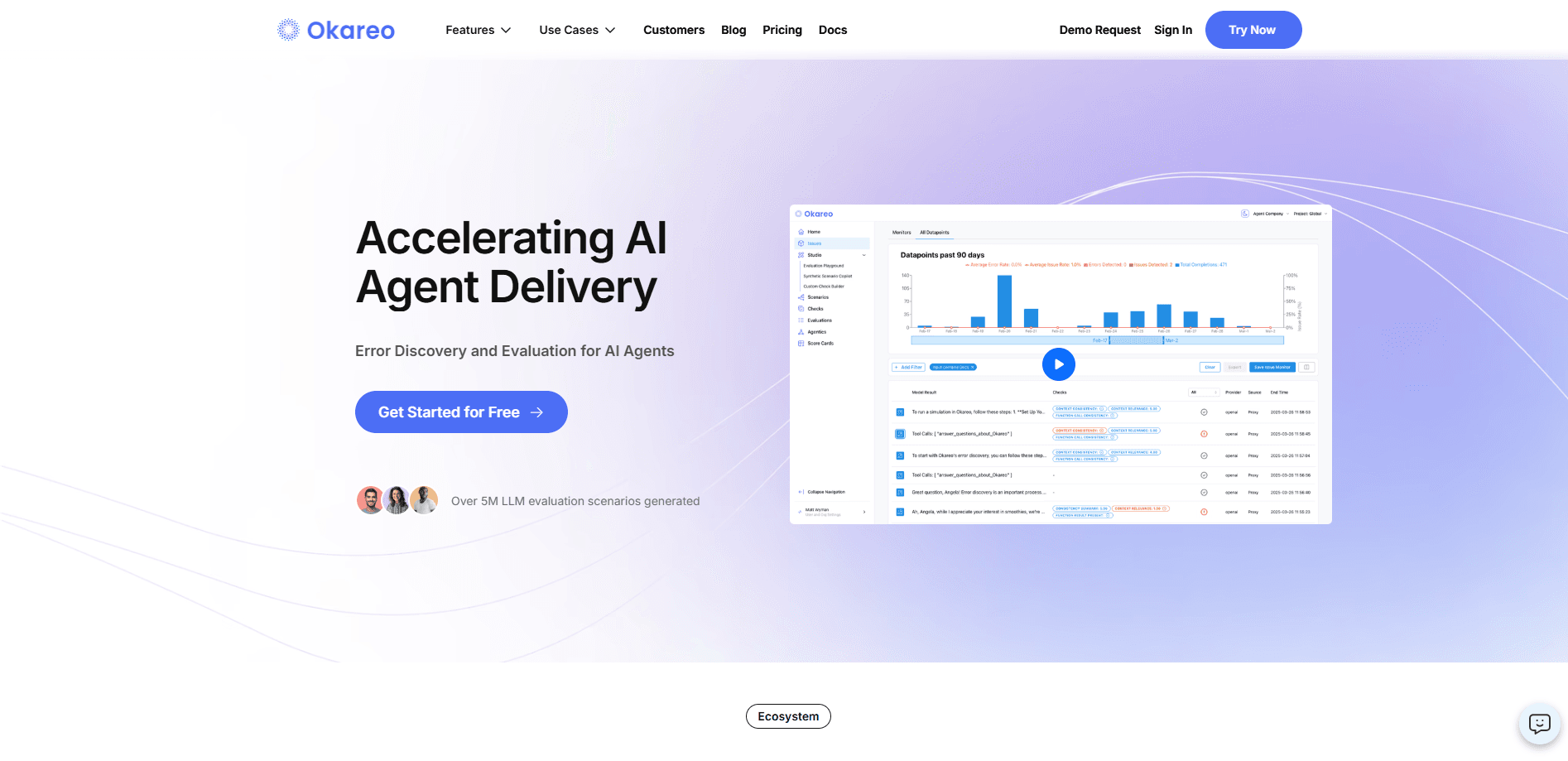
Okareo is an AI agent testing and evaluation platform that runs synthetic users against your voice and text agents to find edge cases, then monitors them in production.
About Okareo
What Is Okareo
Okareo is a simulation and evaluation platform for AI agents. You point it at a voice or text agent, and synthetic users called Drivers hold long, multi-turn conversations with it. They have personality, context, and a goal, so they wander the way real people do and hit behaviors your written test scripts never check. The platform then scores those conversations and keeps watching the agent once it's live.
The problem it solves is a specific one. Agents don't crash when they fail. A voice assistant gives the wrong refund policy or drops a step, and nothing throws an error, so normal tracing never catches it. Okareo looks at the conversation itself rather than the code around it, which is where those quiet failures actually live.
The limits matter too. This is a developer and QA tool, not a plug-in that fixes your agent for you. It works on voice, text, and headless agents, but you need an agent to test in the first place, and the pricing is aimed at teams running agents in production rather than hobbyists.
Getting Started
- Create an account on the Okareo site and start the 14-day trial, which unlocks the Pro limits without a credit card.
- Register your agent as a Target, whether that's a phone number for a voice agent or an endpoint for a text one.
- Write or generate Scenarios, which set the situations your synthetic Drivers will act out.
- Pick your Checks, the judge, symbolic, and audio-based rules that decide what a passing conversation looks like.
- Run a Simulation to replay the scenarios against your agent, then read the results on the scorecard.
- Wire the same run into CI so every pull request gets gated on real conversations.
Product Information
A quick look at Okareo's pricing, supported platforms, and performance.
Best for
The users, tasks, and scenarios where this tool fits best.
Users
- AI engineers
- QA and test leads
- Conversation designers
- Product teams at companies shipping agents
Tasks
- Catching regressions before release
- Testing voice agents like real calls
- Stress-testing a RAG pipeline
- Turning production failures into tests
Scenarios
- Deciding whether an agent is ready to ship
- Handling a multilingual support line
- Keeping a voice agent stable across releases
- Auditing an agent for compliance
Key features
Synthetic users, not scripts
Okareo runs Drivers, synthetic users with a personality and a goal, instead of a fixed script. They hold long, multi-turn conversations and wander into behaviors nobody wrote down. The payoff is coverage: a script can only check what you already thought to test, while a Driver surfaces the edges you didn't.
Voice and text on one platform
The same Scenario and Check workflow covers voice, text, and headless agents. Voice simulation handles the phone number, text to speech, speech to text, recording, and orchestration, so you bring the agent and Okareo runs the call. Teams stop switching tools when the modality changes.
Audio, transcript, and trace in one view
Every call lands as audio, a transcript, and a step-by-step trace on the same timeline. That means a conversation designer debugging a bad call and an engineer chasing the failing tool call look at the same screen. Diagnosing a failure stops being a coordination problem.
Prod-grade evaluation on every pull request
Okareo bills itself as the eval in CI layer for agents. You can wire it into CI so each commit replays your scenarios. Judge, symbolic, and audio-based checks score the conversations, and a run that regresses tone, policy, or routing can block the merge. It replaces eyeballing a few samples with a gate that fails loudly.
Real-time production monitoring
Synthetic users keep probing your live agent after launch, which is a live extension of the LLM evaluation you ran before release to catch failures as they happen, including scope violations, wrong tool calls, and broken flows. Where ordinary observability shows healthy code, this shows the conversation going off the rails before users notice.
Closed loop from production back to tests
This is agent regression testing that maintains itself. Every failure that escapes into production can become a new synthetic scenario on your next run. The test library compounds over time without anyone hand-writing new cases, which is how an agent gets harder to break the longer it ships.
Pros and cons
Pros
- Synthetic users find edge cases that fixed test scripts miss, because they improvise instead of following a checklist.
- Voice and text agents are tested in one place, so you don't split your tooling across modalities.
- Audio, transcript, and trace share one timeline, which shortens the back-and-forth between designers and engineers.
- Runs fit into CI and can block a release, turning evaluation into a gate instead of a manual review.
- Production failures feed back in as new scenarios, so coverage grows without extra authoring work.
Cons
- It's built for teams with a running agent to test, so it's not useful if you haven't shipped anything yet.
- The paid plans start at $199 per month, which prices out solo developers and small side projects.
- Getting value depends on writing good Scenarios and Checks, and there's a real learning curve to those.
- Because it evaluates conversations rather than code, it won't replace unit tests or standard tracing for logic bugs.
Frequently asked questions
It tests and evaluates AI agents. Synthetic users called Drivers talk to your voice or text agent, your Checks score the conversations, and the platform monitors the agent in production for failures that don't throw errors.
Related content
Explore related tools, skills, and articles for Okareo.
Okareo Alternatives

Base Code
Base44 (Wix) · Coding · ProductivityBase Code is a shared cloud development environment from Base44. Teammates describe changes to an existing GitHub codebase in chat, preview them live and send them back as pull requests.

Google EmbeddingGemma 2
Google DeepMind · Writing · Image · CodingGoogle EmbeddingGemma 2 is a 740M-parameter open model that turns text, code, images, audio, and video frames into vectors in one 768-dimension space, running on phones and laptops.

GitGlow
GitGlow · Coding · ProductivityGitGlow is a local-first desktop Git client that lets independent developers review their own code and their AI agents' changes in one place before shipping.