

OmegaCloud.ai
OmegaCloud · Coding · Other
OmegaCloud.ai is an AI application factory for enterprises. Teams describe an app in plain language, then deploy, govern and run it inside their own network.
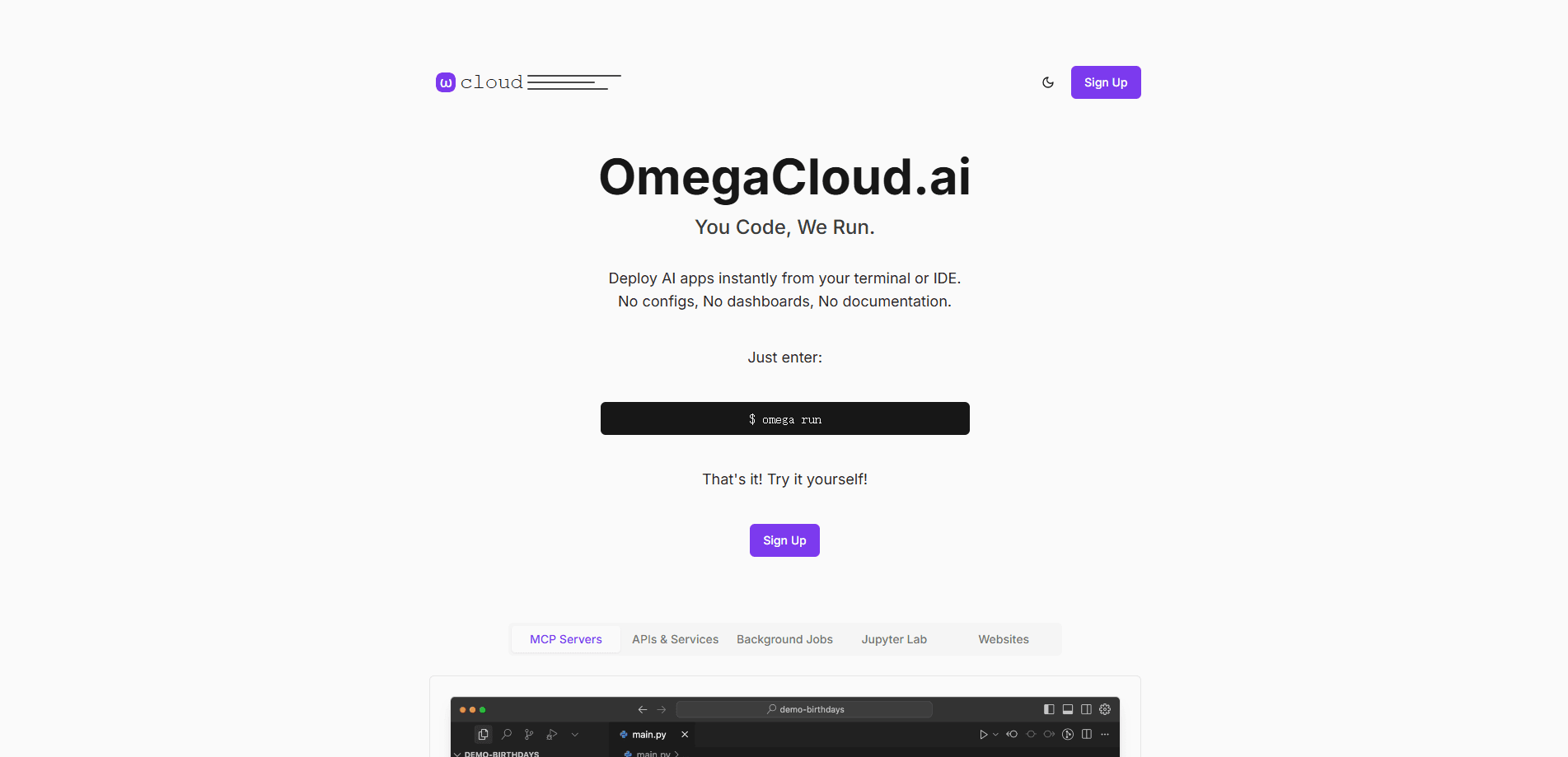
About OmegaCloud.ai
What Is OmegaCloud.ai
OmegaCloud.ai is a platform that turns natural language descriptions into working business apps, then handles the boring and risky part: getting them deployed, secured and governed inside a company. The pitch is aimed at the gap between how fast people can now build with AI and how slowly most companies can safely run what they build.
The problem it targets is real. Employees everywhere are vibe coding small tools with chatbots: a script to reconcile spreadsheets, a form that talks to an internal database, a helper that drafts invoices. Those tools work, but they sit outside IT, outside security review and often outside data-residency rules. OmegaCloud.ai runs the whole lifecycle, from build to deployment to operations, so business teams get their speed without the compliance risk.
One thing to know before you dig in. This is an enterprise product, not a consumer app. There's no free tier you sign up for in a browser, and the sales motion starts with a call, not a checkout. The company's own framing is that it fits businesses that already have corporate data, security policy and audit requirements to respect.
Getting Started
- Book a call and describe what you're trying to build and the constraints the tool must respect, such as data residency or GDPR
- Deploy OmegaCloud inside your own infrastructure so apps run within your network perimeter and security boundary
- Describe the app you want in natural language and let the platform generate a working application
- Connect it to your corporate data sources, then review the audit trail and governance controls before you roll it out
Product Information
A quick look at OmegaCloud.ai's pricing, supported platforms, and performance.
Best for
The users, tasks, and scenarios where this tool fits best.
Users
- Business teams without engineers
- Enterprise IT and platform teams
- Security and compliance officers
- Operations and process owners
Tasks
- Building internal tools
- Automating back-office work
- Connecting to corporate data
- Governing AI-built apps
- Replacing shadow IT
Scenarios
- A finance team wants an invoicing helper
- A regulated firm can't use cloud builders
- IT is buried in small automation requests
- A company worries about compliance incidents
- An enterprise wants every AI action auditable
Key features
Natural Language App Building
The core idea is that you describe what you want and the platform generates a production-ready application. OmegaCloud says it understands natural language rather than requiring you to wire up screens and logic by hand, which sets it apart from classic no-code and low-code tools that still expect you to assemble the pieces yourself. The result is that a non-technical team can build a solution to a real business problem without an engineering background.
Inside Your Network Perimeter
The agents and the apps they build run inside your own infrastructure, not on a vendor's cloud. That's the difference the company leans on hardest, and it's aimed straight at tools like Replit and Lovable that run in the cloud and can clash with data-residency rules. Keeping the workflows inside the corporate boundary means sensitive data stays private and every action stays subject to your own security policy.
Enterprise Governance and Audit Trails
OmegaCloud pairs the speed of AI building with controls a large company expects: centralized policy enforcement, audit trails and governance over what gets built and run. The design goal is that you don't have to rely on individual users doing the right thing. A company can set the rules once and have them applied to every app and every action, which is what makes an IT team comfortable saying yes.
Corporate Data Integration
Unlike cloud builders that can't reach internal systems, OmegaCloud runs on-premise and connects to your corporate data sources. That means the apps it generates can read and write the databases and systems your business actually runs on, instead of being useful prototypes that can't touch real data. Building on real systems is what turns a demo into a tool people use daily.
Reducing Shadow IT
Unauthorized personal cloud tools are one of the quiet ways companies rack up compliance violations, and the company frames its own product as the fix. It gives business teams a secure, approved way to build, so the same work that used to happen in unsanctioned tools happens under IT's watch instead. For a compliance team, that turns an unbounded risk into a controlled one.
Workflow and System Connections
The platform is built to plug into the workflows a company already runs rather than sit beside them. The site's framing is that it connects to your real workflows, which matters because a tool that can't reach the systems where work happens just adds another place to copy data in and out of. By fitting into existing processes, apps built here can take over a step in a real pipeline instead of living off to the side.
Pros and cons
Pros
- Lets non-technical teams build working apps from plain-language descriptions, so IT isn't the bottleneck for every small automation
- Runs inside your own network and security boundary, which keeps sensitive data private and satisfies data-residency and GDPR needs
- Connects to corporate data sources, so built apps can work on real internal systems rather than standalone prototypes
- Central governance and audit trails let a company enforce policy without depending on individual users
- Gives business teams an approved building path, which cuts the shadow-IT risk that unmanaged cloud tools create
Cons
- Enterprise-only with a book-a-call sales process, so there's no free plan or self-serve signup to test it first
- Pricing isn't published, which makes it hard to budget without talking to sales
- Because it deploys inside your infrastructure, getting it running depends on your own IT setup and involvement
- Public detail on the product is thin beyond the marketing site, so builders have little to evaluate before a demo
Frequently asked questions
OmegaCloud.ai turns natural language descriptions into working business apps, then deploys, governs and runs them inside a company's own network. It's aimed at enterprises that want the speed of AI app building without giving up security, data residency or compliance.
Related content
Explore related tools, skills, and articles for OmegaCloud.ai.
OmegaCloud.ai Alternatives

Base Code
Base44 (Wix) · Coding · ProductivityBase Code is a shared cloud development environment from Base44. Teammates describe changes to an existing GitHub codebase in chat, preview them live and send them back as pull requests.

Google EmbeddingGemma 2
Google DeepMind · Writing · Image · CodingGoogle EmbeddingGemma 2 is a 740M-parameter open model that turns text, code, images, audio, and video frames into vectors in one 768-dimension space, running on phones and laptops.

GitGlow
GitGlow · Coding · ProductivityGitGlow is a local-first desktop Git client that lets independent developers review their own code and their AI agents' changes in one place before shipping.