

OmniAI
OmniAI (now Monumint) · Coding · Marketing
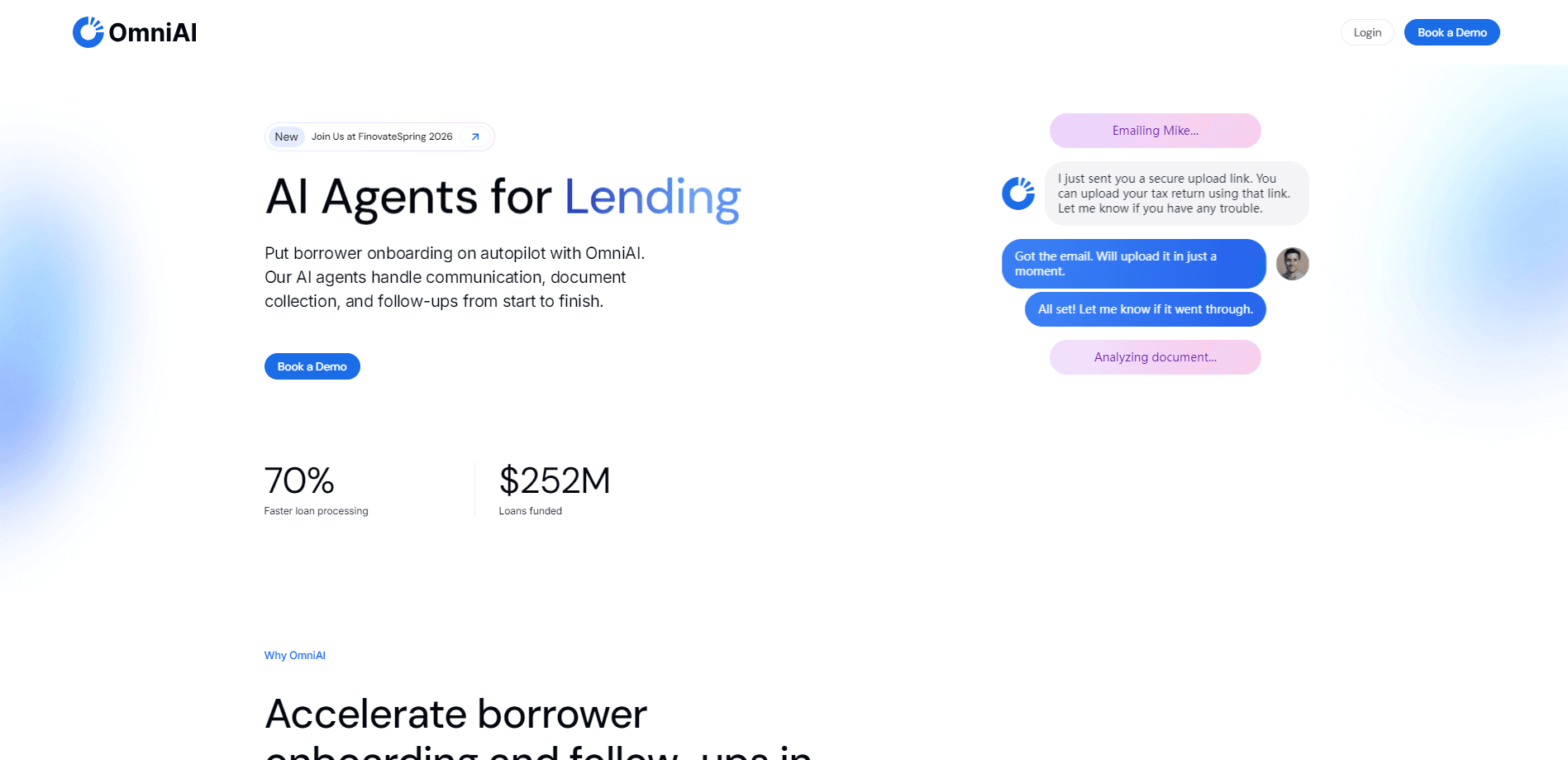
OmniAI, now called Monumint, builds conversational AI agents for banks and lenders: document collection, applicant follow-ups, and borrower questions over voice, email, SMS, and chat.
About OmniAI
What Is OmniAI
OmniAI began as a data infrastructure layer for AI teams. The pitch was practical: pull structured data out of messy PDFs, and run language models inside infrastructure you already control. Its open-source zerox library and the Omni OCR benchmark, which scored OCR providers and vision models across 1,000 documents, both came out of that period.
The company then narrowed onto lending. Teams used it to collect borrower documents, follow up on applications, and keep files moving without adding back-office staff. On July 9, 2026 the product was relaunched as Monumint, positioned as conversational AI for financial institutions. The old name still points at the same company and the same underlying document work.
What limits it today is scope. Monumint is sold to institutions, not individuals. There is no signup page, no published price list, and no free plan. Onboarding runs through a demo and an implementation project, which means you need a committed ops team and access to the systems the agent has to read and write.
Getting Started
- Book a demo and bring a real workflow, such as document collection for a personal loan queue, rather than a general request for automation.
- Map the systems the agent needs: the CRM, the loan origination system, the core, credit data, and wherever documents land.
- Load policies, product rules, and scripts into the knowledge base so replies stay inside what your compliance team will approve.
- Connect channels and set the guardrails: contact windows, escalation rules, and the wording checks that apply to lending conversations.
- Pilot one queue for a few weeks, compare completion rates and rep workload against the manual baseline, then widen access.
Product Information
A quick look at OmniAI's pricing, supported platforms, and performance.
Best for
The users, tasks, and scenarios where this tool fits best.
Users
- Lending operations teams
- Loan officers and underwriters
- Collections and servicing desks
- Fintech and credit union leaders planning to grow volume without proportional headcount, provided they can give engineering time to the integration work.
Tasks
- Collecting pay stubs, bank statements, and IDs across email, SMS, and chat, then checking that each file is legible and complete.
- Classifying and extracting data from loan documents so an application moves forward without a human opening every PDF.
- Following up with applicants who stalled mid-application, using policy-bounded messages instead of blanket reminder blasts.
- Answering balance, payment, and account questions instantly, and logging the exchange back into the system of record.
Scenarios
- Evening and weekend applications
- Seasonal volume spikes in consumer lending, where hiring temporary processors is slow and expensive.
- Multi-channel borrower bases
Key features
One Agent Across Voice, Email, SMS, and Chat
The agent holds a single conversation that moves between channels. A borrower can start in web chat, get a text reminder, and finish on a call without the context resetting. That matters in lending, where the same applicant often drifts across three channels before sending the last document.
Document Intelligence and Collection
Monumint collects files, classifies what arrived, and extracts the fields the loan file needs. Applications do not stall because a statement sat unopened in an inbox overnight. This is the part of the product with the longest track record, since document AI was the company's original business.
Connections to Systems of Record
Agents read and write to CRMs, loan platforms, cores, credit data, and document stores. API and webhook access is available for the systems without a native connector. The practical effect is that a completed conversation updates the file, instead of leaving a note for someone to re-enter by hand.
Compliance Guardrails
Contact windows, fair-lending language scoring, and one-click evidence packs sit inside the workflow rather than beside it. Every message, decision, and system update produces a record. For a regulated lender this is the difference between a pilot that passes review and one that dies in legal.
Policy-Bounded Answers
Product rules, scripts, and institutional knowledge live in a knowledge base the agent answers from. You set what it can promise, and it stays inside those limits. Escalation is part of the design, so hardship or refinance signals route to a human rather than being talked around.
Audit Trail and Reporting
Each conversation is logged and scored, with real-time reporting on volume, resolution, and handoffs. Teams can pull the trail for a single borrower or scan a week of outreach for language risk. No black box, in the company's phrasing, which is the claim audits tend to test.
Pros and cons
Pros
- Genuine channel coverage: voice, SMS, email, and web chat run through one agent with shared context.
- Write-back into CRMs and loan systems, so conversations produce updated records instead of manual re-entry.
- Compliance tooling for contact windows and fair-lending language is built in, not bolted on.
- Document collection and extraction run end to end, backed by years of OCR and extraction work.
- Named lender customers, including Lendio, CRNCY, and Byzfunder, with public claims of roughly 4x capacity gains.
Cons
- No self-serve signup, no published pricing, and no free tier, so evaluation starts with a sales conversation.
- The compliance framing is built around US lending rules, which limits the value for institutions elsewhere.
- Integration work is real: without access to your CRM and loan systems, the agent has little to work with.
- The rebrand leaves older OmniAI material scattered online, so developers hunting the old data extraction APIs will land on a different product.
Frequently asked questions
Yes. OmniAI relaunched as Monumint on July 9, 2026, and the site, docs, and GitHub organization now run under that name. The company and the document AI work behind it carried over.
Related content
Explore related tools, skills, and articles for OmniAI.
OmniAI Alternatives

Base Code
Base44 (Wix) · Coding · ProductivityBase Code is a shared cloud development environment from Base44. Teammates describe changes to an existing GitHub codebase in chat, preview them live and send them back as pull requests.

Google EmbeddingGemma 2
Google DeepMind · Writing · Image · CodingGoogle EmbeddingGemma 2 is a 740M-parameter open model that turns text, code, images, audio, and video frames into vectors in one 768-dimension space, running on phones and laptops.

GitGlow
GitGlow · Coding · ProductivityGitGlow is a local-first desktop Git client that lets independent developers review their own code and their AI agents' changes in one place before shipping.