

OnDemand
OnDemand AI · Marketing · Leaning · Other · Chatbot
OnDemand is a RAG-powered AI platform where teams build agents, connect private data and ship them through APIs, with a model library plus bring-your-own-model support.
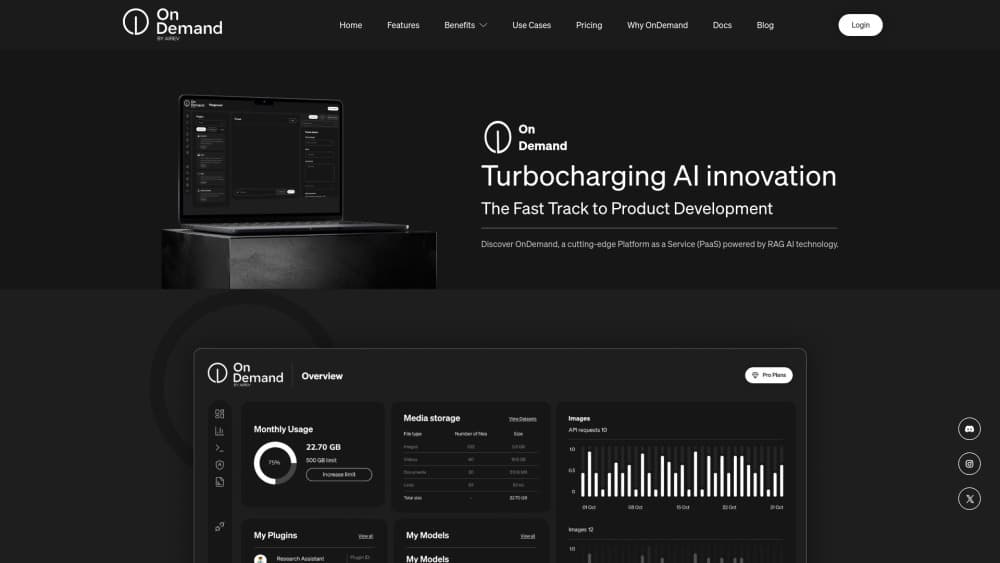
About OnDemand
What Is OnDemand
OnDemand AI is an AI PaaS for putting agents inside software that already exists. You point it at your own documents and services, pick a model, then publish the result as an agent, a chat endpoint or a workflow.
That focus makes it a RAG platform before anything else: retrieval augmented generation is the product, not an add-on. Most of the tooling exists to answer questions from company data and to run actions across outside systems, so retrieval setup matters more than prompt wording.
The main limit is audience. OnDemand is built for people who work with APIs and structured data. There's no consumer app, and paid pricing is quoted per project rather than listed on a public card.
Getting Started
- Create an account at app.on-demand.io and open the Playground to test a model without writing code.
- Generate an API key in the dashboard, then send a first request to the API base at https://api.on-demand.io/.
- Upload documents or connect a data source, and build a Knowledge agent so answers come from that content.
- Add tools, REST agents or a flow, then publish the setup as an endpoint your app calls.
Product Information
A quick look at OnDemand's pricing, supported platforms, and performance.
Best for
The users, tasks, and scenarios where this tool fits best.
Users
- Backend and full stack developers
- AI engineers at mid-size companies
- Product teams with a corpus already in hand
Tasks
- Building a support assistant over help center articles and past tickets, with answers grounded in the source documents.
- Wrapping internal REST services as agents so a chat request can check order status or open a ticket.
- Comparing model behavior on the same private dataset before committing to one provider, since models can swap behind the same agent.
Scenarios
- A pilot that has to show working AI in weeks
- Regulated teams that can't send documents to an unknown endpoint
- Multi-step back office work such as intake, classification and routing, where one workflow replaces a chain of scripts.
Key features
Predefined Model Library and Playground
OnDemand ships a catalog of hosted models for text, vision and data tasks, and the Playground lets you compare responses before committing. You can run one prompt against several models, then keep the one that fits your budget and latency target. It's the fastest way to learn whether a task is solvable before you build around it.
BYOI and BYOM
Bring Your Own Inference points OnDemand at an endpoint you already run. Bring Your Own Model goes further: deploy a Hugging Face model on vLLM using dedicated bare metal GPUs, with your own token for private weights. Teams use this to keep a tuned model in production without moving data or paying twice for hosting.
Agents and Connectors
Agents extend a model past chat. A REST API agent turns an OpenAPI schema into callable actions, a Knowledge agent answers from indexed documents, and connectors link outside services through OAuth. IoT agents over MQTT and a Terminal agent cover device and shell tasks, which matters when a workflow touches hardware or servers.
Agents Flow Builder
The flow builder chains models, agents and logic into a repeatable pipeline. Nodes handle branching, data transforms and tool calls, so a multi-step job runs as one workflow instead of a queue of cron scripts. Published flows get their own endpoint and execution history, which makes failures easier to trace than a black box agent.
RAG with Vector Search and File Handling
Uploaded files are parsed, chunked and stored in a managed vector database. Answers come back grounded in those chunks, and retrieval settings are exposed far enough to tune chunk size and result count. Smart file handling covers large documents, so a 200 page PDF doesn't stall ingestion.
APIs, Webhooks and Serverless Apps
Every object has an API: chat, agents, workflows and executions, all under one base URL with standard keys and rate limits. Webhooks push results back to your system when a run finishes. Serverless applications host small functions next to the agents, which cuts the number of services you have to operate.
Pros and cons
Pros
- One place for retrieval, agents, workflows and API access, so a RAG feature doesn't need four vendors.
- BYOM on dedicated GPUs is a real option for privacy-sensitive teams, not a marketing line.
- The Playground shortens model comparison from days to an afternoon.
- Published workflows expose execution logs, which helps when an agent returns a wrong answer.
Cons
- Pricing is quote-based, so you can't estimate a monthly bill from the site alone. Budget approval takes longer.
- The platform assumes API literacy. Non-technical users will find the dashboard dense and the docs aimed at developers.
- Retrieval quality still depends on document preparation. Poorly structured sources produce confident but wrong answers.
Frequently asked questions
OnDemand is used to add AI agents and retrieval to existing products. Typical work includes a support assistant over company documents, chat endpoints that call internal APIs, and automated back office flows.
Related content
Explore related tools, skills, and articles for OnDemand.
OnDemand Alternatives

ngram 2.0
ngram · Video · Marketingngram 2.0 is an AI video generator for teams. It turns a prompt, a screen recording, or a product URL into a narrated explainer, product demo, or AI avatar video, and every scene stays editable.

shippedit.me
Krawlup · Marketing · Businessshippedit.me now redirects to Krawlup, a web platform that audits SEO, AEO and page speed every week, then hands the fixes to AI coding agents over MCP.

MePersona
MePersona, Inc. · Writing · Productivity · MarketingMePersona is an AI unified inbox for creators. It learns your voice, drafts replies to fan messages from 12 platforms, and sends only what you approve.