

Ontosight.ai
Innoplexus (now Partex AI) · Coding · Business
Ontosight.ai is an AI research assistant from Innoplexus that answers life sciences questions with cited sources and maps links among drugs, targets, and clinical trials.
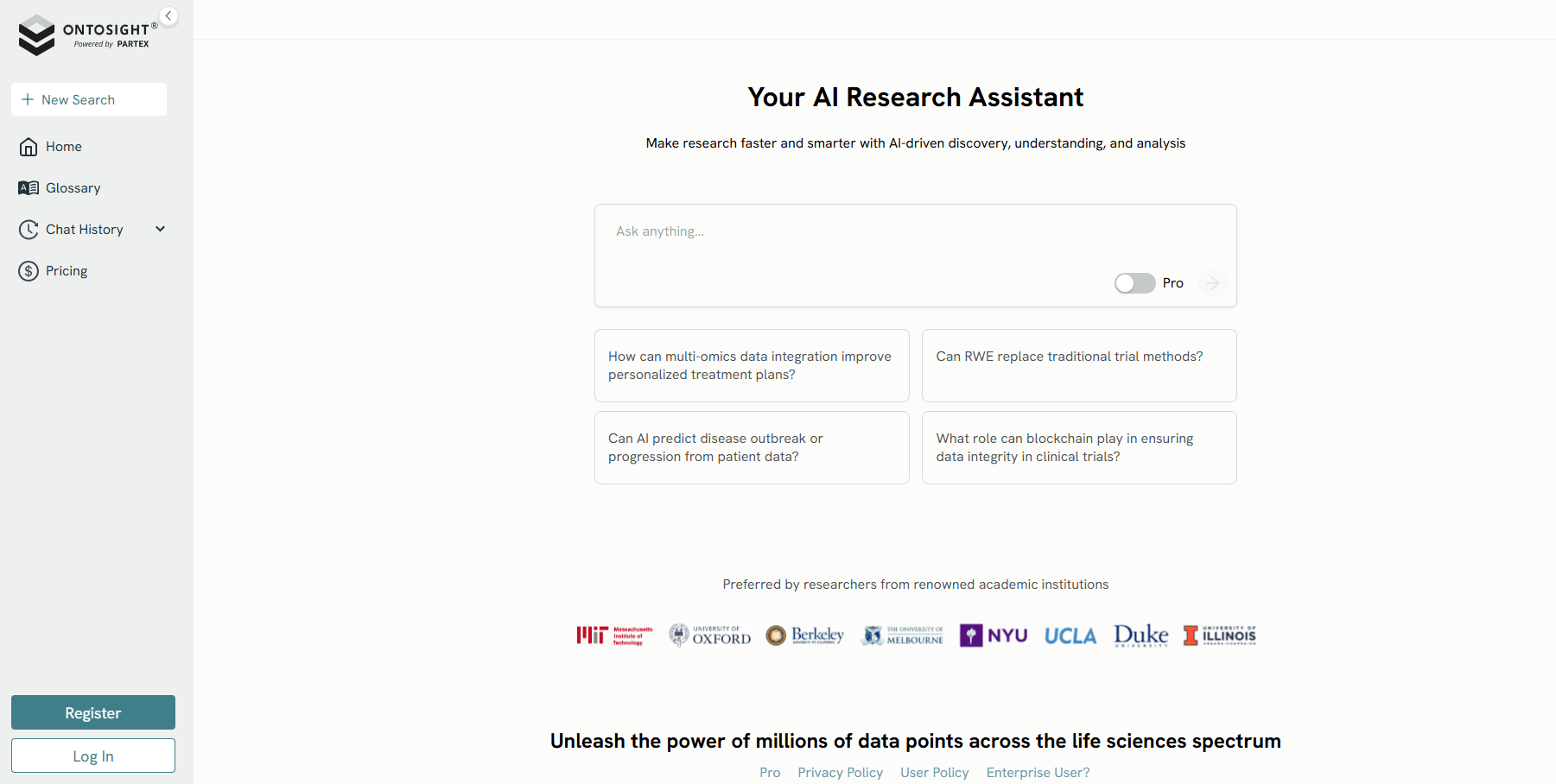
About Ontosight.ai
What Is Ontosight.ai
Ontosight.ai is a research platform built for people who work with life sciences data: drug developers, medical affairs teams, and academic researchers. As a drug discovery tool, its job is simple to state. You ask a question in plain language, and it answers with a summary that points back to the publications, patents, and trial records it used. That citation trail is the main selling point, since a plain chatbot answer is hard to defend in a research setting.
The platform sits on top of what its developer calls a data ocean. Innoplexus says it covers about 95% of publicly available life sciences data, which it lists as 42 million publications, 639,000 clinical trials, 5 million grants, 1.3 million theses, and 3.3 million congress articles. A self-learning ontology ties those records together, so the system can surface links between a drug, a target, and the papers that mention both.
The biggest catch is access. Ontosight.ai is free for verified academic and institutional email addresses, and it turns away sign-ups from public providers like Gmail or Yahoo. Researchers outside that group need to go through the company for a commercial arrangement, and pricing isn't published.
Getting Started
- Go to the Ontosight.ai site and sign up with a university or institutional email address. Public email domains are rejected.
- Verify the address through the confirmation link the platform sends you.
- Open a new research question and type it in plain language, for example a drug name plus a disease or a target you want to explore.
- Review the answer, then follow the citations back to the source publications, trials, or patents.
- Use the power maps and research graphs to visualize how the entities in your question connect to each other.
Product Information
A quick look at Ontosight.ai's pricing, supported platforms, and performance.
Best for
The users, tasks, and scenarios where this tool fits best.
Users
- Drug discovery researchers
- Medical affairs and KOL teams
- Academic scientists
Tasks
- Biomedical literature search
- Target and drug mapping
- Competitive and pipeline tracking
Scenarios
- Early-stage project scoping
- Pre-trial planning
- Cross-checking a hypothesis
Key features
Cited answers instead of bare claims
Every response links back to the publications, patents, clinical trials, and grants behind it. That turn of citation-backed answers makes it easier to check a claim before you repeat it in a report or a slide deck.
Self-learning ontology
The system organizes drugs, targets, genes, and diseases into a network that updates as new data arrives. It's the layer that lets the platform find connections a plain keyword search would skip.
Power maps and research graphs
You can visualize how entities relate to one another rather than reading a wall of text. Useful when you need to see the shape of a research area before deciding where to dig.
KOL and DOL discovery
The platform finds key opinion leaders and digital opinion leaders by their publication record and affiliations. Teams can then build an engagement plan around who is connected to which advocacy group, hospital, or society.
Access to a large life sciences data ocean
Innoplexus says the platform reaches roughly 95% of publicly available life sciences data, including 42 million publications and 639,000 clinical trials. Broad coverage is the main reason a sourced answer here is often richer than a generic web search.
Data as a service for teams
Beyond the app, the company offers life sciences data APIs covering publications, clinical trials, patents, grants, and drug and gene profiles. That's aimed at teams that want to feed the same data into their own tools.
Pros and cons
Pros
- Answers come with citations, so you can verify claims before using them
- Free for researchers with a verified academic or institutional email
- Covers a wide set of sources, from publications to clinical trials and patents
- KOL discovery and mapping are built in, not bolted on
- Data APIs let teams reuse the same sources outside the app
Cons
- Public email providers like Gmail are blocked, which shuts out independent researchers
- Pricing for commercial users isn't published, so teams have to ask for a quote
- It's aimed at life sciences only, so it's the wrong tool for other fields
- API availability and terms aren't clearly documented on the public site
Frequently asked questions
Yes, for people with a verified academic or institutional email address. Public providers such as Gmail and Yahoo are not accepted, so independent researchers usually can't sign up without going through the company.
Related content
Explore related tools, skills, and articles for Ontosight.ai.
Ontosight.ai Alternatives

Base Code
Base44 (Wix) · Coding · ProductivityBase Code is a shared cloud development environment from Base44. Teammates describe changes to an existing GitHub codebase in chat, preview them live and send them back as pull requests.

Google EmbeddingGemma 2
Google DeepMind · Writing · Image · CodingGoogle EmbeddingGemma 2 is a 740M-parameter open model that turns text, code, images, audio, and video frames into vectors in one 768-dimension space, running on phones and laptops.

GitGlow
GitGlow · Coding · ProductivityGitGlow is a local-first desktop Git client that lets independent developers review their own code and their AI agents' changes in one place before shipping.