

Oogwai Beacon
Oogwai · Marketing · Business
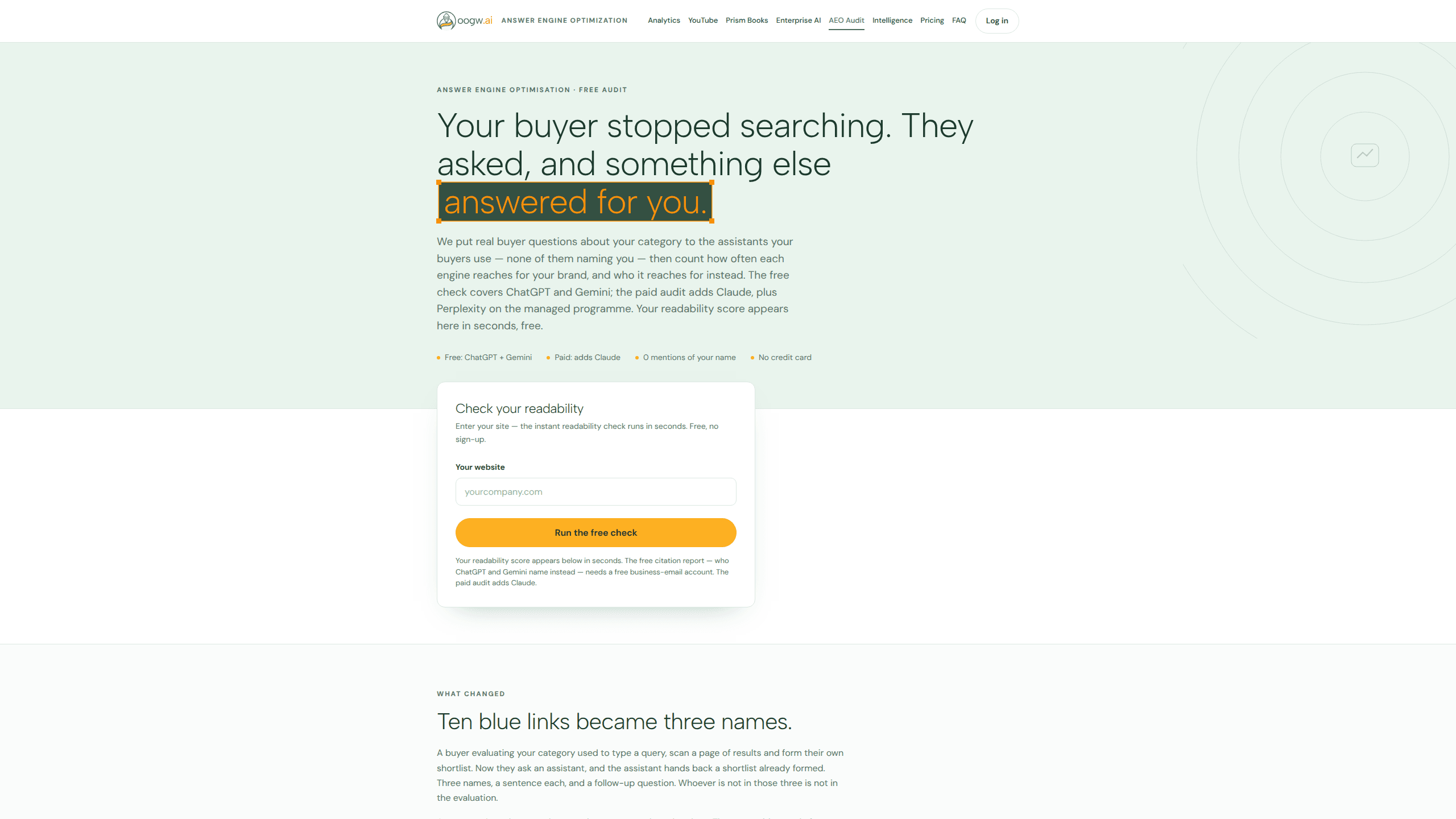
Oogwai Beacon is an answer engine optimization audit. It checks whether AI crawlers can read your site, then puts 20 buyer questions to ChatGPT, Gemini and Claude to see which brands get named.
About Oogwai Beacon
What Is Oogwai Beacon
Oogwai Beacon is the answer engine audit from Oogwai, a data and analytics company with offices in Dubai and Bengaluru. It answers a question your web analytics cannot: when a buyer asks an AI assistant for the best option in your category, does the assistant say your name?
The audit splits that question into two halves and reports them apart on purpose. Readability runs first, over plain HTTP with no model calls. Beacon checks whether GPTBot, ClaudeBot, PerplexityBot and Google-Extended can reach your pages, and whether they find real content when they arrive. Robots rules, server-rendered HTML, Organization, Product and FAQ structured data, llms.txt, heading structure, canonical URLs and sitemaps all feed that score.
Citation is the slower half. Beacon writes 20 questions a buyer would ask about your category, none of which mentions your brand, and records how each engine answers. The free check covers ChatGPT and Gemini. The paid AEO audit adds Claude, which grades harder than the other two, and the managed programme covers Perplexity and Copilot with regional variants and buyer personas.
The limit worth knowing before you start: a clean readability score and zero citations is a normal result, and it means the problem sits off your site. Fixing that half is media and editorial work, which Oogwai sells separately. The audit is also built for B2B categories where buyers compare vendors by name, so a local service business with no real competitors will get a thin answer.
Getting Started
- Open oogw.ai/aeo and enter your site address. The readability check runs in seconds, with no card and no account.
- Read the crawler result. Beacon lists each named AI crawler and what your robots.txt says to it, then flags the pages a bot would see as an empty shell.
- Add an email address to request the citation half. The 20 questions are drawn from your category, so the report reflects how buyers phrase the search rather than how you describe the product.
- Open the emailed report and look at two numbers first: how often each engine names you unprompted, and which competitors it names instead. The cited domains list follows in the same file.
- Decide on the next step. A technical fix is usually yours to make, and a paid audit adds Claude for a three-engine baseline.
Product Information
A quick look at Oogwai Beacon's pricing, supported platforms, and performance.
Best for
The users, tasks, and scenarios where this tool fits best.
Users
- B2B marketing leads
- SEO managers adding AEO to the remit
- Agency strategists
- Founders of small software companies
Tasks
- Checking AI crawler readability
- Finding out who the engines name
- Building a source target list
- Tracking share of answers over time
Scenarios
- Before a category launch
- After a migration to a JavaScript-heavy front end
- Preparing a retainer pitch
Key features
A free readability check that returns in seconds
The first result needs no account and no call to a language model, because it only reads your pages over HTTP. Beacon reports whether the four named AI crawlers can reach the site and whether the HTML contains the content they came for. Most teams treat this as a five-minute sanity check before a larger project.
Per-crawler access and markup checks
Beacon separates the four crawlers instead of lumping them together, since a robots.txt rule that allows GPTBot can still block Google-Extended. The report covers server-rendered HTML, Organization, Product and FAQ structured data, llms.txt, heading order, canonicals and sitemaps. It also flags inconsistent entity facts, where one page calls the company something different from another.
Twenty buyer questions that never name your brand
The question set is written the way a buyer asks an assistant about a category, so your name does not appear in any of them. That design choice matters: a question containing your brand only tests whether an engine has heard of you. Twenty questions about your category test whether it recommends you when the buyer has no preference yet.
An engine-by-engine citation report
The report records, for each engine, how often your brand is named, which competitors appear instead, and which sources the engine cited to reach that answer. It also captures what the models believe your company does, including the parts they get wrong. You get a per-question view, so the weak spots show up as patterns rather than a single score.
Cited domains turned into a target list
Because every run stores the domains the engines pulled from, the audit ends with a ranked list of places worth appearing on next. Weighting accounts for how often a source is quoted, how hard it is to get onto, and whether competitors already sit there. That list is the bridge between the audit and the media programme.
Managed placement and monthly re-runs
Oogwai's content team works the list through editorial placements, review platform profiles, comparison pages, community answers and transcribed video. The same 20 questions run again each month, so share of answers becomes the metric and a channel that does not move gets dropped.
Pros and cons
Pros
- The readability check runs without a sign-up, so you see a real result before any sales call.
- Splitting readability from citation keeps a zero-citation result useful, because it points at the right problem.
- Questions avoid your brand, which tests whether an engine recommends you rather than whether it recognizes you.
- The report names the exact domains each engine cited, so the follow-up work starts from evidence.
- Paid tiers extend coverage to Claude, Perplexity and Copilot for a fuller baseline.
Cons
- No price is published for the paid audit or the managed programme, so budgeting needs a conversation with sales.
- Twenty fixed questions give a narrow sample, and a small or new category may produce thin comparison data.
- The AEO score only arrives with the paid audit, so a two-engine free result cannot be compared directly against a three-engine one.
- There is no self-serve dashboard and no API, so results arrive as an emailed report instead of live data.
Frequently asked questions
It's an answer engine optimization audit from Oogwai. Beacon checks whether AI crawlers can read your site, then asks ChatGPT, Gemini and Claude 20 buyer questions about your category and records whether your brand comes up.
Related content
Explore related tools, skills, and articles for Oogwai Beacon.
Oogwai Beacon Alternatives

ngram 2.0
ngram · Video · Marketingngram 2.0 is an AI video generator for teams. It turns a prompt, a screen recording, or a product URL into a narrated explainer, product demo, or AI avatar video, and every scene stays editable.

shippedit.me
Krawlup · Marketing · Businessshippedit.me now redirects to Krawlup, a web platform that audits SEO, AEO and page speed every week, then hands the fixes to AI coding agents over MCP.

MePersona
MePersona, Inc. · Writing · Productivity · MarketingMePersona is an AI unified inbox for creators. It learns your voice, drafts replies to fan messages from 12 platforms, and sends only what you approve.