

Openbase
Openbase · Coding
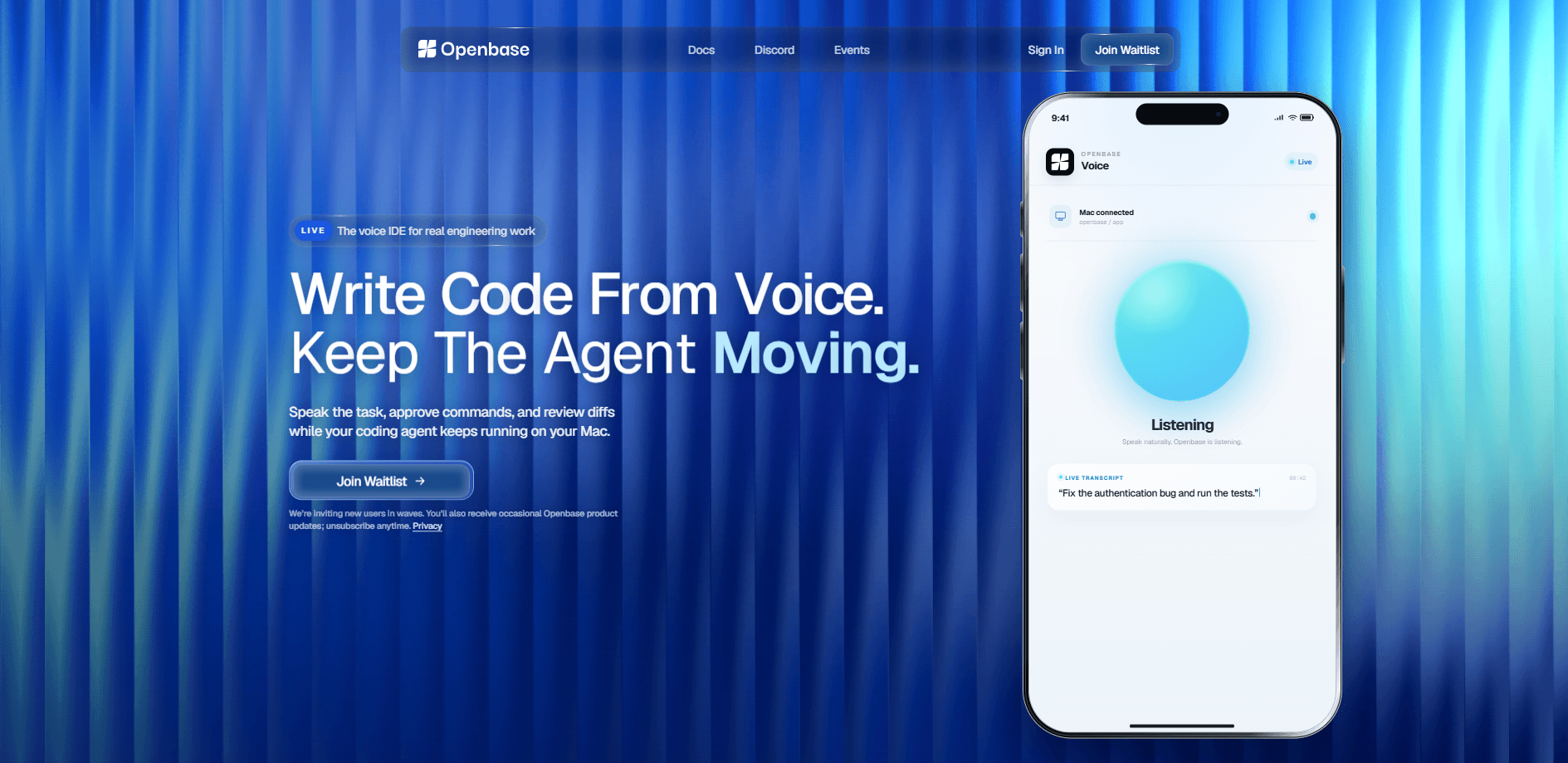
Openbase is a voice-first IDE and workspace built for developers who run AI coding agents. It turns scattered agent activity into one conversation. Start AI coding sessions by voice, route a task into the right workspace, approve sensitive commands, and review the resulting diff before anything lands. No more reconstructing what happened across chat threads and terminals. The whole session stays in one place.
About Openbase
What Is Openbase
Openbase is a workspace where AI coding agents stay connected to your project and your decisions. You talk through what you want, the agent picks up the task, and the work flows back as a report, a diff, and a set of tests you inspect before it reaches production or a cloud sandbox.
The problem it solves is fragmentation. Coding agents are fast but noisy, and their output usually gets spread across a terminal, a chat window, and a browser tab. Openbase pulls approvals, blockers, and reviews into one continuous view, so you always know what an agent changed and why. That matters most when several sessions run at once. What did the last one actually touch?
The main limit is scope. This is a developer tool for people already using agent-based coding, not a beginner-friendly editor. If you don't run agents in your workflow, most of the value goes unused. Pricing details aren't published on the homepage, so check the official site before you commit.
Getting Started
- Create an account on the Openbase site and connect the workspace you want agents to work in.
- Link the coding agents you already use, so Openbase can dispatch tasks to them.
- Start a live coding call and describe the change you want in plain language.
- Watch the session as the agent pauses for approval on any sensitive action, such as a database reset.
- Review the diff, test results, and report, then approve the change to ship it to a sandbox or production.
Product Information
A quick look at Openbase's pricing, supported platforms, and performance.
Best for
The users, tasks, and scenarios where this tool fits best.
Users
- Developers running coding agents
- Solo builders shipping to production
- Teams reviewing AI-generated code
Tasks
- Approving sensitive commands
- Reviewing agent diffs
- Routing tasks into the right workspace
Scenarios
- Deploying a fix late at night
- Running several agents across projects
- Handing off work between devices
Key features
Voice-First Session Control
You start a live coding call and speak the change you want. Openbase captures the intent and routes it as a task, which cuts the back-and-forth of typing long prompts. Speaking a bug fix takes seconds. The voice layer is the entry point, not a gimmick bolted onto a text box, and it keeps your hands on the keyboard only when you actually want to edit.
Approval Gates for Sensitive Actions
When an agent wants to run something risky, like resetting a linked database before redeploying, Openbase pauses the session and asks first. You see the exact command before it runs. Risky, unpredictable work stops at the gate. That single checkpoint is what makes agent-driven deploys less nerve-wracking, because a wrong command never executes without your yes.
Diff and Artifact Review
Finished work comes back as a diff, a report, and tests. You read the changes with line counts, such as 18 files touched, before the code lands. It reads like a pull request, which keeps review familiar. Nothing gets skipped, and nothing ships silently.
One Conversation Across Agents and Devices
Openbase brings scattered agent activity into a single thread. Changes, blockers, and reviews surface in one place; you aren't reconstructing a timeline from three different tools while trying to remember which agent touched which file last. Switching devices keeps the same session alive, which matters when you start a fix on a laptop and finish it somewhere else.
Stack-Agnostic Integration
The workspace is built to work with your existing stack rather than replace it. Agents and tooling you already run connect to the session instead of forcing a migration. Setup checks confirm the local environment is ready before you start. Fewer surprises. If a required check fails, the session tells you which piece is missing so you can fix the local setup before spending an hour debugging an agent that never had what it needed.
Pros and cons
Pros
- Keeps agent sessions, approvals, and reviews in one place instead of scattered across tools.
- Pauses destructive commands so you confirm them before they run.
- Presents agent output as a readable diff with reports and tests.
- Works alongside coding agents you already use, so there's no forced migration.
Cons
- Pricing isn't published on the homepage, so you have to ask or dig before budgeting.
- It's aimed at developers already running agents, which limits its use for anyone coding without them.
- Most details live in a hosted product with little public documentation to preview.
Frequently asked questions
Openbase is a voice-first IDE and workspace for working with AI coding agents. It lets you start a live coding call, route tasks into a workspace, approve sensitive commands, and review diffs before code ships to a cloud sandbox or production.
Related content
Explore related tools, skills, and articles for Openbase.
Openbase Alternatives
Forefront
Forefront · CodingForefront is a web platform for building with open-source AI. It lets you fine-tune leading open-source language models on your own data, evaluate how they perform, and run them through an API or export them to host yourself. Developers who want the convenience of a closed-source platform but insist on owning their models and data are the target audience here.

Startkit
StartKit.AI · CodingStartkit is a boilerplate for building AI SaaS and AI wrapper products. Think of it as an AI startup boilerplate with the boring parts already wired up: authentication, Stripe and Lemon Squeezy payments, usage limits, transactional email, and an AI API starter that talks to OpenAI, Anthropic, Groq, or Llama. You clone the repo, set your price, and start on the part of your product that people actually pay for. It's Next.js under React and Tailwind, so most of the boilerplate code already feels familiar.
Testim
Tricentis · CodingTestim is an AI-powered test automation platform for building and running end-to-end tests across web, mobile, and Salesforce applications. It leans on machine learning to keep tests stable when an interface changes, so teams spend less time fixing broken selectors. Not bad for an automated testing tool you can start using today. You create tests by recording actions in a browser, then optionally add JavaScript when you need more control. It's a solid pick for busy QA teams.