

OpenFunnel(YC F24)
OpenFunnel · Marketing
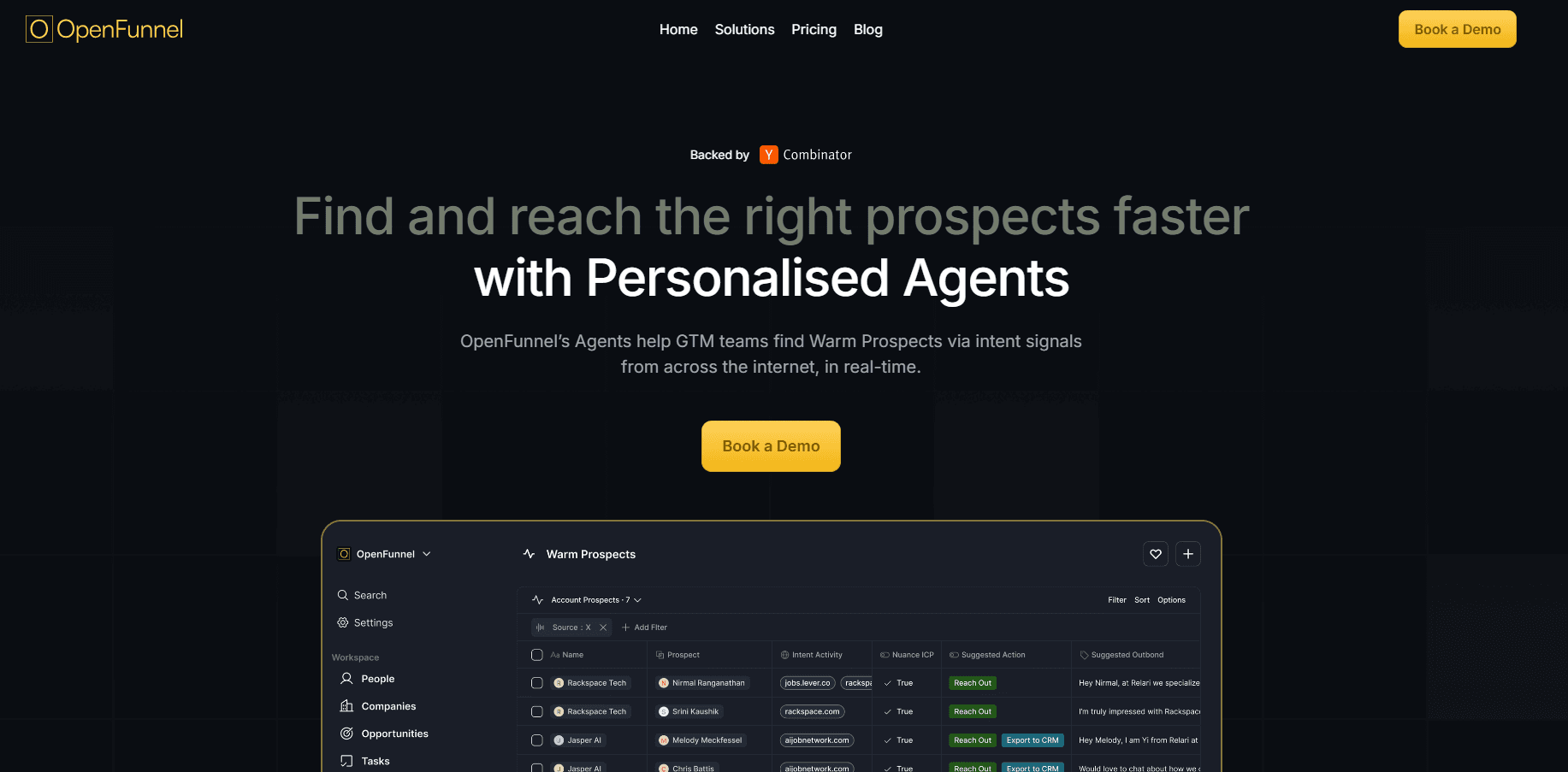
OpenFunnel is a YC-backed AI platform for GTM teams. It turns live intent signals into qualified sales leads.
About OpenFunnel(YC F24)
What Is OpenFunnel(YC F24)
OpenFunnel is a search engine for inferred pain. Instead of filtering a static database by firmographics like "B2B SaaS, 501-1000 employees", you describe the activity you care about. It finds companies showing that activity right now. Two founders met at BITS Pilani and shipped the first version during Y Combinator's F24 batch.
Timing matters more than data volume, and a company that just started migrating off a tool is far more reachable than one that merely matches a demographic filter on paper. So is a team that opened a role for a specific initiative or posted about a problem last week. OpenFunnel runs live search agents that watch these intent signals across job posts, LinkedIn, and X. Then it syncs matched accounts and contacts into Salesforce or HubSpot.
Scope is the catch. OpenFunnel is a B2B go-to-market tool aimed at sales, marketing, and revenue teams at tech companies. It isn't for individuals chasing general web leads. The closed-won lookalike and deep research features also work best once you have some customer history to seed them with.
Getting Started
- Sign up at app.openfunnel.dev and claim the free 50,000 starting credits.
- Describe the insight you want in natural language, like "companies implementing usage-based billing in the past 3-6 months".
- Pick or generate an API key from the docs if you plan to call primitives from a coding agent.
- Run the search, then review the accounts and people it returns with their qualifying context.
- Connect Salesforce or HubSpot and sync the matched accounts and contacts in one job.
Product Information
A quick look at OpenFunnel(YC F24)'s pricing, supported platforms, and performance.
Best for
The users, tasks, and scenarios where this tool fits best.
Users
- Developer tooling startups
- GTM engineers and RevOps leads
- SDR and BDR teams
Tasks
- Building a total addressable market
- Finding lookalikes
- Sourcing hiring signals
- Account research
Scenarios
- Watching for migrations
- Tracking tech stack changes
- Keeping a CRM clean
Key features
Intent-based company search
You describe an activity and a time window, like "companies moving from OpenAI to self-hosted Llama in the last 2 months". OpenFunnel returns the companies matching it. Live search agents keep watching, so new matches surface as they happen. Not at the end of a quarter. This is what separates it from a static database: the signal comes with timing attached.
Lookalike and TAM builder
Point OpenFunnel at your closed-won or closed-lost accounts and it finds companies that look like them. The TAM builder goes further. It spins a full total addressable market out of a single ICP definition, so you start from a complete list instead of an arbitrary export.
Tech-stack search
Two primitives find companies by the tools and vendors they run, sourced from recent job posts, so you can target the ones actually adopting the part of the stack your product plugs into. Search on a stack alone, or combine it with buying intent to narrow to companies that are also showing movement. No guesswork about who's actually using it.
Hiring and people signals
OpenFunnel reads job posts for named initiatives, roles, and concepts, and it flags companies scaling a specific effort across multiple posts. It also tracks people who were recently hired or who changed jobs, which is often the earliest sign that a company is about to spend on something new.
CRM sync
Matched accounts and contacts sync straight into Salesforce or HubSpot with deduplication built in. Jobs are asynchronous, so you fire off a sync and poll the status instead of babysitting an import that blocks the rest of your workflow. That keeps the CRM current without a weekly manual pass.
Agent-ready API
Everything above is exposed as stateless primitives you can chain inside your own agent loop. The base URL is api.openfunnel.dev. Every request carries an X-API-Key header. Calls work from Claude Code, Codex, or Cursor. Billing is transparent: each billable response echoes the exact credits it used, and empty results are free.
Pros and cons
Pros
- Signal-first search returns companies by the activity that reveals a need, not just firmographics.
- Free plan includes 50,000 credits, enough to test several primitives before committing.
- API-first design fits coding agents and custom GTM workflows instead of forcing a dashboard.
- Native Salesforce and HubSpot sync with deduplication cuts manual CRM cleanup.
- Transparent credit billing shows exactly what each response cost, and empty results don't charge.
Cons
- Pricing above the free tier is custom only. You can't estimate enterprise cost without talking to sales.
- It's built for B2B tech GTM teams. Solo users and non-sales use cases won't get much from it.
- Lookalike and deep research quality depends on having your own closed-won data to seed the search. No customers, no lookalikes.
Frequently asked questions
It finds companies showing specific buying activities and hands you the accounts, the right people, and context for outreach. Think of it as a search engine for inferred pain, not a database you filter by demographics like headcount or industry.
Related content
Explore related tools, skills, and articles for OpenFunnel(YC F24).
OpenFunnel(YC F24) Alternatives

ngram 2.0
ngram · Video · Marketingngram 2.0 is an AI video generator for teams. It turns a prompt, a screen recording, or a product URL into a narrated explainer, product demo, or AI avatar video, and every scene stays editable.

shippedit.me
Krawlup · Marketing · Businessshippedit.me now redirects to Krawlup, a web platform that audits SEO, AEO and page speed every week, then hands the fixes to AI coding agents over MCP.

MePersona
MePersona, Inc. · Writing · Productivity · MarketingMePersona is an AI unified inbox for creators. It learns your voice, drafts replies to fan messages from 12 platforms, and sends only what you approve.