

Openkoda
Openkoda · Coding
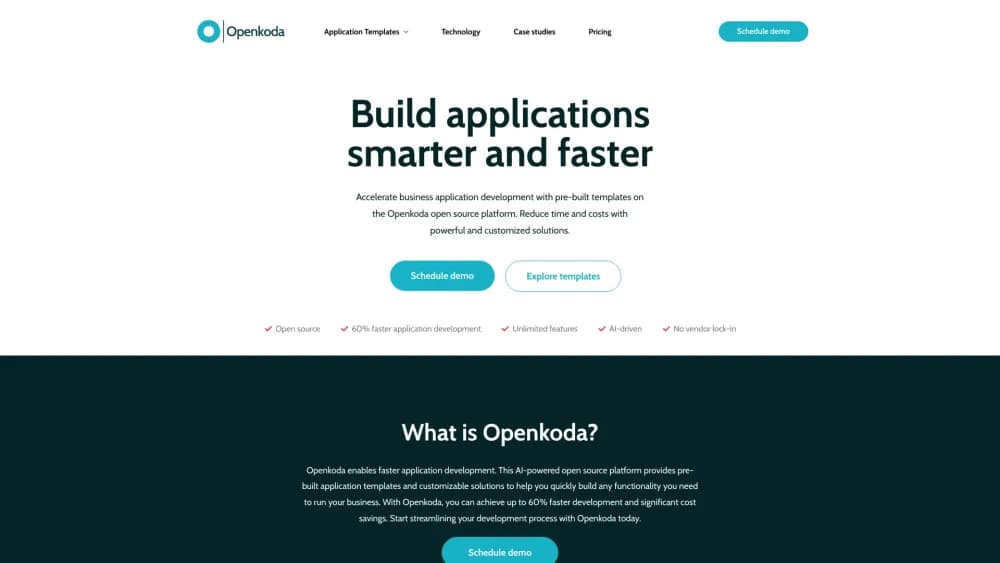
Openkoda is an AI-configurable insurance policy administration platform that covers quoting, policies, claims and billing on a flat monthly plan, managed or on-premise.
About Openkoda
What Is Openkoda
Openkoda PAS is insurance policy administration software for carriers. It puts product setup, rating, underwriting, policy administration, claims, billing, documents and reporting into one platform, then lets your own team change the setup through an AI product builder instead of a development project.
That focus separates it from general low-code tools. The project began as an MIT-licensed low-code framework on GitHub, and an open core is still published there. The commercial product you buy today, sold as Openkoda PAS, is a low-code insurance platform that's narrower and deeper: it ships with insurance modules, carrier workflows and templates for lines such as motor, home, travel, cyber, marine and life.
The limit is the flip side of that depth. Openkoda isn't a fit for a retailer building an internal app or a SaaS startup shipping a workflow tool. It's also priced for insurance operations, so a solo founder or a very small agency won't get far on the published plans.
Getting Started
- Book a demo and walk the team through your current stack, products and reporting needs.
- Use the five complimentary professional-services days to model your products, rates, rules and workflows with Openkoda's team.
- Configure the first product in the AI product builder. Describe coverages, pricing and rules in plain English.
- Review the before-and-after draft, approve it, and check the version history and audit trail.
- Connect portals, partner submission APIs and payment or email tools, then move the product into production.
Product Information
A quick look at Openkoda's pricing, supported platforms, and performance.
Best for
The users, tasks, and scenarios where this tool fits best.
Users
- Insurance product managers
- Underwriting and operations teams
- Insurers, MGAs and brokers with their own products
- IT and platform teams at carriers
Tasks
- Launching a new insurance line
- Repricing an existing book
- Running policy administration day to day
- Opening distribution to partners
Scenarios
- Replacing a legacy policy administration system
- Operating several brands or programmes
- Working under data residency rules
Key features
AI Product Builder
Describe a coverage, a price change or a workflow step in plain English and Openkoda drafts the configuration. You see a before-and-after comparison, approve or reject it, and every change lands in a version history with an audit trail. Business users can lead the work while a human stays in control of what ships.
Full Lifecycle Modules
Product, rating, underwriting, policy, claims, billing, documents and reporting come as one set. That matters at renewal time, when a rating change has to reach quotes, policies and billing without a data sync project. Carriers avoid paying for a stitched suite and a middleware layer between each part.
Client and Broker Portals
Policyholders get self-service forms for payments and claims, and brokers get a portal for submissions and quotes. Both are configurable to your brand, and the data behind them stays in your account. On Enterprise you can serve them from a custom domain.
Multi-Organization and Multi-Tenancy
Enterprise runs many brands, subsidiaries or partners from one deployment. Each organization gets its own products, users and reports, while your platform team keeps one upgrade path. That's the difference between launching a second brand in weeks and standing up a second stack.
Integrations and MCP Server
Per-form submission APIs let partners quote and bind from their own systems. Stripe handles card payments, Gmail and Office 365 cover email, and an MCP server gives AI tools a supported way to reach platform data. Custom integrations are available as a scoped service.
Managed Cloud With Export and Audit
Openkoda hosts the platform on high-availability infrastructure and handles backups, uptime checks and upgrades. Role-based access and a full audit trail are standard, and you can export your configuration and data at any time. If your regulator requires it, the same platform runs on-premise.
Pros and cons
Pros
- Published flat pricing with no per-seat, per-policy or percentage-of-premium fees, so cost doesn't rise when you hire or write more business.
- AI changes go through a human approval step and a version history, which keeps speed from turning into unaudited config drift.
- The whole quote-to-claim lifecycle sits in one platform and cuts the integration work that comes with a multi-vendor stack.
- Your configuration and data are exportable, and an on-premise option exists, so leaving the vendor doesn't mean losing the setup.
- Insurance-specific templates for motor, home, travel, cyber, marine and life shorten the first build.
Cons
- The $2,000 monthly floor with an annual contract rules out small agencies, pilot budgets and side projects.
- It only does insurance. Teams that want a general low-code platform for internal apps need a different tool.
- AI features cost extra, from $500 per month for 1,000 credits, and heavy use can push the bill past the platform fee.
- Customization beyond configuration is billed on time and materials, and implementation work past the first five days is quoted separately, so the real first-year cost runs above the list price.
Frequently asked questions
Openkoda runs insurance operations end to end. Teams configure products, rates and rules, then administer policies, claims and billing in the same system. It fits carriers, MGAs and brokers that want one platform instead of a stack of separate insurance systems.
Related content
Explore related tools, skills, and articles for Openkoda.
Openkoda Alternatives

Base Code
Base44 (Wix) · Coding · ProductivityBase Code is a shared cloud development environment from Base44. Teammates describe changes to an existing GitHub codebase in chat, preview them live and send them back as pull requests.

Google EmbeddingGemma 2
Google DeepMind · Writing · Image · CodingGoogle EmbeddingGemma 2 is a 740M-parameter open model that turns text, code, images, audio, and video frames into vectors in one 768-dimension space, running on phones and laptops.

GitGlow
GitGlow · Coding · ProductivityGitGlow is a local-first desktop Git client that lets independent developers review their own code and their AI agents' changes in one place before shipping.