

OpenSEO - AI Visibility
EveryApp · Coding · Marketing · Business
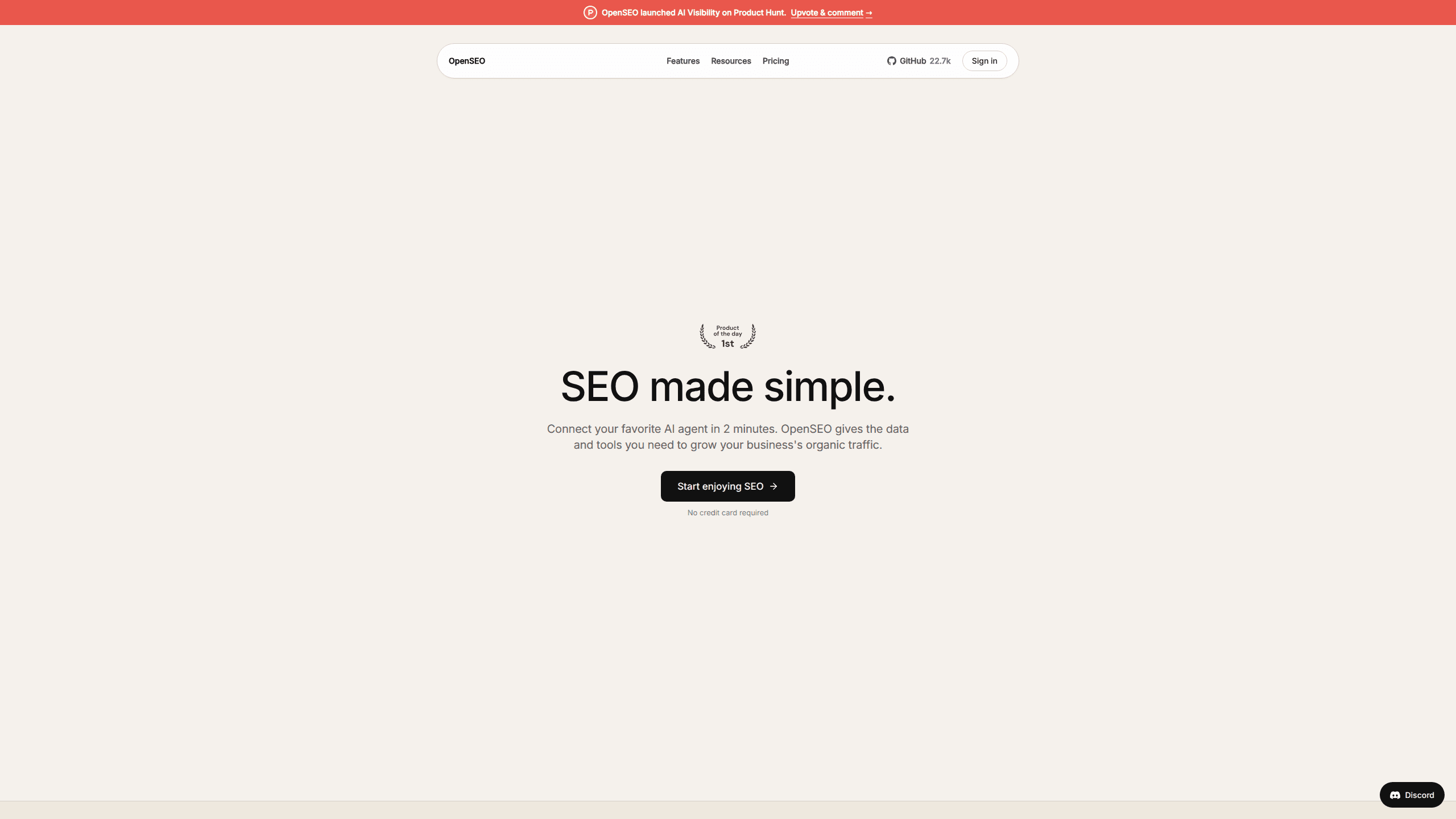
OpenSEO is an open source SEO platform for keyword research, backlinks, rank tracking, site audits, and AI visibility, with usage-based pricing and MCP access for AI agents.
About OpenSEO - AI Visibility
What Is OpenSEO
OpenSEO is a self-serve SEO platform built by EveryApp, a Y Combinator backed team. It covers the everyday research jobs a small site owner or agency actually runs: finding keywords, checking who links to a domain, watching positions, crawling for technical problems, and now watching how AI assistants describe a brand. The code is public under the MIT license, and search data comes from DataForSEO, a pay-per-call provider that also supplies several commercial tools.
The pricing model is the first thing most people notice. Instead of a fixed seat fee, each plan includes a monthly amount of usage, and every data lookup draws from that balance. Base is $10 a month with $10 of usage inside it, Pro is $30 with $36 of usage, and Agency is $200 with $240. You can also run the software yourself with your own DataForSEO key and skip the subscription entirely.
The limits matter as much as the features. You need a DataForSEO account if you self-host, and the platform is a browser tool with no mobile app. AI visibility only covers the engines and markets it supports, and it reads a sample of prompts rather than every conversation happening in ChatGPT. Treat it as a measurement of your tracked questions, not a window into all AI traffic.
Getting Started
- Open openseo.so and create an account with an email address. No card is needed for the trial, which comes with $0.50 of credits.
- Create a project for your site, then add the domain and, if you want first-party data, connect Google Search Console.
- Add two or three competitors to the project so domain, keyword, and AI answer comparisons have something to measure against.
- Pick a starting job: run keyword research from a seed topic, or open AI visibility and enter the questions buyers might ask about your category.
- Schedule collection weekly for the prompts you care about. Results land in the project, where you can export them or hand them to an agent over MCP.
Product Information
A quick look at OpenSEO - AI Visibility's pricing, supported platforms, and performance.
Best for
The users, tasks, and scenarios where this tool fits best.
Users
- Solo founders and indie hackers
- Content marketers at small companies
- Freelance SEO consultants
- Developers who want control
Tasks
- AI visibility checks
- Keyword research
- Backlink analysis
- Site audit
Scenarios
- A brand new site with no rankings
- A category where buyers ask AI for recommendations
- An agency running several client domains
Key features
AI visibility for ChatGPT, Gemini and Google AI Overviews
Type in a question your buyers might ask, and OpenSEO records the answer, notes whether your brand appears, and lists the pages cited. Running the same prompt on a schedule turns a one-off check into a trend line, so you can see whether a mention lasts. It reads the answers it collected, not all AI traffic, and that distinction matters when you report results.
Prompt research and scheduled collection
Prompt Explorer surfaces the questions people ask around a keyword, grouped by the model that answered them. You pick the ones worth tracking, preview the cost per run, then collect daily, weekly, or monthly in a chosen market. Cost preview before the run is the useful part, since AI checks bill per prompt per platform.
Keyword research with live SERPs
Start from a seed term and get ideas with volume, difficulty, CPC, and intent. A live SERP panel shows the current top results for a keyword, which is the fastest way to judge whether a page can compete. Clustering and saved keyword lists keep research from turning into a spreadsheet of loose ends.
Backlinks and domain overview
The backlink checker reports referring domains, link quality, and new or lost links over time. Domain overview estimates organic traffic and shows which keywords a competitor already ranks for, so you can find gaps rather than guess at them. Both views pull from DataForSEO, the same data layer several paid platforms resell.
Rank tracking and site audit
Rank tracking follows desktop and mobile positions for the keywords you choose and flags SERP features on the results page. Site audit crawls the domain, checks on-page and technical signals, and sorts issues by severity with a fix suggestion for each. Together they cover the maintenance work that keeps a site from quietly losing ground.
An SEO MCP server for your agent
OpenSEO runs an MCP server, so Claude, Cursor, Codex, or any other MCP client can call keyword, SERP, backlink, domain, rank, and Search Console tools directly. Agent work saves back into the project, which means you review findings in the interface instead of copying text out of a chat. Prebuilt skills cover setup, keyword research, competitor analysis, and audits.
Open source code you can deploy yourself
The repository is public under the MIT license, with setup paths for Docker on a local machine and Cloudflare for a shared deployment. Self-hosting removes the subscription, but you still pay DataForSEO for the data you request. For a team that wants its SEO tooling inside its own infrastructure, that option is the reason to pick this over a Semrush alternative with no export path.
Pros and cons
Pros
- Usage billing keeps a light month cheap, and top-up credits do not expire.
- AI visibility sits next to keyword, backlink, and audit data, so you compare answer coverage with rankings in one place.
- The MCP server lets an agent query live SEO data and save results back to a project.
- MIT licensed source code, with Docker and Cloudflare deployment guides.
- Google Search Console data is included at no usage cost.
Cons
- Every data lookup spends credits, so heavy research months cost more than the headline plan price.
- The data comes from DataForSEO rather than an in-house index, so you inherit that provider's coverage limits.
- AI visibility covers the supported engines and markets only, and it samples prompts rather than all AI conversations.
- No mobile app, and the workflow assumes you are comfortable working with an AI agent or a browser dashboard.
Frequently asked questions
OpenSEO is an SEO platform from EveryApp that covers keyword research, backlinks, rank tracking, site audits, and AI visibility. The source code is open under the MIT license, and the hosted version starts at $10 a month with usage included.
Related content
Explore related tools, skills, and articles for OpenSEO - AI Visibility.
OpenSEO - AI Visibility Alternatives

Base Code
Base44 (Wix) · Coding · ProductivityBase Code is a shared cloud development environment from Base44. Teammates describe changes to an existing GitHub codebase in chat, preview them live and send them back as pull requests.

Google EmbeddingGemma 2
Google DeepMind · Writing · Image · CodingGoogle EmbeddingGemma 2 is a 740M-parameter open model that turns text, code, images, audio, and video frames into vectors in one 768-dimension space, running on phones and laptops.

GitGlow
GitGlow · Coding · ProductivityGitGlow is a local-first desktop Git client that lets independent developers review their own code and their AI agents' changes in one place before shipping.