

OpenServ
OpenServ · Other
OpenServ puts a structured reasoning layer under your AI agents. You change the base URL in the OpenAI or Anthropic SDK and every call runs through bounded, schema-checked steps you can audit later.
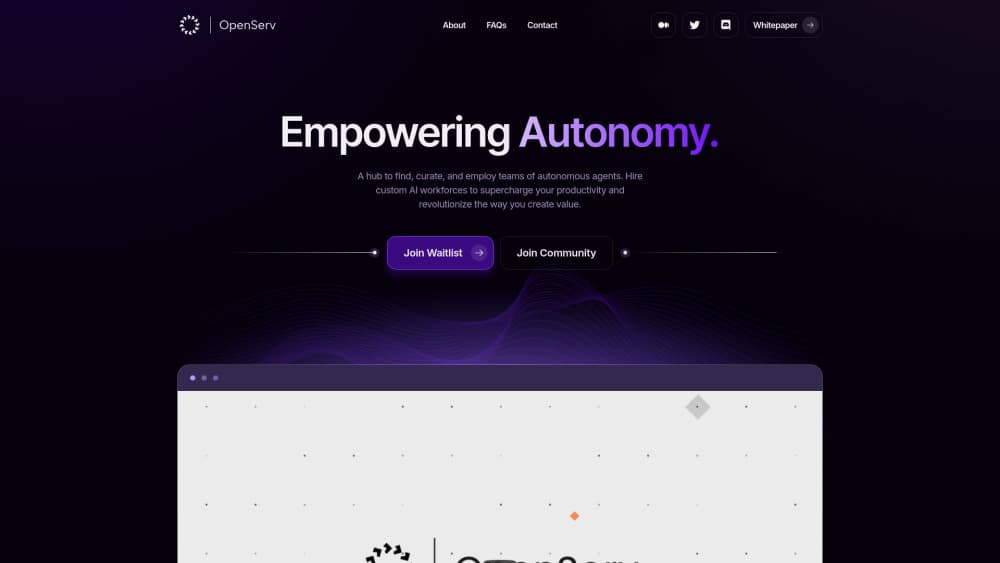
About OpenServ
What Is OpenServ
OpenServ is an AI agent infrastructure company. Its main product, the SERV Reasoning API, works as an LLM reasoning layer between your application and a language model, then rewrites each request into a structured reasoning graph before the model answers. The pitch is narrow and practical: fewer broken outputs, smaller bills, and a record of how each answer was reached.
The problem it targets is familiar to anyone who has shipped an agent. A demo that answers well once turns into a pile of retries and parse errors at production volume, because errors stack up across a long chain of model calls and each call bills tokens whether or not it helped. OpenServ's answer is to stop treating each call as free-form text generation and force it through defined inputs, defined outputs, and a validation contract. That makes it less a model wrapper and more an agent reliability platform, with the checks baked into the request path.
The limits matter too. You need a system prompt on every request or the API rejects it, so it is not a drop-in for sloppy prototypes. The catalog leans on OpenAI, Anthropic, and Google models, and several capabilities listed on the roadmap (graph sharding, private inference, SOC 2) were still in progress as of October 2026. OpenServ also runs on prepaid credits, so you cannot test forever without a card on file.
Getting Started
- Create an account at console.openserv.ai and pick the organization your keys will belong to.
- Open Billing, add a payment method, and buy a credit balance. Owners can also set a balance threshold and a monthly limit for auto top-up.
- Open API Keys, select Create secret key, name it, and copy the value right away, since the full key shows once.
- Point your existing OpenAI or Anthropic client at https://inference-api.openserv.ai/v1, pass the SERV key, and send the same request you already send. Compare the output against a direct model call in the Playground before you ship.
Product Information
A quick look at OpenServ's pricing, supported platforms, and performance.
Best for
The users, tasks, and scenarios where this tool fits best.
Users
- Backend developers running agents in production
- Platform engineers at banks, insurers, and public sector agencies
- Startup founders shipping an AI-native product
Tasks
- Stabilizing long multi-step workflows
- Cutting inference spend on high-volume jobs
- Producing decision records for regulated work
Scenarios
- A support agent that classifies and routes tickets
- Document review in a bank
- Evaluating before buying
Key features
Drop-In SDK Compatibility
The integration is a base URL and an API key. Your prompts, tool definitions, and application logic stay untouched, whether you use the OpenAI SDK, the Anthropic SDK, the Vercel AI SDK, or LangChain. It's an OpenAI compatible endpoint first, with an Anthropic messages route and a Responses route alongside it, so /v1/chat/completions, /v1/responses, and /v1/messages all map cleanly. For a team already in production, that means the migration cost is measured in hours rather than sprints.
Bounded Reasoning Graphs
Each task decomposes into steps with explicit dependencies, and every step carries a defined input schema, output schema, and validation contract. A model cannot wander off the path because the structure will not let it. In practice this is what kills most parse failures, and it also stops reasoning tokens from multiplying without limit, which is where a large share of agent cost usually hides.
Shadow Agents and Verification Hints
Shadow agents are separate reviewers that check a decision before it ships, so a hard task gets a validate-and-iterate loop instead of a single pass. Verification hints go further upstream and tell the agent what a correct answer should look like before it starts writing one. Both are opt-in through tool definitions, so you can apply the extra scrutiny to the handful of steps that need it rather than to every call.
One Endpoint, Many Models
The catalog spans OpenAI, Anthropic, and Google, with context windows up to 1M tokens and published per-million-token prices that already include the reasoning layer. You can route a routine extraction to a small model and a hard planning step to a larger one without holding three sets of credentials. Switching models is a string change in the request body, and sending different steps to different models is the simplest form of agent orchestration.
Audit Trails and Prompt Guard
Every decision, cost, and step shows up in one dashboard, and prompts plus customer data are not stored or used for training. PromptGuard screens incoming requests for injection attempts and outgoing text for system prompt leakage, with a content filter on by default. For teams building auditable AI agents in finance or the public sector, this is the part that gets a security review signed off.
Playground Benchmarking
The Playground runs any supported model with and without SERV Reasoning side by side, no code required. OpenServ also ships Benchmark Tooling so you can measure cost savings and reliability gains on your own workloads before integrating anything. Vendor benchmark claims deserve skepticism, and this setup at least lets you test them against your own prompts.
Pros and cons
Pros
- Integration is genuinely small: a base URL swap and a new key, with no rewrite of prompts or tool definitions.
- Schema-bound steps cut parse failures and retry loops, which is where agent budgets usually bleed out.
- Model coverage across three vendors with one key and one bill simplifies a stack that would otherwise need separate accounts.
- Audit trails and prompt-injection screening give regulated buyers something concrete to show reviewers.
Cons
- Billing runs on prepaid credits with no free tier, so evaluating the service means putting a card on file first.
- A system prompt is mandatory on every request, which rules out quick scripts and sloppy prototypes.
- Several advertised capabilities, including graph sharding and SOC 2, were still unfinished in late 2026, so compliance-sensitive teams may need to wait.
Frequently asked questions
OpenServ sells a reasoning layer for AI agents. Requests go to a SERV endpoint instead of straight to a model provider, and each one runs through a structured graph with schema checks, verification, and a recorded trail. The model still does the thinking, but the path it takes is constrained.
Related content
Explore related tools, skills, and articles for OpenServ.
OpenServ Alternatives

Odyssey 3
Odyssey · OtherOdyssey-3 is Odyssey's foundation world model. It simulates physics in real time, turns a prompt into an interactive environment, and adapts to robots, cars and games.

JarvisCore
Prescott Data · Coding · Productivity · OtherJarvisCore is an open source Python runtime where AI agents work as equal peers on an agent mesh, claim tasks from a shared ledger, and reach external services through a zero-trust broker.
Clef
Cloudflare · Business · OtherClef is Cloudflare's open-source decision model for Workers AI. It returns calibrated probabilities for typed questions, not generated text, so agents can classify, route, and act fast.