
Optionsfy
Optionsfy · Coding · Business
Optionsfy is an AI options picker that scans the full options chain, ranks setups with its HotScore model, and emails daily ideas with tickers, strikes, and expiration dates.
About Optionsfy
What Is Optionsfy
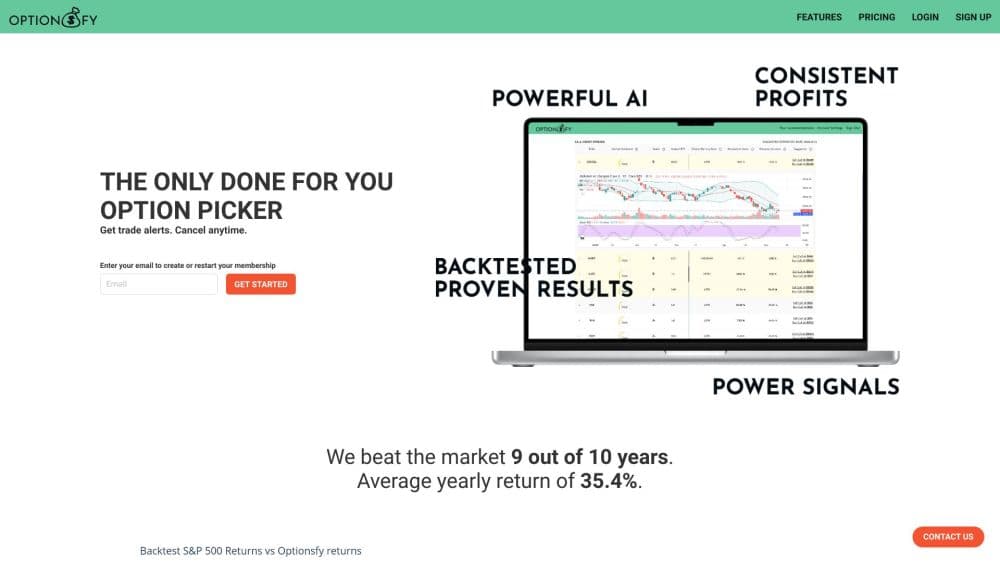
Optionsfy is AI options trading software, sold as a monthly or annual subscription. It doesn't run trades for you. Each market morning it sends an email with the symbols it likes, the strikes to use, the expiration to pick, and the strategy that fits. The company says the picks come from an algorithm trained on 10 years of market data and weighted by 10 factors its team found useful. The people behind it describe themselves as former quants with 37 combined years on trading desks.
The problem it targets is decision fatigue at the options chain. A single stock can list dozens of expirations and hundreds of strikes, and picking the wrong strike turns a correct market call into a loss. Optionsfy narrows that list to a handful of trades and writes out the strike and expiry for each, so the work left is placing the order and managing the exit.
The limits matter before you pay. Optionsfy is a signal service, not a broker. You place every order yourself, at your own broker, with your own risk controls. There's no free tier, so you can't sample the alerts before subscribing. Performance figures such as the 35.4% average yearly return come from the company and aren't audited by an outside firm. And like any options service, the disclaimer is blunt: trading options carries a substantial risk of loss, and the emails count as educational research, not personal investment advice.
Getting Started
- Choose a plan on the pricing page: $99 per month, $497 per year, or $997 once for lifetime access.
- Enter your email to create the account. Alerts arrive at that address, so use one you check before the opening bell.
- Open the morning email when the market opens. Each idea lists the ticker, the strategy, the strike, and the expiration.
- Check the trade against your account size, your options approval level, and your own thesis, then place the order at your broker.
- Track the position yourself and exit on your rules. Optionsfy doesn't manage the trade after the alert.
Product Information
A quick look at Optionsfy's pricing, supported platforms, and performance.
Best for
The users, tasks, and scenarios where this tool fits best.
Users
- Self-directed options traders who already place their own orders
- Beginners who've read about options but freeze at the chain
- Traders with a day job
Tasks
- Picking a strike and expiration for a directional view
- Selling premium for income
- Trading around earnings
- Planning a position over months
Scenarios
- Ten minutes before the open
- A quiet week with no strong view
- Reviewing your process once a month
Key features
Daily Options Recommendations
The core of the service is one email per trading day with specific trades: symbol, strategy, suggested strike, and expiration. You don't get a watchlist to interpret. You get a filled-in trade ticket you can copy into your broker. Each idea also carries the reasoning behind it, which is what separates a usable alert from a ticker dump.
HotScore Ranking
HotScore is Optionsfy's own scoring model. It pulls data from several sources and turns them into one number per trade, so ideas can be ranked instead of listed. Higher scores mark the setups the model expects to work best. The site doesn't explain the score in detail, so treat it as a shortlist tool rather than a guarantee.
Options Chain Scanning
The options chain scanner reads every strike and expiration in a chain, then works through the combinations before the market opens. That matters on liquid names where the chain runs to hundreds of contracts. The output is the small set of trades worth a look, which is the part most people skip when they trade by hand.
Eight Strategy Playbooks
The service covers eight setups: buy call, buy put, sell put, covered call, debit call spread, debit put spread, call credit spread, and put credit spread. That range matters because it covers both directions and both sides of the volatility trade. Beginners can stay with single legs, while income traders can use the credit spreads.
Grading System and Proprietary Indicators
Each recommendation comes with a grade and a set of indicators the company built itself. The grade is a quick filter for how strongly the model backs a trade. The indicators add context that a bare strike price can't give, such as whether the setup depends on a move or on time passing.
Pre-Earnings Strategies and Price Forecasts
Ahead of earnings, Optionsfy suggests strategies built for the event, which usually means positions that profit from implied volatility falling after the report. The plan also includes stock price predictions for 3, 6, and 12 month periods, useful when you want to hold a thesis longer than a single expiry.
Research Notes and Monthly Reviews
Alongside the alerts, subscribers get daily news on major market stocks, regular research insights, and a monthly portfolio review from an analyst. These are the parts that help you judge whether the alerts fit the current market, instead of taking each trade on faith.
Pros and cons
Pros
- The output is specific. You get a ticker, a strike, and an expiration, not a vague note to watch financials.
- Eight strategies cover income, direction, and volatility, so the same subscription serves a covered call seller and a directional buyer.
- The annual plan at $497 works out far below twelve months at $99, a $691 saving by the company's own math.
- Alerts land at the market open, which fits a schedule that doesn't allow all-day screen time.
- Lifetime access at $997 removes the recurring bill for anyone who plans to stay a subscriber.
Cons
- There's no free plan. You pay $99 for the first month before you see a single alert, and a trial only comes with a promo code.
- Optionsfy doesn't connect to a broker. Every order is manual, which adds slippage and delay on fast moves.
- The 35.4% yearly return and the 9-out-of-10 record are company claims with no independent audit behind them.
- There's no public API or mobile app, so options trade alerts arrive by email and the website is the only interface. Support is a contact form, thin for a service that handles money and open positions.
Frequently asked questions
One email each trading day with specific options trades: the ticker, the strategy, the suggested strike, and the expiration. It also includes a grade, proprietary indicators, and a short rationale for each idea.
Related content
Explore related tools, skills, and articles for Optionsfy.
Optionsfy Alternatives

Base Code
Base44 (Wix) · Coding · ProductivityBase Code is a shared cloud development environment from Base44. Teammates describe changes to an existing GitHub codebase in chat, preview them live and send them back as pull requests.

Google EmbeddingGemma 2
Google DeepMind · Writing · Image · CodingGoogle EmbeddingGemma 2 is a 740M-parameter open model that turns text, code, images, audio, and video frames into vectors in one 768-dimension space, running on phones and laptops.

GitGlow
GitGlow · Coding · ProductivityGitGlow is a local-first desktop Git client that lets independent developers review their own code and their AI agents' changes in one place before shipping.