

Opttab
Opttab · Other
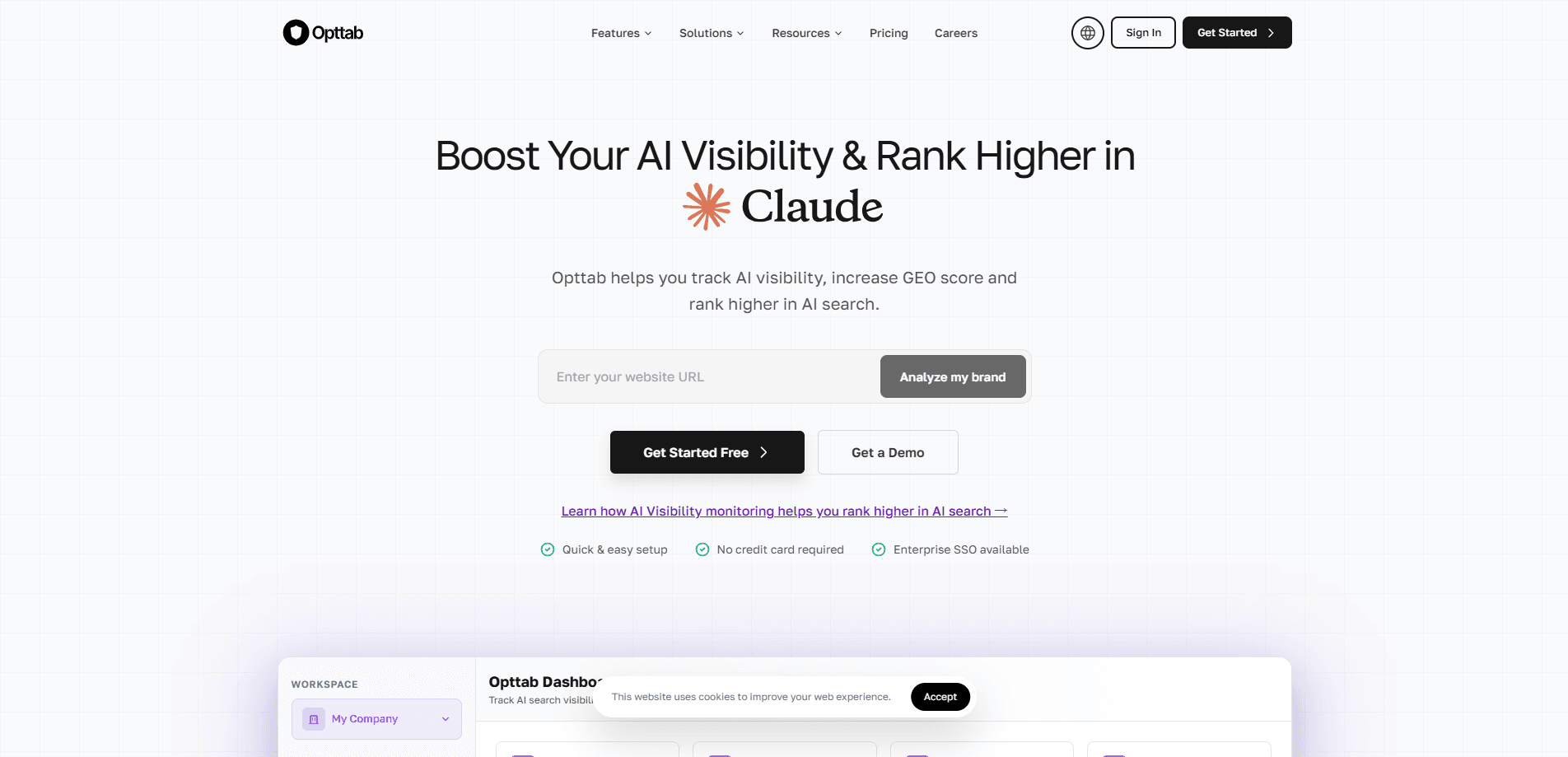
Opttab is an AI visibility and Generative Engine Optimization platform that shows whether your brand shows up in answers from ChatGPT, Gemini, Claude, Perplexity, and Google AI Mode, then gives you the actions to climb higher. It combines prompt tracking, citation and sentiment analysis, content generation, and technical GEO workflows in one dashboard. Marketing teams, agencies, and SaaS brands use it to treat AI search as a real growth channel instead of a mystery that nobody on the team can measure or explain.
About Opttab
What Is Opttab
Opttab is a web-based AI visibility platform built for marketers who care about how large language models describe their brand. It tracks the prompts people actually type into AI assistants, records whether your product gets mentioned, and scores the quality of those mentions. You don't need a research background to read it. Plug in your URL, and the tool builds a baseline.
The problem it solves is straightforward. Traditional rank trackers tell you where you sit on a search results page, but AI answers don't work that way. A model can mention you in one prompt, ignore you in the next, and cite a competitor instead. Opttab watches that behavior across models and languages, so you can see exactly where the gap is, why a competitor got mentioned instead of you, and what to change to close it. It's one of a growing set of AI visibility tools that treat AI search optimization as its own discipline.
The biggest limitation is scope. It's a paid business platform, not a free consumer tool, and the deeper features like automated content and backlink workflows sit behind higher tiers that you'll need to pay for. If you're a solo blogger or just curious, the free visibility report is a taster, not the full product.
Getting Started
- Sign up at app.opttab.com and connect your brand by entering your website URL.
- Pick the prompts that match how your customers search, or let the Prompt Generator suggest them from your niche.
- Choose the AI models to track, from ChatGPT and Gemini on the Lite plan up to Copilot and Meta AI on Growth and Enterprise.
- Review your visibility score, citations, and sentiment in the dashboard, then work through the suggested GEO actions.
- Use Content Studio to draft articles and structured pages built to be cited by AI answers, then publish and re-track.
Product Information
A quick look at Opttab's pricing, supported platforms, and performance.
Best for
The users, tasks, and scenarios where this tool fits best.
Users
- SEO and content teams shifting budget toward AI search
- Marketing agencies managing multiple clients
- SaaS and ecommerce brands losing clicks to zero-click answers
Tasks
- Tracking brand mentions across models
- Generating AI-ready content
- Automating GEO actions
Scenarios
- Launching a new product
- Auditing a competitor's AI presence
- Reporting monthly to your team
Key features
AI Visibility Tracking
This is the core of the platform. Opttab runs your prompts against multiple AI models and records every mention of your brand, then scores how prominent and positive those mentions are. You get a visibility score that moves as you publish and improve, so you can tell whether your GEO effort is actually working.
Prompt Volume and Prompt Generator
You can't win prompts you don't know about. Prompt Volume estimates which queries carry commercial weight, and the Prompt Generator suggests relevant prompts based on your site and niche. For a marketing team, that's the difference between guessing and tracking the questions that bring buyers.
GEO / AEO Workflows
GEO stands for Generative Engine Optimization, and it's the practice of making your content the one an AI model quotes. Opttab bundles the technical side, like structured content and bot pages, with described actions you can assign and run. The automation matters if you manage several brands and don't have time to chase every fix by hand. No spreadsheet required.
Content Studio
Content Studio generates articles and pages written to be cited by AI assistants, not just read by humans. Plans cap output at 2, 10, or 40 articles a month depending on tier, and you can import existing pieces to restructure them. A word of caution: generated content still needs a human editor, especially for brand voice. Thin output helps nobody.
Agent and Crawler Analytics
Opttab tracks how AI crawlers and agents actually hit your site, including which pages they pull and how they move through your funnel. Website analytics and funnel conversion views show whether AI traffic turns into signups, which is the number most teams really want. In short, it connects AI visibility to revenue. That link matters.
AI Commerce and AI Ads
For ecommerce brands, AI Commerce tracks how products surface in AI shopping answers, and AI Ads covers how paid placements behave in AI surfaces. Is any of that worth paying for yet? The honest answer is that it depends on your category. It's a newer area of the category, and coverage varies by plan and model, so treat the numbers as directional rather than definitive.
Integrations and API
Opttab connects to your existing stack and offers API and MCP access on eligible plans. Developers can pull visibility data into their own dashboards, while MCP access makes it usable inside agent tools. Integration depth depends on your tier, from what I gather, so confirm before you commit.
Pros and cons
Pros
- Covers the major answer engines, from ChatGPT, Gemini and Claude to Perplexity, Grok and Google AI Mode.
- Combines tracking with execution, so you don't just see the problem, you get a workflow to fix it.
- Prompt and content tooling in one place cuts the number of separate tools you pay for.
- Free visibility report lets you test the platform before spending anything.
- Scales from single-brand teams up to Enterprise with custom prompts and responses.
Cons
- Public pricing isn't listed on the site, so you'll need a sales conversation for real numbers.
- The most valuable auto-content and backlink features sit behind higher tiers and article caps apply.
- Automated content still needs editing, and thin output won't help AI visibility anyway.
- Model and country coverage differs by plan, which can frustrate brands tracking many markets.
Frequently asked questions
It tracks how AI models like ChatGPT and Gemini mention your brand in their answers, then gives you content and technical actions to improve those mentions. Think of it as rank tracking rebuilt for AI search. Simple idea. Real work behind it.
Related content
Explore related tools, skills, and articles for Opttab.
Opttab Alternatives
BinkBink
BinkBink · OtherBinkBink is a free online game platform and AI game maker that lets anyone turn a short text description into a playable browser game. You can jump into hundreds of community-made games. Or describe your own idea and play it in seconds, then share it with friends. Want to create your own game? You don't need to code. No engine setup, no download, no hassle.

Audiogen
Audiogen Inc. · OtherAudiogen is an AI music generator built by Audiogen Inc., a small research team that spent about 2.5 years training its own generative music model and designing a web interface around it. Instead of a plain text box, this AI music tool turns the timeline into a beginner-friendly Generative Audio Workstation, or GAW, where inpainting, extending, remixing and stem editing work more like painting on a canvas. The product is still in beta, so access runs through a waitlist or an invite. Paid plans aren't published yet.

Aiml API
AIMLAPI OÜ · OtherAiml API is a unified AI model API that puts more than 1000 models from OpenAI, Google, Anthropic, and others behind one endpoint and one bill. You write code against a single OpenAI-compatible schema, then switch between chat, image, video, and audio models by changing a model string. It suits developers and small teams who want multi-model access without juggling a dozen separate provider accounts, and it removes the usual billing headache that comes with testing several vendors. One key covers it all.