

Ora.ai
era labs · Coding · Chatbot
Ora.ai is an agent readiness scanner that scores how well AI agents can find, read, and use a website, tests it with live agents, and ranks products on a public leaderboard.
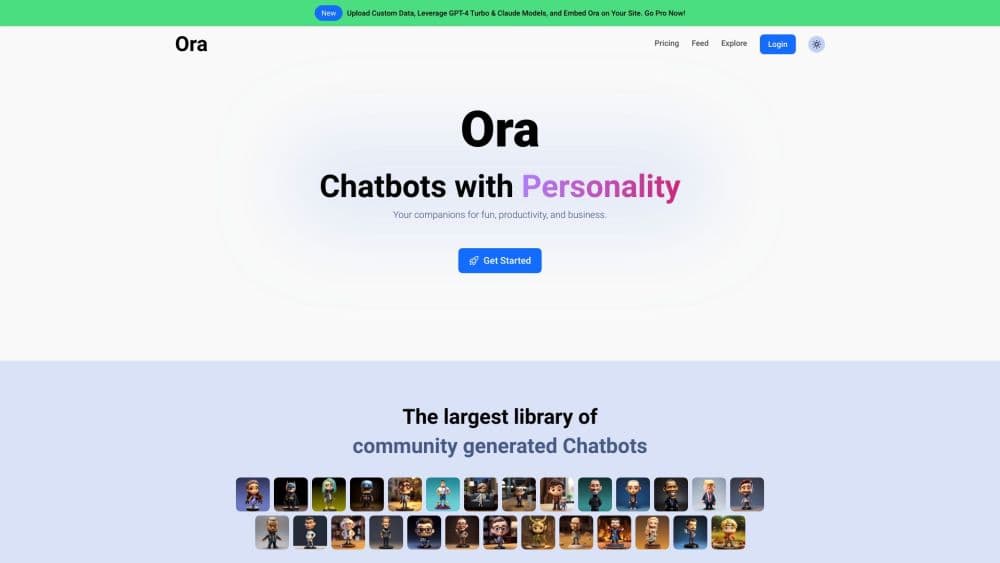
About Ora.ai
What Is Ora.ai
Ora.ai is a web platform that measures agent experience, the shorthand it uses for how easily an AI agent can discover a site, understand it, act on it, and pay through it. You point it at a domain, an MCP server URL, or an MCP App, and it returns a score from 0 to 100, a letter grade from A to F, and a breakdown of where the site stalls.
The idea is simple. Businesses spent years tuning sites for humans, with search rankings and funnels built around clicks. Agents don't browse that way. They reason, parse structured data, and call APIs, and when they hit a wall they move on to the next product that works. Ora exists to show a team where that wall is.
The main limit is scope. Ora only reads public URLs. It can't scan private or internal sites, or anything sitting behind a login, so the score reflects what a product exposes in the open, not what it does in a closed demo.
Getting Started
- Enter your domain on the Ora.ai home page, or pull a cached score first with a single request to the score endpoint.
- Run a fresh scan and wait about 30 seconds for the four-layer result to build.
- Read the failing checks in the report, each tagged by the layer it belongs to, and fix the ones ranked highest by impact.
- Watch a Journey run, where a real agent attempts a task on the domain and records every step it takes.
- Wire the same scan into your workflow through the MCP server or the
npx ax auditcommand, then rescan to confirm the fix.
Product Information
A quick look at Ora.ai's pricing, supported platforms, and performance.
Best for
The users, tasks, and scenarios where this tool fits best.
Users
- Product and marketing teams
- Developers building MCP servers or APIs
- SEO and growth specialists
- Founders and indie makers
Tasks
- Auditing a website for agent readiness
- Scoring an MCP server
- Watching a real agent attempt a task
- Benchmarking against competitors
- Adding an agent check to CI
Scenarios
- A product team preparing for launch
- A developer debugging a tool integration
- A marketer tracking visibility over time
Key features
Agent Readiness Score with Four Layers
Ora breaks agent readiness into four layers: Discovery, Access, Usability, and Payments, then normalizes them to a 100 point scale. Each layer maps to a real step an agent takes, from finding the product to completing a payment. The breakdown shows which stage of the journey is failing, rather than leaving you with a single low score and no direction.
Journey Runs with Live Agents
Journey points a real agent at a domain with an intent you choose, then records every step: what it found, where it stalled, and whether it finished. Instead of a static checklist, you watch an agent try the product and see the trajectory as a stream. This is the closest thing to a firsthand test of how your site behaves for an agent.
Free REST API and MCP Server
Every scan, score lookup, and leaderboard read is open over a REST API that needs no key. The same capability ships as a streamable HTTP MCP server, so a coding agent can scan a product, read each failing check, and rescan after a fix. Writes, like agent feedback, are MCP only and verified first.
ax CLI for Terminal and CI
The npx ax audit command runs the same scan from a terminal and prints what to fix, ranked by impact. It supports auditing a localhost build over your own tunnel, and a minimum-score flag that gates a release in CI. For developers, this turns agent readiness into a repeatable step in the build.
Public Leaderboard and Directory
Ora publishes a ranked leaderboard of products by agent readiness, filterable by category, plus a searchable directory of agent ready products, MCP servers, docs, and paid capabilities. The directory also indexes pay per call endpoints, so agents can find services they can actually pay for.
Intent Based Product Discovery
Through the discover endpoint, you describe a task or a category and get products ranked by their agent experience score. Discovery works both ways: a product owner sees where they rank for a given intent, and an agent gets a shortlist of options that fit the job.
Pros and cons
Pros
- The free tier is genuinely open: no API key, no credit card, and no signup for reads, so you can audit a site in minutes.
- The four-layer scoring turns agent visibility into specific, actionable checks instead of a single opaque number.
- Journey runs use live agents rather than a static checklist, so the feedback reflects how agents actually behave on the site.
- The MCP server and the ax CLI put the same checks in a coding agent or a CI pipeline, which fits developer workflows.
- A public leaderboard and directory give a clear benchmark against competitors in the same category.
Cons
- Scans cover public URLs only, so private, internal, or login gated pages can't be scored, which leaves some products out.
- A fresh scan takes around 30 seconds, and deep checks that use live agents resolve asynchronously afterward, so results aren't instant.
- Contribute features such as agent feedback are MCP only, so teams without an MCP capable client have to set one up first.
- The platform measures readiness but doesn't fix the site for you, so the actual work still falls on your team.
Frequently asked questions
Ora.ai scores how ready a website is for AI agents. It scans a domain or an MCP server and returns a 0 to 100 score, a letter grade, and a four-layer breakdown of discovery, access, usability, and payments.
Related content
Explore related tools, skills, and articles for Ora.ai.
Ora.ai Alternatives

Base Code
Base44 (Wix) · Coding · ProductivityBase Code is a shared cloud development environment from Base44. Teammates describe changes to an existing GitHub codebase in chat, preview them live and send them back as pull requests.

Google EmbeddingGemma 2
Google DeepMind · Writing · Image · CodingGoogle EmbeddingGemma 2 is a 740M-parameter open model that turns text, code, images, audio, and video frames into vectors in one 768-dimension space, running on phones and laptops.

GitGlow
GitGlow · Coding · ProductivityGitGlow is a local-first desktop Git client that lets independent developers review their own code and their AI agents' changes in one place before shipping.