

Overcut
Overcut · Coding
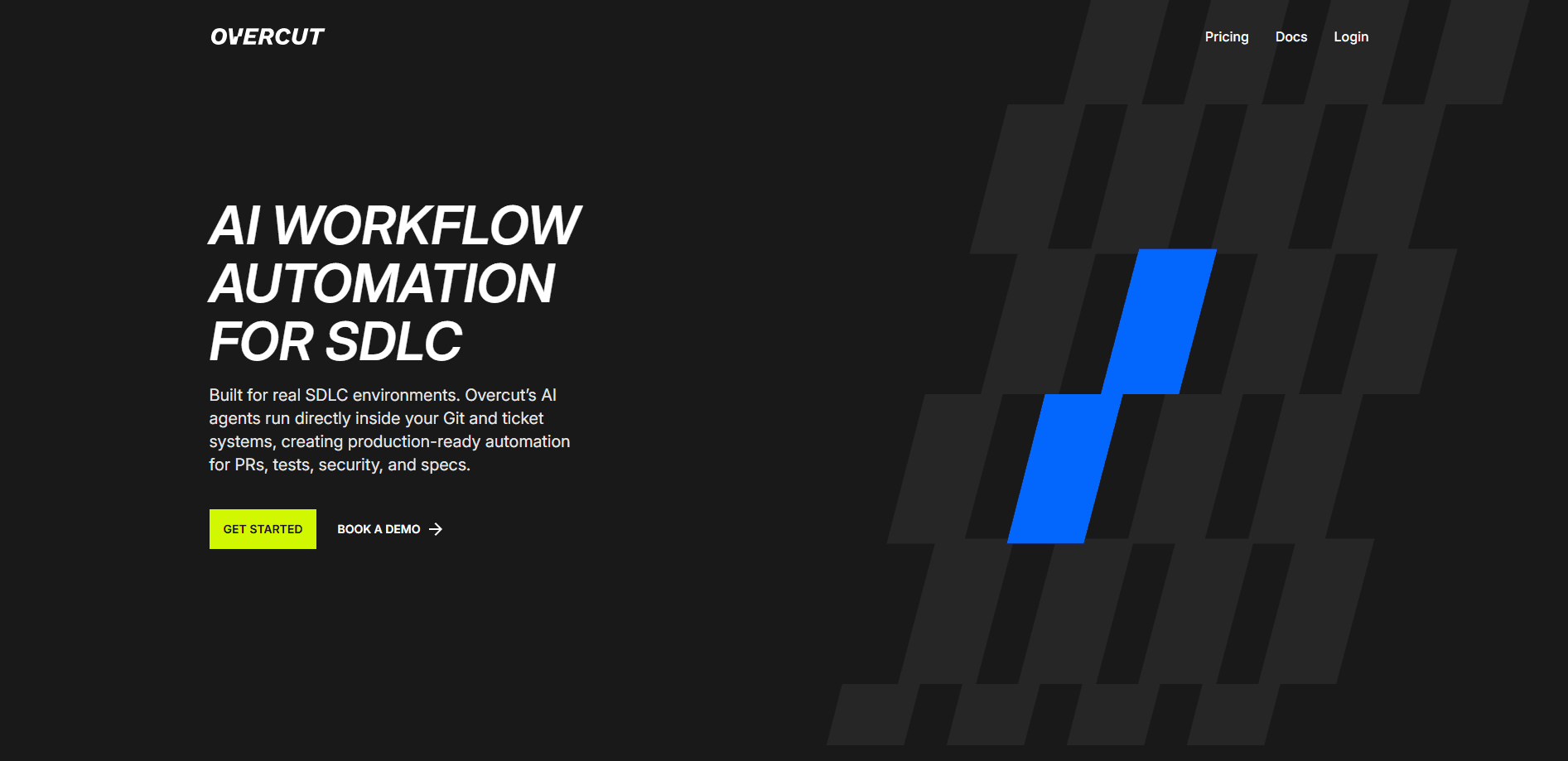
Overcut is an AI agent orchestration platform that puts autonomous agents to work inside your software delivery pipeline. It connects to the tools your team already uses, like GitHub, GitLab, Jira, Azure DevOps, and Slack, then runs event-driven agent workflows for code review, ticket triage, release notes, and more. Every run is permissioned, sandboxed, and logged. It's built for engineering teams that want automation without handing over control. Think of it as AI code review automation plus a lot more.
About Overcut
What Is Overcut
Overcut is the control plane for what its maker calls a software factory. Instead of a single copilot suggesting lines of code, it coordinates multiple AI agents across the whole development lifecycle. You define a workflow, it fires on a real event (a pull request, a new ticket), the agents do the work inside guardrails, and results land back in your systems of record. The pitch is an agentic SDLC: agents that carry work through to a verified outcome.
The problem it targets is tool sprawl. Most engineering teams juggle a dozen services, and a lot of work between them is repetitive: reviewing diffs, sorting incoming tickets, writing release notes, tracking down root causes. Overcut's agents plug into those gaps and handle the routine portion, which the vendor says adds up to faster pull request cycles over time. That's the promise of AI workflow automation. Whether it holds depends on your setup.
The catch is scope. This is enterprise infrastructure, not a weekend tool. There's no public free-forever tier beyond a limited sandbox, the paid plan starts at $500 per month, and the advanced controls assume you have a platform team to configure them. That's a steep entry point. Genuine uncertainty here: public benchmarks for AI coding agents vary so widely that vendor figures like "10x development cycle" should be read as marketing, not a measured outcome.
Getting Started
- Create an account at app.overcut.ai and connect your first repository and issue tracker from the free tier.
- Pick a playbook from the ready-to-run catalog, such as code review or ticket triage, or start building a custom workflow.
- Set the triggers, steps, agents, and severity thresholds so the run matches how your team actually works.
- Execute the workflow on a real event and review the audit trail to confirm the guardrails behave as expected.
- Upgrade to the Team or Enterprise plan once you're ready to scale executions across projects.
Product Information
A quick look at Overcut's pricing, supported platforms, and performance.
Best for
The users, tasks, and scenarios where this tool fits best.
Users
- Platform engineering teams
- DevOps and release managers
- Development leads at growing companies
Tasks
- Automated code review
- Ticket triage
- Release notes generation
Scenarios
- A team drowning in pull requests that sit unreviewed for days
- A release that needs a changelog by morning
- An enterprise rollout where security wants proof of control
Key features
Event-Driven Agent Workflows
Overcut runs at the workflow level, not the chat level. A real event, like a pull request or a new ticket, starts a run, and agents carry it through defined steps before outcomes flow back to your systems of record. That makes the automation predictable: the same trigger produces the same structured process every time. It's a software factory, not a chatbot.
Ready-to-Run Playbooks
The platform ships 18 production-ready playbooks covering code review, ticket triage, root cause analysis, CVE remediation, documentation, release notes, and test coverage. Each one deploys in minutes against repositories and trackers you already have. New ones get added regularly, so you're not starting from a blank page. Pick one. Run it today.
Playbooks Defined as Code
Every playbook is configuration you can edit, not a locked black box. You can change its triggers, steps, agents, and thresholds, or build a workflow from scratch when none of the shipped templates match your process. That flexibility is what separates it from a fixed SaaS integration.
Multi-Tool Orchestration
One control plane spans GitHub, GitLab, Bitbucket, Azure DevOps, Jira, CI/CD systems, and Slack. Agents work across all of them in a single run, which means you don't have to stitch together separate automations for each service. The result flows back to whichever system you treat as the source of truth. For autonomous agents for developers, that reach is the whole point. No manual handoffs. No copy-paste between tabs.
Enterprise Guardrails and Audit Trails
Every agent run is permissioned, sandboxed, and verified, then written to an audit trail you can trace. The Enterprise tier adds single sign-on, centralized billing, private LLM integration with your own keys, and self-hosted or on-premises deployment. For regulated teams, that's often the deciding factor. What happens when an agent touches production code? You'll want an answer on file.
Pros and cons
Pros
- Runs across the full development lifecycle instead of stopping at code suggestions.
- 18 shipped playbooks mean most teams can deploy something useful on day one.
- Workflows are editable code, so you can tailor triggers and thresholds to your process.
- Enterprise tier supports self-hosting, SSO, and bring-your-own-LLM keys.
- Unlimited users on every plan, including the free tier.
Cons
- The Team plan costs $500 per month, which rules it out for solo developers and small side projects.
- The free tier caps you at 10 workflow executions per month, so it's really an evaluation sandbox rather than a working setup.
- No public API documentation surfaced on the site, so programmatic integrations stay unclear until you talk to sales.
- The heaviest controls (self-hosting, private LLM) are locked behind a custom Enterprise quote.
Frequently asked questions
Overcut runs autonomous AI agents inside your software development workflow. It connects to your repositories, issue trackers, and chat tools, then executes event-driven tasks like code review, ticket triage, and release notes generation under configurable guardrails.
Related content
Explore related tools, skills, and articles for Overcut.
Overcut Alternatives
Forefront
Forefront · CodingForefront is a web platform for building with open-source AI. It lets you fine-tune leading open-source language models on your own data, evaluate how they perform, and run them through an API or export them to host yourself. Developers who want the convenience of a closed-source platform but insist on owning their models and data are the target audience here.

Startkit
StartKit.AI · CodingStartkit is a boilerplate for building AI SaaS and AI wrapper products. Think of it as an AI startup boilerplate with the boring parts already wired up: authentication, Stripe and Lemon Squeezy payments, usage limits, transactional email, and an AI API starter that talks to OpenAI, Anthropic, Groq, or Llama. You clone the repo, set your price, and start on the part of your product that people actually pay for. It's Next.js under React and Tailwind, so most of the boilerplate code already feels familiar.
Testim
Tricentis · CodingTestim is an AI-powered test automation platform for building and running end-to-end tests across web, mobile, and Salesforce applications. It leans on machine learning to keep tests stable when an interface changes, so teams spend less time fixing broken selectors. Not bad for an automated testing tool you can start using today. You create tests by recording actions in a browser, then optionally add JavaScript when you need more control. It's a solid pick for busy QA teams.