

Oxlo.ai
Oxlo.ai · Coding
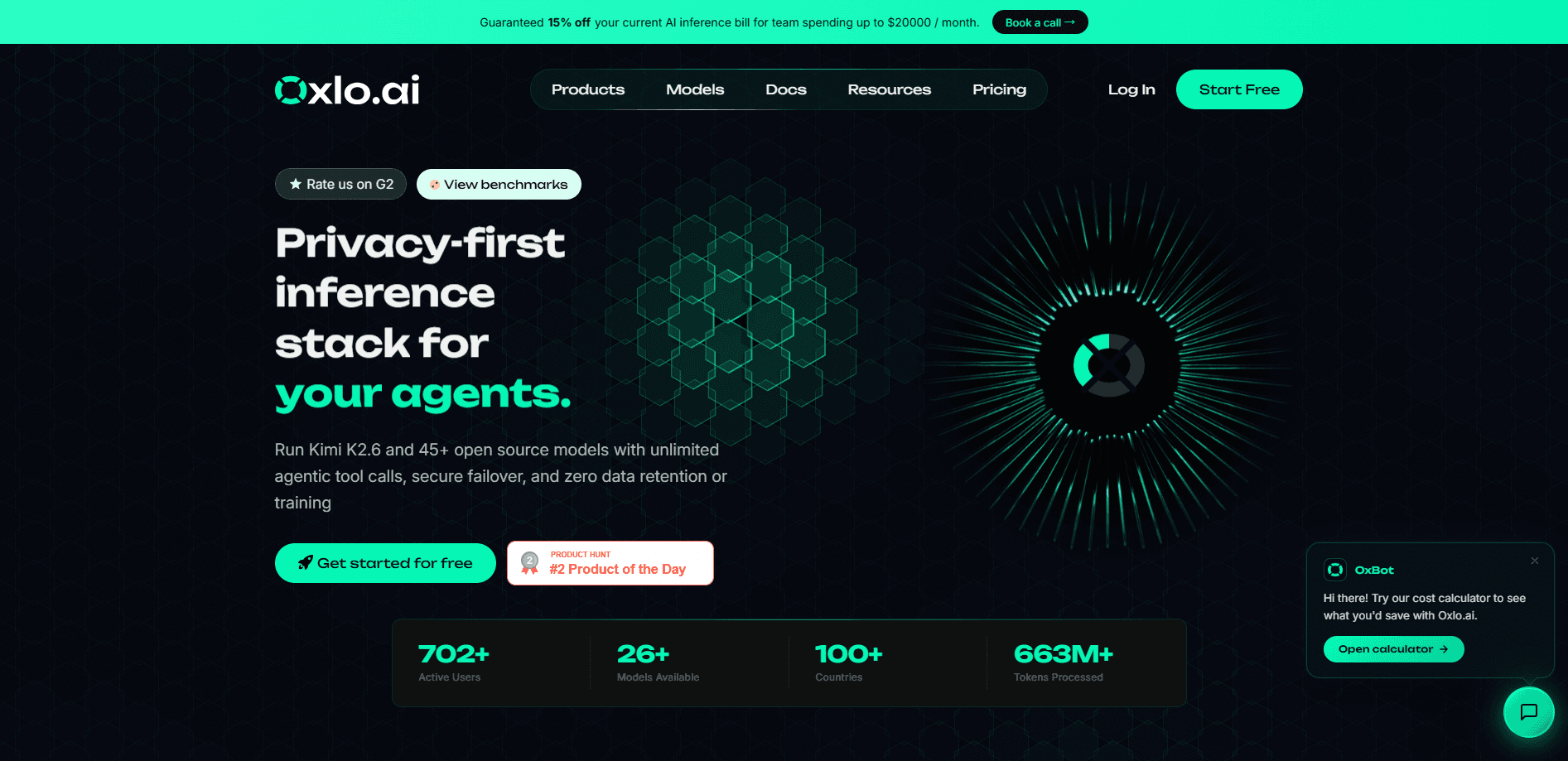
Oxlo.ai is a privacy-first AI inference platform that lets you run more than 40 frontier open models through a single OpenAI-compatible API. Instead of counting tokens, it charges per request, which makes costs easier to predict when you're shipping an app. It supports streaming and tool calling, and it targets teams that want production-grade reliability without managing GPUs.
About Oxlo.ai
What Is Oxlo.ai
Oxlo.ai is an AI inference platform, which means it hosts large language models and serves them to you over an API. You don't download weights or rent servers. You send a request, you get an answer back. The pitch is simple: pick from 40+ frontier open models, keep your existing OpenAI SDK code, and pay a flat fee per request instead of tracking every single input and output token across long sessions.
The main problem it solves is cost anxiety. Most inference providers bill by token, so a long chat session or a big document can quietly blow past your budget before you notice the meter running. Request-based pricing flips that around. You know what a call costs before you make it. For hobby projects this barely matters. For anything with real traffic, predictable bills are a big deal.
The trade-off to keep in mind is that tokenless billing is only a win when your requests stay reasonably sized. If you routinely push 100k-token prompts through an LLM inference platform that charges by the call, a per-request model can end up costing far more than a per-token one, and you should run your own numbers before committing to it. Oxlo.ai also markets itself as privacy-first, so data-handling terms are worth reading closely if you're working with sensitive content.
Getting Started
- Create an account on the Oxlo.ai site and generate an API key from the dashboard.
- Point your existing OpenAI client at the Oxlo.ai base URL and paste in the key. Most code needs nothing else.
- Choose a model from the supported list by setting the
modelfield in your request. - Send a test call with streaming enabled to confirm latency and output look right for your use case.
- Move the key into your production environment and monitor usage before scaling traffic.
Product Information
A quick look at Oxlo.ai's pricing, supported platforms, and performance.
Best for
The users, tasks, and scenarios where this tool fits best.
Users
- Indie developers
- Startups shipping AI features
- Teams that need open models
Tasks
- Chatbots and assistants
- Agent workflows
- Prototyping model choices
Scenarios
- Launching an MVP on a tight budget
- Migrating off a token-metered provider
- Running privacy-sensitive workloads
Key features
One API for 40+ Open Models
The draw here is breadth without extra integration work. You keep a single LLM inference endpoint and switch models by changing one field. That means you can test a cheaper model for drafts and a stronger one for final answers, all in the same codebase.
Request-Based (Tokenless) Pricing
Oxlo.ai bills per request rather than per token. Your invoice tracks calls made, not characters processed, which is far easier to forecast. The catch is that value depends on how large your prompts and completions run. Short calls win. Huge ones don't.
OpenAI-Compatible API
Existing OpenAI client libraries work with a base URL change and a new key. If your app already speaks the OpenAI format, migration is mostly a config edit, which is the practical reason teams can try an LLM inference platform without rebuilding their stack from scratch. No rewrite needed.
Streaming Responses
A streaming API sends output as it's generated instead of waiting for the full reply. Users see text appear word by word, which makes chatbots feel responsive. Why does that matter for an LLM inference platform? Latency sells. In anything interactive, a pause reads as a stall, and stalls kill engagement.
Tool Calling
Tool calling lets a model request a function from your code and then use the result inside its own reply. It powers agents that look things up, do math, or hit your own APIs without a human in the loop for every step. That's the gap between a chat toy and a working automation.
Privacy-First Positioning
Oxlo.ai markets itself around privacy rather than raw benchmark wins. If your workload involves user data, that positioning is a reason to look closer, not a reason to skip your own due diligence. Read the actual data terms before you trust the label. Trust, but verify.
Pros and cons
Pros
- Predictable bills: per-request pricing removes token counting from your cost math.
- Broad model access: 40+ open models behind one endpoint cuts integration work.
- Easy migration: OpenAI-compatible API means most code needs only a base URL change.
- Streaming and tool calling: covers both chat and agent use cases out of the box.
Cons
- Long prompts can cost more: tokenless billing punishes very large requests, so heavy context users should compare against token-based providers.
- No free plan: you can't test the full platform at zero cost before committing.
- Open models only: teams that need a specific closed frontier model won't find it here.
- Privacy claims need scrutiny: the positioning is a starting point, and you still have to verify the data terms yourself.
Frequently asked questions
It's an AI inference platform for running open language models through an API. Developers use it to add chat, summarization, and agent features to apps without hosting models themselves.
Related content
Explore related tools, skills, and articles for Oxlo.ai.
Oxlo.ai Alternatives
Forefront
Forefront · CodingForefront is a web platform for building with open-source AI. It lets you fine-tune leading open-source language models on your own data, evaluate how they perform, and run them through an API or export them to host yourself. Developers who want the convenience of a closed-source platform but insist on owning their models and data are the target audience here.

Startkit
StartKit.AI · CodingStartkit is a boilerplate for building AI SaaS and AI wrapper products. Think of it as an AI startup boilerplate with the boring parts already wired up: authentication, Stripe and Lemon Squeezy payments, usage limits, transactional email, and an AI API starter that talks to OpenAI, Anthropic, Groq, or Llama. You clone the repo, set your price, and start on the part of your product that people actually pay for. It's Next.js under React and Tailwind, so most of the boilerplate code already feels familiar.
Testim
Tricentis · CodingTestim is an AI-powered test automation platform for building and running end-to-end tests across web, mobile, and Salesforce applications. It leans on machine learning to keep tests stable when an interface changes, so teams spend less time fixing broken selectors. Not bad for an automated testing tool you can start using today. You create tests by recording actions in a browser, then optionally add JavaScript when you need more control. It's a solid pick for busy QA teams.