

Private GenAI Chatbots
Pangeanic · Writing
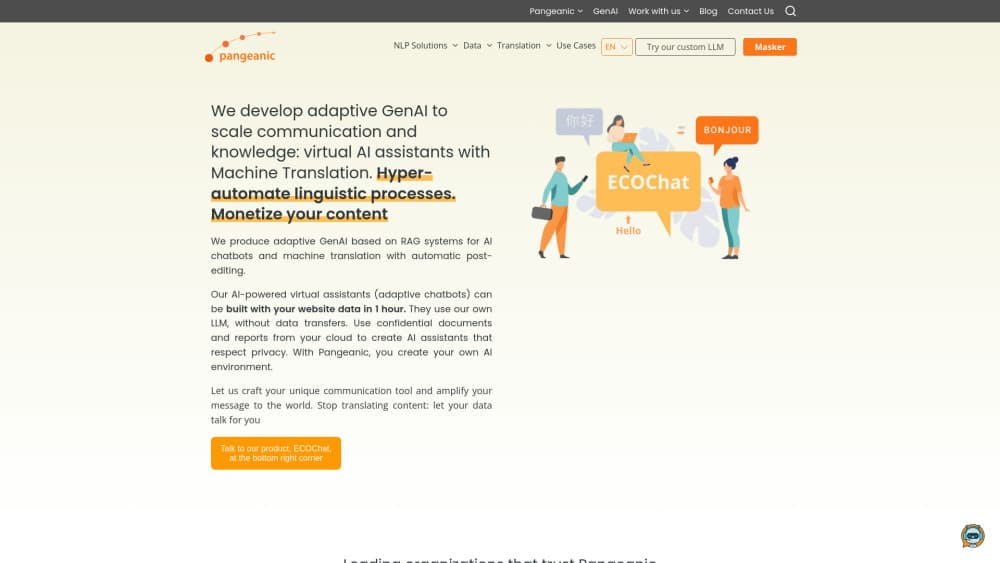
Pangeanic builds private GenAI chatbots that answer from your own documents, with retrieval, small language models, and deployment on your servers or an air-gapped network.
About Private GenAI Chatbots
What Is Pangeanic Private GenAI
Pangeanic is a Spanish language technology company that has spent more than two decades on machine translation, multilingual corpora and training data for AI models. Private GenAI is the enterprise side of that work: chatbots and knowledge assistants that run on a customer's own infrastructure and answer from the customer's own files.
The problem it solves is easy to describe. A general chatbot works fine until someone pastes a supplier contract, a personnel file or an unpublished policy into it. Private GenAI keeps that material inside a governed environment, pulls answers from approved sources, and connects each answer to the document it came from.
The model itself is only one piece. Pangeanic combines retrieval, model adaptation, anonymization, human evaluation and controlled hosting in one deployment, which is why the company talks about a private AI system rather than a single chatbot.
The main limit is commercial. There's no signup page, no public price list and no free tier, so a small team that wants a chatbot this afternoon should look elsewhere. Installs on your own hardware also put patching, GPU capacity and uptime on your side of the fence.
Getting Started
- Describe the job first: internal knowledge search, document intelligence, customer support or a translation workflow. Pangeanic scopes the deployment from that, not from a feature checklist.
- List the sources the assistant may read and the ones it must never touch, then agree who approves access for each group of users.
- Pick the hosting model. Private cloud is the fastest route, on premises keeps everything inside your data center, and air-gapped is for networks with no outside connection at all.
- Choose or adapt the model. A small language model tuned on your terminology usually costs less to run than a large general model, and Pangeanic tests both against your own questions.
- Review sample answers with your experts, fix the gaps in the source documents, then widen access in stages rather than opening the whole company at once.
Product Information
A quick look at Private GenAI Chatbots's pricing, supported platforms, and performance.
Best for
The users, tasks, and scenarios where this tool fits best.
Users
- Public administration knowledge teams
- Regulated enterprises in finance, legal and healthcare
- Multilingual documentation and support teams
Tasks
- Answering staff questions from policy manuals and procedure documents, with the source document attached to the reply.
- Searching an archive across languages, where the question is written in one language and the answer sits in another.
- Masking personal data before text reaches a model, for workflows that mix customer records with AI processing.
- Summarizing, classifying and translating sensitive documents inside a network that has no route to a public API.
Scenarios
- An agency or ministry that cannot send citizen records to a cloud region outside its jurisdiction.
- A utility, defense supplier or manufacturer running an isolated network where external API calls are simply not allowed.
- A company rolling out an internal help desk for HR, IT and legal policies, where the first version has to survive an audit before it gets a wider rollout.
Key features
Retrieval Grounded in Your Own Sources
The assistant answers from documents you approve rather than from whatever a general model memorized during training. Pangeanic builds a multilingual retrieval layer over repositories, terminology and internal content, then applies access rules so each user sees only the material they're allowed to see. Answers point back to the source, which is the difference between a demo and something a compliance team will sign off on. That mix of retrieval, permissions and citations is what most buyers mean by enterprise RAG.
Small Language Models Tuned to Your Domain
Not every question needs a frontier model. Pangeanic adapts smaller language models to a customer's terminology, languages and document style, and can route harder requests to a larger model inside the same architecture. Smaller models need less hardware, which matters when the deployment has to fit an existing GPU budget or a single server rack.
Private Cloud, On Premises and Air-Gapped Installs
The same platform can run in a private cloud tenancy, in your own data center, or on infrastructure with no internet connection. An on-premises AI chatbot keeps the model behind your own firewall, and Pangeanic describes the choice as the degree of sovereignty you actually need, since an internal knowledge assistant and a defense network have different requirements. Air-gapped deployment rules out per-token calls to a hosted provider, so the model has to be local.
Multilingual Answers and Cross-Language Search
Pangeanic's language business covers far more than English, and the company's own assistant handles more than a dozen European languages plus Catalan, Basque and Galician. In practice a user can ask in one language and retrieve a passage written in another, with the reply generated in the language they asked in. A custom multilingual AI assistant usually needs terminology control too, so glossaries carry over from project to project.
Anonymization Before the Model Sees the Text
Pangeanic builds data masking and anonymization into the pipeline, so names, account numbers and other personal details can be detected and replaced before inference. That matters for any private AI deployment that touches customer records, and the company has sold this capability as a standalone service for years. Masking also reduces what a leaked prompt could expose.
Admin Console, Embedding and Output Review
An admin interface lets a team manage assistants, sources and users, and the assistant can be embedded in a website or intranet page. Pangeanic pairs the console with human evaluation, where specialists review answers for factual grounding, domain accuracy and language quality before the system reaches more users. For many buyers that review loop is the part that gets a pilot approved.
Pros and cons
Pros
- Answers are tied to approved documents, so staff can check a claim instead of trusting a fluent paragraph.
- Three hosting routes cover everything from a private cloud tenant to a network with no outside connection.
- Multilingual retrieval is native rather than bolted on, which fits European public sector and cross-border teams.
- Small model adaptation keeps the hardware bill lower than serving one large general model for every request.
- Anonymization sits in the pipeline, so personal data can be stripped before a model reads it.
Cons
- No self-serve trial and no published pricing, so evaluating it means a sales conversation and a scoped quote.
- An on-premises install leaves you responsible for servers, patches and model updates, which is real work for a small IT team.
- Answer quality depends on the state of your source documents, and scanned PDFs with no text layer will still produce poor retrieval.
- The model catalog is curated for private deployment rather than broad, so a team that wants to switch between many frontier models will find it narrow.
Frequently asked questions
It's a private deployment of GenAI chatbots and knowledge assistants, built on Pangeanic's retrieval, model adaptation and evaluation stack. The assistant runs on infrastructure the customer controls and answers from the customer's own documents instead of the open web.
Related content
Explore related tools, skills, and articles for Private GenAI Chatbots.
Private GenAI Chatbots Alternatives

Claude for Google Workspace
Anthropic · Writing · Productivity · BusinessClaude for Google Workspace puts Claude in a sidebar inside Google Docs, Sheets, and Slides, where it reads the file you have open and edits it in place.

Claude Haiku 5.5
Anthropic · Writing · Coding · ChatbotClaude Haiku 5.5 is Anthropic's fastest and cheapest small model, built for high volume tasks at $0.10 per million input tokens with a 1M token context window.
NoteWorthy
Suman Hansada · Writing · Productivity · AI AssistantNoteWorthy is a notes app for iPhone, iPad and Mac that writes titles, tidies formatting, summarizes long notes and files each one with on-device AI. No account, no upload, no network requests.