

Parafact
Parafact AI · AI Detection
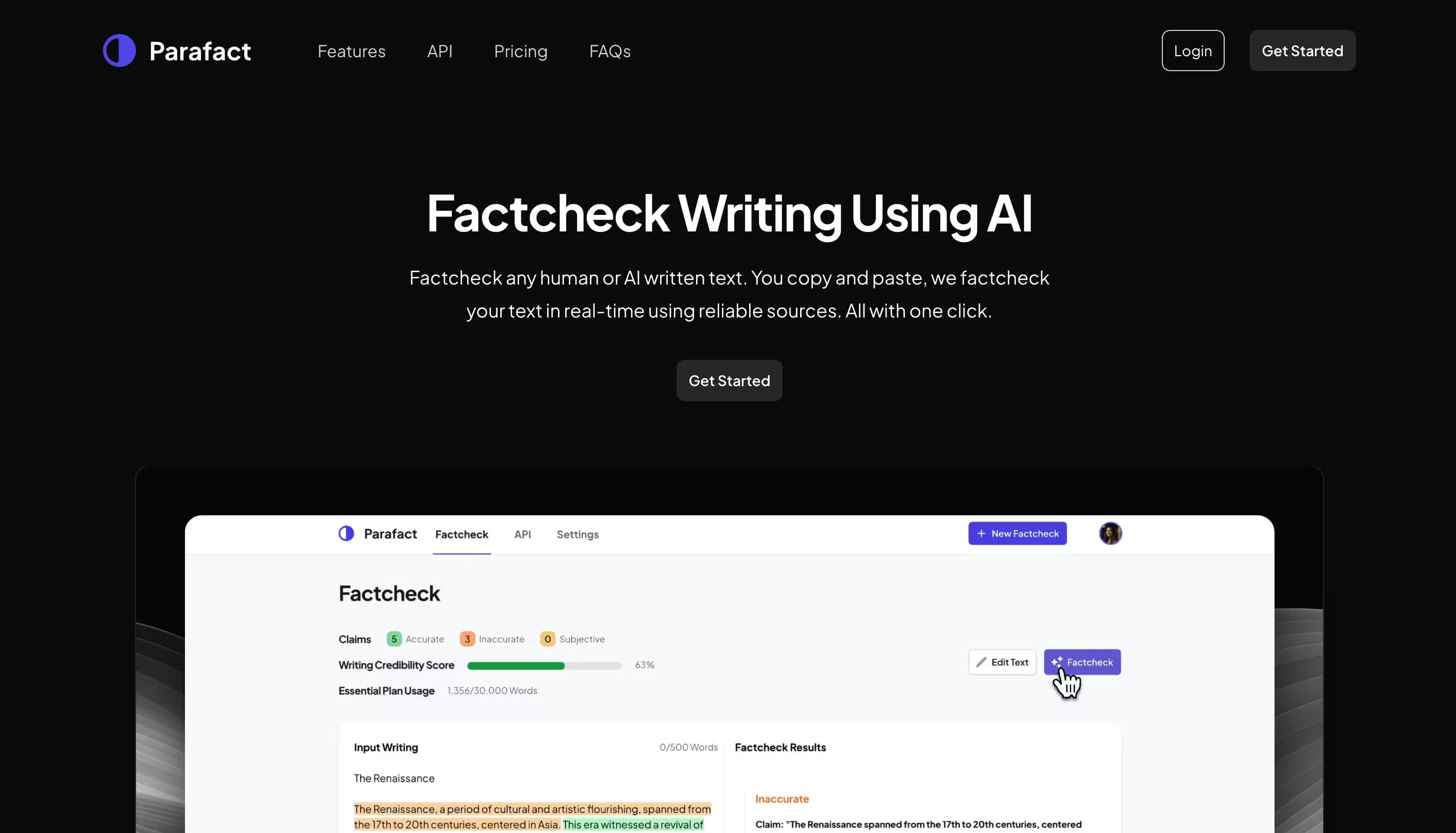
Parafact is an AI fact-checking tool that scans your writing in seconds and shows a cited source for every claim it checks.
About Parafact
What Is Parafact
Parafact is a web-based AI fact-checking tool built for anyone who publishes claims they can't afford to get wrong, and it's designed for fact-check writing you'd otherwise verify by hand. You paste in a draft, and it reads through the text, flags statements that need support, and points to sources for each one. It targets writers, researchers, journalists, and legal teams who currently lose hours cross-referencing facts by hand.
The appeal is speed. Instead of opening a dozen tabs and rereading each sentence while you try to remember which statistic came from which report, you get one clean pass over the whole document in seconds. Every checked claim comes back with a citation, so you can see where the tool found its answer rather than trusting a black box.
I should be clear about the limits. Parafact is a web tool with no mobile app, and the developer API is gated behind a request form, so you can't just grab a key and start building today. Pricing also isn't posted publicly on the site, which means you'll want to reach out before committing a team to it.
Getting Started
- Go to parafactai.com and open the fact-checking tool from the homepage.
- Paste in the text you want reviewed, or drop in a draft from a document, article, or report.
- Run the check and wait a few seconds while the AI scans the whole passage.
- Review each flagged claim together with its attached citation and source.
- Fix, reword, or remove the statements that don't hold up, then re-run the check.
- For product or platform work, submit the API access form to integrate the same checks at scale.
Product Information
A quick look at Parafact's pricing, supported platforms, and performance.
Best for
The users, tasks, and scenarios where this tool fits best.
Users
- Journalists
- Researchers and graduate students
- Legal teams
- Content marketers
- Developers
Tasks
- Checking a blog post for unsupported claims before it goes live.
- Verifying statistics, dates, and names in a research report.
- Screening AI-generated articles for fabricated facts.
- Reviewing press releases and public announcements for accuracy.
- Fact-checking long legal or corporate documents at scale.
Scenarios
- Publishing on a deadline and needing a fast second pass over a finished draft.
- Working with dense material where manual cross-referencing would take hours.
- Running content moderation across large volumes of submitted text.
- Posting daily on social media and wanting a credibility check on short, high-frequency posts.
Key features
Instant Fact-Checking
Paste your text and Parafact scans the whole passage in seconds. The pull here is time saved: what used to be an afternoon of digging becomes a quick pass before you hit publish. It reads full drafts, not just single sentences. That's the whole trick. Few tools cut this much manual work out of a deadline.
Citations for Every Claim
Each checked statement comes back with a source attached, so you can trace where the answer came from and decide for yourself whether that source is actually strong enough to support the claim in question. That citation trail is what separates a usable fact-check from a guess. It's the difference between a citation checker and a magic eight ball. If a source looks weak, you can judge it yourself and decide whether the claim holds.
Works Across Writing Types
The tool handles research papers, news articles, blog posts, social posts, and marketing copy in the same way, which means you can move from one long document to the next without hunting for a special export or reformatting anything first. You don't need a special export or format. That flexibility matters when your day mixes formats, which it usually does.
Advanced AI Models
Parafact runs on modern language models that read context rather than matching keywords. That's why it can flag a claim that's subtly wrong, not just one with an obvious typo. It's the engine behind the accuracy. Treat its output as a first pass anyway, because the models behind it can still miss context you catch by reading the cited source yourself.
Developer API
A developer-friendly API lets you wire the same fact-checking into your own product, aimed at automated content moderation at scale, where hundreds or thousands of submissions arrive faster than any human team could ever read them. Access is requested through a form rather than self-serve signup. For engineering teams, that's the path to checking thousands of submissions without a human in the loop.
Fully Automated Workflow
The system runs the checks without you babysitting each step. You feed text in, you get flagged claims and sources back. No setup. No per-sentence grind. Teams report cutting hours of manual verification, which is the whole point of automating this kind of work.
Pros and cons
Pros
- Fast checks that turn an hours-long verification pass into seconds.
- A source attached to every flagged claim, so you can trace the reasoning.
- Handles many writing formats without extra setup.
- A developer API opens the door to automated moderation at scale.
- Useful for both human and AI-generated content, which matters as AI drafts become common.
Cons
- No mobile app, so you can't check text on the go from a phone.
- API access requires an approval form, which slows down getting started.
- Pricing isn't published on the site, so you can't estimate cost before contacting the team.
- The tool flags claims but doesn't fix them, so you still do the rewriting.
Frequently asked questions
It reads a passage of text, flags statements that need support, and attaches a source to each checked claim. You paste the writing in, and it returns the reviewed text in seconds. Ever spent an evening checking one report line by line? This is meant to replace that. Think of it as a fast first pass, not a replacement for your own judgment.
Related content
Explore related tools, skills, and articles for Parafact.
Parafact Alternatives
Isgen AI
Isgen · AI DetectionIsgen AI is a web-based AI detector that scores text for machine authorship and shows you which sentences and phrases push the number up. It's built for teachers, editors, students, and writers. Their question is simple: did this draft come from ChatGPT, GPT-5, Claude, Gemini, DeepSeek, or another model? You paste or upload content, run a scan, and get a Human, AI, and Mixed breakdown in seconds. There's also a companion editor that scores text while you write it.
Humanizeai Tools
Humanizeai Tools · Writing · AI DetectionHumanizeai Tools is a web-based AI humanizer that rewrites machine-generated text so it sounds like a person wrote it, which is the whole point of the category it belongs to. Paste a draft from ChatGPT, Claude, or Gemini, run it through the tool, and it swaps out the phrases and sentence patterns that AI detectors flag. If your goal is to make AI text sound human before you publish it, this is the kind of tool built for exactly that. It suits students, bloggers, and marketers who need copy that reads naturally and clears tools like GPTZero, Copyleaks, and Winston AI after a single pass.

Hidemyai
Hidemyai · Writing · AI DetectionHidemyai is an AI content humanizer. It rewrites text from ChatGPT, Jasper, and similar tools so the result reads like a person wrote it. You paste your draft, pick a document type and tone, and the service returns a version meant to bypass AI detectors such as Originality.ai, Turnitin, and ZeroGPT. It targets writers, marketers, and students who lean on AI drafts but can't ship copy that sounds robotic. The promise is simple: make AI content undetectable.