
Parrot Speech-to-text API
Ringg AI · Voice & Language
Parrot Speech-to-text API is Ringg's speech recognition engine, built for voice agents that need transcripts fast. It handles Hindi and English conversations, including the code-mixed Hinglish that real Indian callers use, and returns results either as a live WebSocket stream or as a single request on an uploaded audio file. If you're building a voice bot and your current STT mangles accents or adds awkward lag, this API is aimed squarely at that problem.
About Parrot Speech-to-text API
What Is Parrot Speech-to-text API
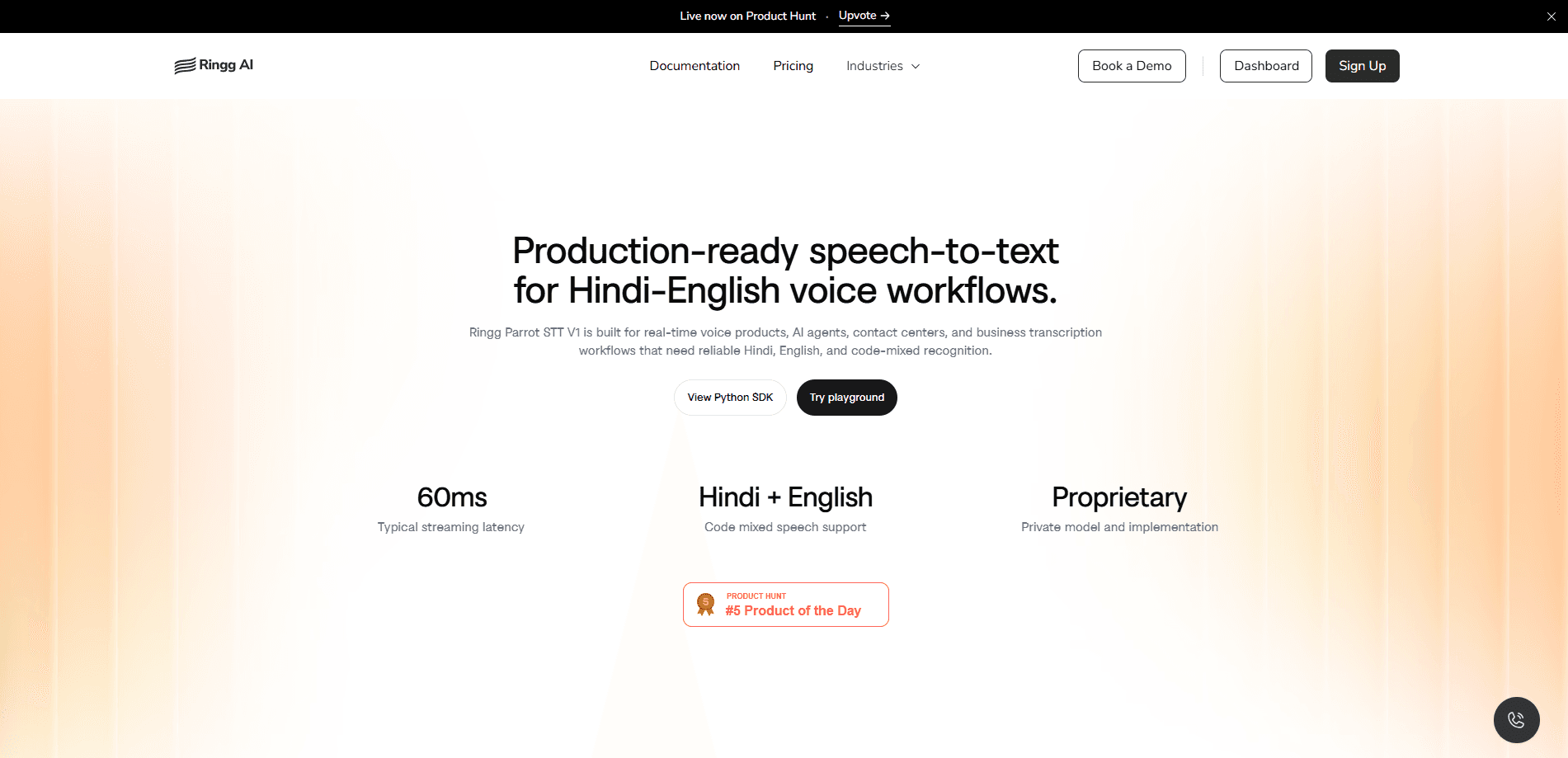
Parrot is a speech-to-text engine from Ringg AI, sold as a standalone API and also bundled into Ringg's voice agent platform. The pitch is narrow and honest: real-time speech recognition with low latency, strong accuracy on Indian accents and telephony audio, and output that's already cleaned up enough for a downstream AI model to read. It transcribes one audio file per REST call, or handles streaming transcription over a WebSocket and prints words as the speaker talks.
The engine currently supports Hindi (the default) and English, with dedicated tuning for Hindi-English code-mixed speech. That focus matters.
Most general-purpose recognizers treat a Hinglish sentence as two languages fighting each other, and the transcript ends up a mess that no downstream model can repair. Parrot's accuracy comes from being trained on that mixed speech pattern from the ground up, so it can follow a caller who drifts between the two languages mid-sentence without losing the thread of what's being said.
The big caveat is maturity. According to Ringg's docs, Parrot STT is in beta, with the Python SDK sitting at v0.1.x under an MIT license. That's early. Parameters and event fields may change before general availability, so don't build a fragile integration around a field name you saw today. Is that a dealbreaker? Not for a prototype. For anything headed to production, that beta status is the main thing to weigh.
Getting Started
- Create a Ringg account and open the dashboard under Settings → API Key to generate a workspace key. Store it as an environment variable, since the workspace needs at least one minute of credit before it can start a transcription.
- Install the Python SDK with
pip install ringglabs(Python 3.10 or newer is required). - Send a first file through the synchronous client, passing a local WAV or MP3 and setting the language to
enorhi. - Move to streaming once the basics work. Feed raw mono PCM audio in small chunks over the WebSocket and read partial transcripts as they arrive.
- Print or forward the normalized transcript to your LLM or logging layer.
Product Information
A quick look at Parrot Speech-to-text API's pricing, supported platforms, and performance.
Best for
The users, tasks, and scenarios where this tool fits best.
Users
- Voice AI developers
- Support and call-center teams serving Indian customers
- Product engineers shipping multilingual assistants
Tasks
- Transcribing inbound calls
- Batch file transcription
- Extracting structured data from speech
- Building voice-driven analytics
Scenarios
- A customer rattles off an order ID during a support call, and the agent reads the number back correctly.
- A caller switches from Hindi to English and back, and the transcript still holds together.
- Audio recorded over a patchy phone line where background noise would normally wreck recognition.
Key features
Fast Streaming Recognition
Parrot streams transcripts as a person speaks, not after they stop. The marketing page puts latency at under 150ms, and the live demo shows partial text building word by word over a WebSocket. Timing like that changes the whole feel of a call. For a voice agent, it's the difference between an assistant that answers naturally and one that makes callers wait.
Hindi-English Code-Mixed Speech
This is the feature that sets Parrot apart. It handles sentences where Hindi and English are woven together, the way a lot of Indian speakers actually talk. A general English recognizer will transcribe "weekend kafi mast tha" as gibberish. Parrot is trained on that pattern, so it keeps the meaning intact.
Transcript Normalization
Raw speech is messy: numbers spelled out, filler words, inconsistent phrasing. Parrot normalizes what it hears before handing it off, so "one five zero zero eight" can come through as a clean order ID. That saves work. Fewer formatting quirks means fewer surprises when your LLM tries to parse the text.
File and Streaming Modes
You're not forced into one workflow. Send a complete audio file in a single REST call for offline batches, or open a WebSocket and stream live. Both are covered by the same SDK, so you can prototype with files and switch to streaming without rewriting your whole pipeline.
Multi-Language SDKs
Ringg ships client libraries for JavaScript, Python, and Go, plus a documented REST endpoint that works from any language with an HTTP client. Python gets a synchronous Client and an AsyncClient, which saves you from bolting async support onto a sync library yourself when your voice stack already runs on an event loop.
Telephony-Tuned Accuracy
Parrot is built on large-scale voice interaction data and tuned for enterprise call patterns. The practical payoff is better handling of 8kHz phone audio and Indian accents, exactly the conditions where off-the-shelf recognizers tend to struggle. Phone lines are unforgiving.
Pros and cons
Pros
- Very low latency, which matters most when a human is waiting for a reply.
- Genuinely good with Hindi-English code-mixed speech, a gap many competitors leave open.
- Two integration paths, file and streaming, under one SDK.
- Free credits to start, and pay-as-you-go pricing at ₹30 per hour of transcription.
- Python SDK offers both sync and async clients out of the box.
Cons
- Still in beta, so fields and parameters can change before general availability. Pinning to current behavior carries some risk.
- Language support stops at Hindi and English. If you need Spanish or Arabic, look elsewhere.
- File uploads are capped at 10MB each, which means splitting long recordings yourself.
- The cheapest route runs through the Ringg platform; treating Parrot as a standalone API needs its own billing check.
Frequently asked questions
It turns speech into text for voice AI workflows. You send audio, either as a file or as a live stream, and it returns a transcript with language and confidence info.
Related content
Explore related tools, skills, and articles for Parrot Speech-to-text API.
Parrot Speech-to-text API Alternatives

Foley
Hanamori Labs, LLC · Voice & Language · Productivity · AI AssistantFoley is a voice to-do list that turns a spoken sentence into a filed task, complete with project, date and time, then helps you plan the day around what is already there.

HireKey
HireKey · Voice & Language · Productivity · LeaningHireKey is an AI job search copilot built by a former tech recruiter. It checks role fit, tailors resumes, runs interview practice and tracks every application.

Fluence
Yay Software (Yannick Huchard) · Writing · Voice & Language · ProductivityFluence is an Android app that reads PDFs, EPUBs, Word files and web articles aloud, follows each sentence as it speaks, and answers questions about the text on the phone itself.