

PassGeni
PassGeni · Other
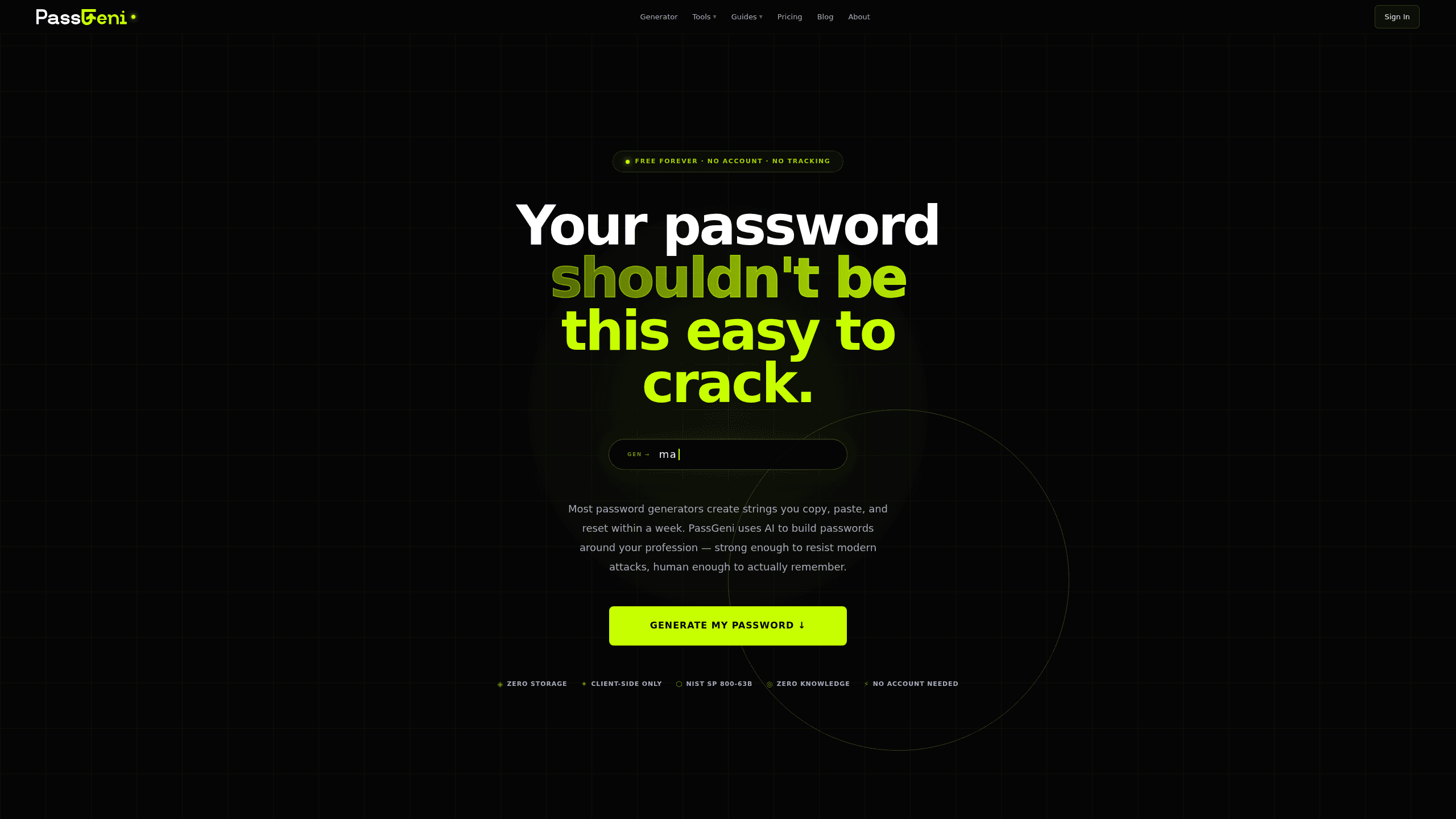
PassGeni is a free AI password generator that builds passwords around your profession, runs entirely in your browser, and stores nothing on its servers.
About PassGeni
What Is PassGeni
PassGeni is a secure password generator that lives in a browser tab. You pick a role, choose a length, and it returns a password assembled from a vocabulary tied to that job plus a random character pool. The randomness comes from crypto.getRandomValues(), the same browser primitive used to make TLS keys. Nothing is sent to a server during generation, and nothing is written to storage afterwards.
The profession part is what separates it from the random-string tools you have probably tried. A nurse gets seed words from medical vocabulary, a developer gets tech terms. The seed makes the result easier to recall while the surrounding characters keep entropy intact. Alongside the generator, PassGeni ships a passphrase generator, a breach checker, a password strength checker, and compliance presets for HIPAA, PCI-DSS, SOC 2 and ISO 27001.
The architecture has a cost. Since no password is stored, there's no history, no sync between devices, and no way to recover something you generated last month. Treat PassGeni as a generator, not a password manager. The free tier stops at 15 passwords per day.
Getting Started
- Open passgeni.ai. No account, email or card is required.
- Pick a profession seed, or leave the default pool if you just want a random string.
- Set the length (up to 32 characters), toggle symbols, numbers and letter case, or apply a compliance preset.
- Choose Password or Passphrase, then generate.
- Copy the result, and open the DNA Score panel if you want the audit before you paste it anywhere.
Product Information
A quick look at PassGeni's pricing, supported platforms, and performance.
Best for
The users, tasks, and scenarios where this tool fits best.
Users
- Security and IT admins at small clinics and payment companies
- Developers and DevOps engineers
- Privacy-focused everyday users
- Hospital or finance staff without a security background
Tasks
- Issuing temporary credentials during staff onboarding
- Creating a passphrase for accounts you type by hand, like an EHR login or a laptop password
- Checking an old password against breach data
- Spinning up unique secrets for a new repository
Scenarios
- A clinic preparing for a HIPAA audit next week and needing every new account to match the access control rule.
- A remote developer creating separate credentials for five client CI/CD pipelines in one sitting.
- A household setting up a guest network
- A student replacing reused passwords after a breach notification email.
Key features
Profession-Aware Seeds
Instead of drawing from the full character pool alone, PassGeni embeds a word tied to your job into the random string. A lawyer might end up with "nexus" inside the password, a designer with "bezier". You still memorize a long string, but the anchor gives your memory something to hold. Entropy stays at the same level as fully random output because the surrounding characters still come from the browser's crypto API.
Passphrase Mode Built on NIST SP 800-63B
Typing a 20 character string into a shared workstation every morning gets old fast. Passphrase mode returns four random words from the profession vocabulary, which lands around 50 bits of entropy and is easier to repeat from memory. The NIST guideline favors this format over forced symbol rules for that exact reason: length beats complexity when a human is the one typing.
Compliance Presets for HIPAA, PCI-DSS, SOC 2 and ISO 27001
Each preset sets the minimum length, required character classes and strength floor that the framework expects. Pick HIPAA and the generator stops letting you build something that would fail an audit. It's a practical shortcut for admins who don't want to cross-reference a policy PDF while onboarding staff. Presets are part of the paid tiers, and the free generator keeps the basic length and character toggles.
Password DNA Score
A seven point audit checks length thresholds, character class variety, repeat patterns and other weak spots, then grades the password from A+ down to C with a per-check breakdown. It answers the question a strength bar can't: which specific rule is failing. Free accounts get one score a day, Pro and Team are unlimited.
Post-Quantum Mode
This mode follows the NIST post-quantum work published in 2024 and targets Grover's algorithm, the quantum search method that halves the effective strength of a symmetric key. In practice you get longer outputs and a wider character pool. It's forward-looking rather than urgent, yet for credentials with a long lifespan it's a cheap hedge.
Bulk Generator and REST API
The bulk password generator builds 25 passwords at once on Pro, 500 on Team, and labels each entry for export to CSV. The REST API at /api/v1/generate takes JSON and returns a passwords array with entropy bits and an audit object. The free API tier allows 50 calls a day per IP, Team raises that to 5,000. One caveat worth knowing: API generation happens on the server, so it's not zero-knowledge, unlike the web generator.
Pros and cons
Pros
- Nothing leaves the device in the web generator: open the network tab while generating and no request appears.
- The free plan works without an account, with 15 passwords a day and passphrase mode included.
- Compliance presets replace policy reading with one click for HIPAA, PCI-DSS and SOC 2.
- The bulk password generator exports labeled CSV, which makes secret rotation for CI/CD teams practical.
Cons
- No vault, no history, no sync: forget a password and it's gone, so you still need a password manager.
- Web only: no browser extension, no autofill and no native app, which means copy and paste every time.
- The useful bulk and compliance tools sit behind Pro at $9/mo and Team at $45/mo.
- API output is generated server-side, so teams that need zero-knowledge have to use the web app.
Frequently asked questions
No. The web generator runs entirely in the browser through crypto.getRandomValues() and makes no network request when you press generate. You can confirm it in DevTools.
Related content
Explore related tools, skills, and articles for PassGeni.
PassGeni Alternatives

Odyssey 3
Odyssey · OtherOdyssey-3 is Odyssey's foundation world model. It simulates physics in real time, turns a prompt into an interactive environment, and adapts to robots, cars and games.

JarvisCore
Prescott Data · Coding · Productivity · OtherJarvisCore is an open source Python runtime where AI agents work as equal peers on an agent mesh, claim tasks from a shared ledger, and reach external services through a zero-trust broker.
Clef
Cloudflare · Business · OtherClef is Cloudflare's open-source decision model for Workers AI. It returns calibrated probabilities for typed questions, not generated text, so agents can classify, route, and act fast.