

Patched
Patched Codes · Coding
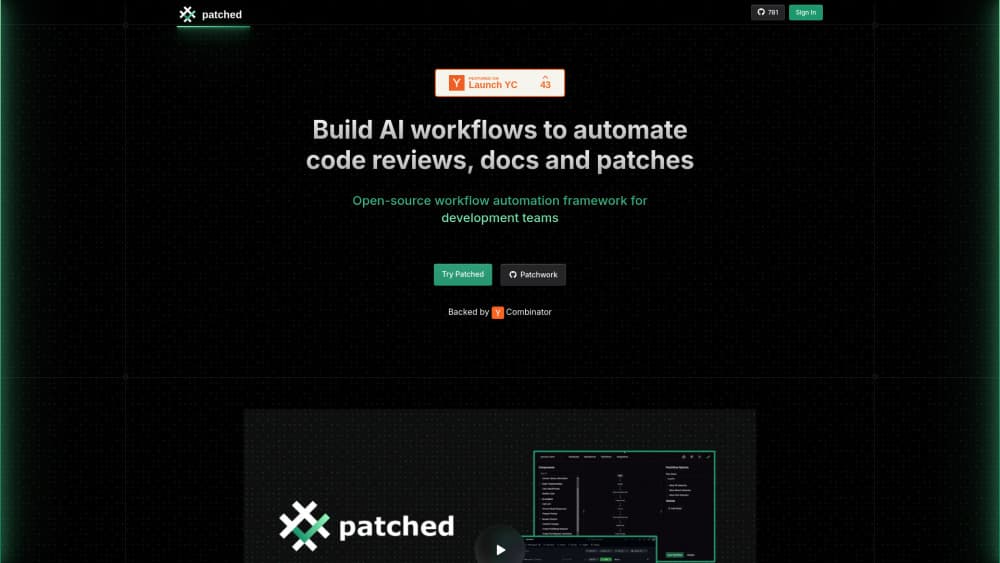
Patched is an AI workflow automation platform that executes regulated back-office tasks, from fraud reviews to reconciliation, with full audit trails.
About Patched
What Is Patched
Patched takes the parts of regulated operations that eat up days of manual work and runs them as AI-powered workflows. Think manual fraud investigations, banking customer operations, and cross-system reconciliation. The company behind it, Patched Codes, frames the product around execution rather than orchestration: it doesn't just wire up a process, it carries the work to completion and owns the outcome.
So what separates it from the pile of workflow builders out there? The answer is where it stops. Most tools hand you a canvas and wish you luck. Patched runs the work.
Under the hood sits Patchwork, the open-source agentic framework that powers the same idea for software teams. Patchwork automates development chores like PR reviews, bug fixing, security patching, and documentation using a self-hosted AI agent and your choice of LLM. The hosted version, app.patched.codes, is the managed entry point for teams that don't want to run it themselves.
Who is this for, then? Ops teams, mostly. Engineers too.
The most important limitation is scope. This isn't a casual automation toy for individuals. It's built for operations teams handling sensitive data at volume, with dedicated infrastructure and SLA ownership. Pricing reflects that: it scales with operational volume rather than sitting at a fixed per-seat rate. If you're a solo user wanting to glue a couple of apps together, you're not the target.
Getting Started
- Sign in at app.patched.codes and generate an API key from the integrations tab.
- Connect your LLM of choice, or use the managed key from Patched, and link your GitHub or internal system credentials.
- Pick a patchflow that matches your task, such as PR review, AutoFix for security patching, or issue resolution.
- Run it locally through the CLI, inside your IDE, or as a step in your CI/CD pipeline.
- Review outputs and set the workflow loose on your production queue.
Product Information
A quick look at Patched's pricing, supported platforms, and performance.
Best for
The users, tasks, and scenarios where this tool fits best.
Users
- Risk and fraud teams
- Banking operations staff
- Software engineering teams
Tasks
- Fraud and risk investigations
- Cross-system reconciliation
- Code review and security patching
Scenarios
- Clearing an investigation backlog that's been growing for months
- Handling routine customer-ops requests at volume
- Automating dependency upgrades in a repo you don't want to touch by hand
Key features
Patchflows
A patchflow is a ready-made automation that combines reusable steps and prompt templates into a job that runs end to end. An AI patchflow handles the full chore, not just a single call. Out of the box there's PR review, AutoFix for security vulnerabilities, DependencyUpgrade, ResolveIssue, GenerateReadme, and GenerateDocstring, each one built to take a repetitive task off your plate and carry it through to a finished result without you babysitting every step. You can chain your own if the built-in set doesn't fit.
Self-Hosted CLI Agent
Patchwork runs as a CLI agent on your own machine or server, so your code and data don't have to leave your environment. Install it with pip and point it at your preferred LLM, whether that's OpenAI, Google, or the Patched managed service. This matters when a compliance team needs to see where the data actually goes. It usually does.
Bring Your Own LLM
The framework isn't tied to one model provider. You can swap in an OpenAI key, a Google model, or the managed Patched key, and even mix providers across patchflows. That flexibility keeps you from being locked into a single vendor's pricing or rate limits. Not a small thing.
CI/CD and IDE Integration
Patchflows aren't confined to the terminal. You can wire them into a CI/CD pipeline so reviews, fixes, and upgrades run on every commit, or call them from inside your IDE while you work. The same automation that reviews a PR can patch a vulnerability before it ships. For teams buried in pull requests, that's AI code review automation without hiring another reviewer.
Auditability and Dedicated Infrastructure
Every workflow is designed to be fully auditable, which is the whole point for regulated industries. Patched deploys systems on dedicated infrastructure and takes ownership of the SLA, so you get a paper trail and an accountable operator rather than a black box. As a workflow execution platform, it owns the outcome, not just the wiring, which is a meaningful shift for any team that has been burned by a tool that automated the easy part and left the hard decisions to a human at 2 a.m.
Custom Patchflow Authoring
When the built-in automations fall short, you build your own by combining steps and prompt templates. A step is an atomic action like creating a PR or committing a change, and a prompt template shapes how the LLM handles a specific chore. That's how Patchwork turns a repetitive task into something you run once and forget. You write it once. It runs every time.
Hosted and Local Options
You can run Patchwork yourself for full control, or use the hosted version at app.patched.codes if you'd rather not manage infrastructure. The hosted route is the faster on-ramp; the self-hosted route is for teams with strict data-residency rules, where keeping code and credentials inside your own network isn't a preference but a hard requirement written into policy.
Pros and cons
Pros
- Open-source core means you can inspect and extend the automation instead of trusting a closed product.
- Runs locally or self-hosted, which keeps sensitive code and data inside your own environment.
- Works with multiple LLM providers, so you're not locked to one vendor's pricing or limits.
- Built-in patchflows cover common dev chores like PR review, dependency upgrades, and security patching.
- Designed for regulated operations, with audit trails and SLA ownership baked in. That combination is rare.
Cons
- The hosted path is priced by operational volume, so costs are hard to predict before you talk to sales.
- No free tier: there's no lightweight way to trial the managed service without signing in.
- The developer-facing patchflows assume familiarity with a CLI, Git, and CI/CD, which rules out non-technical users.
- Setup for the local agent involves juggling API keys and dependency groups, which adds friction early on.
Frequently asked questions
Patched runs regulated operations and development workflows end to end using AI. In practice that means automating fraud investigations, reconciliation, customer ops, code reviews, and security patching, with a full audit trail for each run.
Related content
Explore related tools, skills, and articles for Patched.
Patched Alternatives

Base Code
Base44 (Wix) · Coding · ProductivityBase Code is a shared cloud development environment from Base44. Teammates describe changes to an existing GitHub codebase in chat, preview them live and send them back as pull requests.

Google EmbeddingGemma 2
Google DeepMind · Writing · Image · CodingGoogle EmbeddingGemma 2 is a 740M-parameter open model that turns text, code, images, audio, and video frames into vectors in one 768-dimension space, running on phones and laptops.

GitGlow
GitGlow · Coding · ProductivityGitGlow is a local-first desktop Git client that lets independent developers review their own code and their AI agents' changes in one place before shipping.