

Pathex
Pathex · Marketing
Pathex is an AI data analyst for business teams. It maps your data, learns your KPI logic, and answers questions in plain English with charts, explanations, and reports.
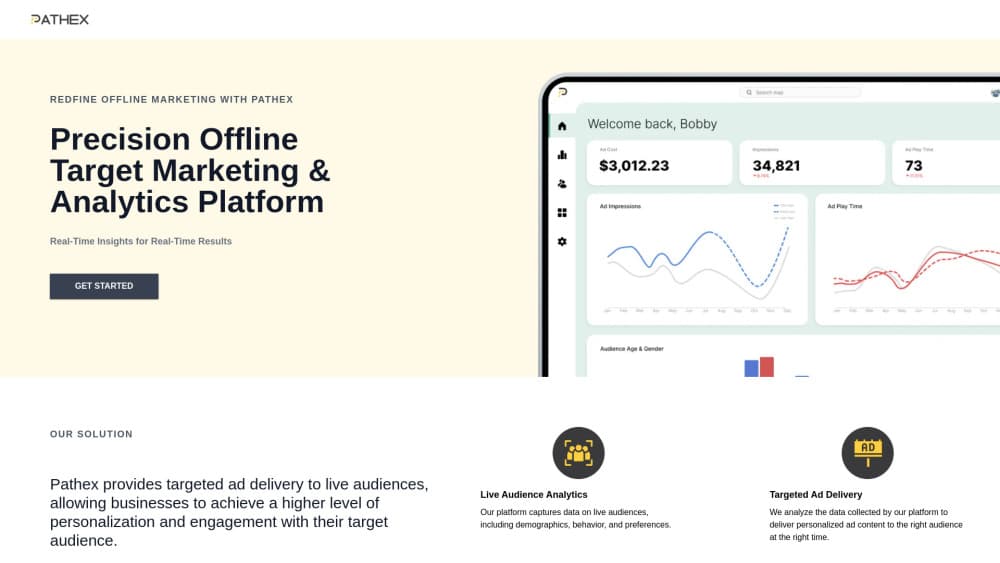
About Pathex
What Is Pathex
Pathex is a web app that answers business questions about your own data. You connect your tables, describe how your company defines its metrics, then ask things like why retention fell in one market after a promotion. The tool comes back with a chart, a written explanation, and a report you can send to someone else.
Think of it as an AI business intelligence tool with a chat front end. The pitch on the official site is memory. Most chat tools start from zero every time, and none of them know that your MRR figure excludes credits or that finance counts a sale a month later than billing does. Pathex says it learns that KPI logic and keeps it, so the second question picks up where the first one stopped. The site also describes the analysis as multi-agent, meaning several steps run separately instead of one model answering in a single pass.
Public information is thin. There is no pricing page, no documentation, and no signup form, only a contact form for sales. The claims about speed and accuracy come from the vendor, so treat them as a starting point for a pilot rather than a settled result.
Getting Started
Pathex doesn't publish a setup guide, so expect an onboarding closer to a sales-led rollout than a self-serve signup. The steps below are what that usually looks like.
- Send a message through the contact form on pathex.io with your company name, your data stack, and two or three questions you want answered.
- Once you have access, connect the tables or warehouse views that hold sales, retention, and finance numbers.
- Define your metrics the way your team defines them, including the exclusions that make billing and finance disagree.
- Pick one of the three starting points on the home screen, then type a question in plain English and run it.
- Save the output as a dashboard or a report and share it with the people who ask you for numbers.
Product Information
A quick look at Pathex's pricing, supported platforms, and performance.
Best for
The users, tasks, and scenarios where this tool fits best.
Users
- Business analysts who field the same questions every week
- Marketing and growth teams that work in spreadsheets
- Finance and revenue operations staff
- Founders and operators without a data team
Tasks
- Explaining a sudden change
- Building a recurring dashboard
- Reconciling two definitions of one number
- Drafting a written summary for a meeting
Scenarios
- A weekly business review that needs numbers fast
- A new market or product line with no reporting yet
- A team spread across regions
Key features
Business Context Memory
This is the core claim. Pathex keeps a store of your definitions, your metric logic, and the answers it has already given, so later questions build on earlier ones. In practice, that means you explain once that a subscription counts from the first paid invoice, and you don't repeat it every session. How much context carries over, and whether you can edit or audit that store, isn't documented publicly.
Multi-Agent Analysis
Instead of one model writing an answer, the platform splits a question into steps and runs separate agents for them, which is why the vendor calls it an AI analytics agent. The intended benefit is depth: a question about why retention dropped can involve segmenting the base, comparing cohorts, and checking the launch calendar before anyone writes a conclusion. Whether the steps are visible to you is something to confirm in a demo.
Plain-English Questions
You type a question the way you'd ask a colleague, with no query language and no schema knowledge. That's natural language data analysis in the plainest sense. It's also the feature that decides whether the tool gets used by marketers and founders, or stays with the analytics team. The quality of the answer still depends on how well your tables are documented, since a vague column name produces a vague result.
Deep Analysis
The first of three modes on the home screen. You ask a causal question about a specific business event, such as why premium skincare retention dropped in Seoul after an April bundle. The output is a chart plus a written explanation that names the segments driving the change. It's the mode that most resembles an analyst's investigation, and the one where a wrong assumption costs the most.
Dashboard Builder
You describe a dashboard in words, including the metrics, dimensions, and market, and Pathex assembles it. The site's own example asks for sell-through, returns, markdowns, and margin by SKU tier for footwear in Germany. In that role it works as a KPI dashboard builder for teams that know what they want to see but not how to model it. A hand-built BI dashboard still gives you more control over layout and edge cases.
Metric Explanation
The third mode handles definition disputes. Ask why UK SMB MRR differs between billing and finance, and the tool is designed to walk the difference back to specific rules, timing, or filters. It's a narrow use case with a high payoff, because those disputes usually eat a meeting on their own.
Pros and cons
Pros
- The question-first workflow fits people who know the business question but not the schema.
- Business context memory targets the real weakness of chat-based analysis, which is that every session starts cold.
- Three named modes map to three common requests: investigate a change, build a view, settle a definition.
- The metric explanation angle is specific enough to be useful, since reconciliation work is rarely covered well by general BI tools.
- Short written explanations ship with the charts, which helps when the audience isn't technical.
Cons
- No published pricing, no free tier, and no self-serve signup, so you can't test it before a sales conversation.
- No public documentation on connectors, data residency, or access controls, which slows down a security review.
- Accuracy claims can't be checked from outside. Causal answers about retention or revenue need a human review step before they reach a decision.
- Context memory is only as good as the definitions you feed it, and a wrong definition will keep producing confident wrong answers.
Frequently asked questions
Pathex is an AI data analyst for business teams. You connect your data, teach it how your company defines its metrics, and ask questions in plain English. It returns charts, written explanations, and reports, and it keeps the business context between sessions.
Related content
Explore related tools, skills, and articles for Pathex.
Pathex Alternatives

ngram 2.0
ngram · Video · Marketingngram 2.0 is an AI video generator for teams. It turns a prompt, a screen recording, or a product URL into a narrated explainer, product demo, or AI avatar video, and every scene stays editable.

shippedit.me
Krawlup · Marketing · Businessshippedit.me now redirects to Krawlup, a web platform that audits SEO, AEO and page speed every week, then hands the fixes to AI coding agents over MCP.

MePersona
MePersona, Inc. · Writing · Productivity · MarketingMePersona is an AI unified inbox for creators. It learns your voice, drafts replies to fan messages from 12 platforms, and sends only what you approve.