

Pave Robotics
Pave Robotics · Other
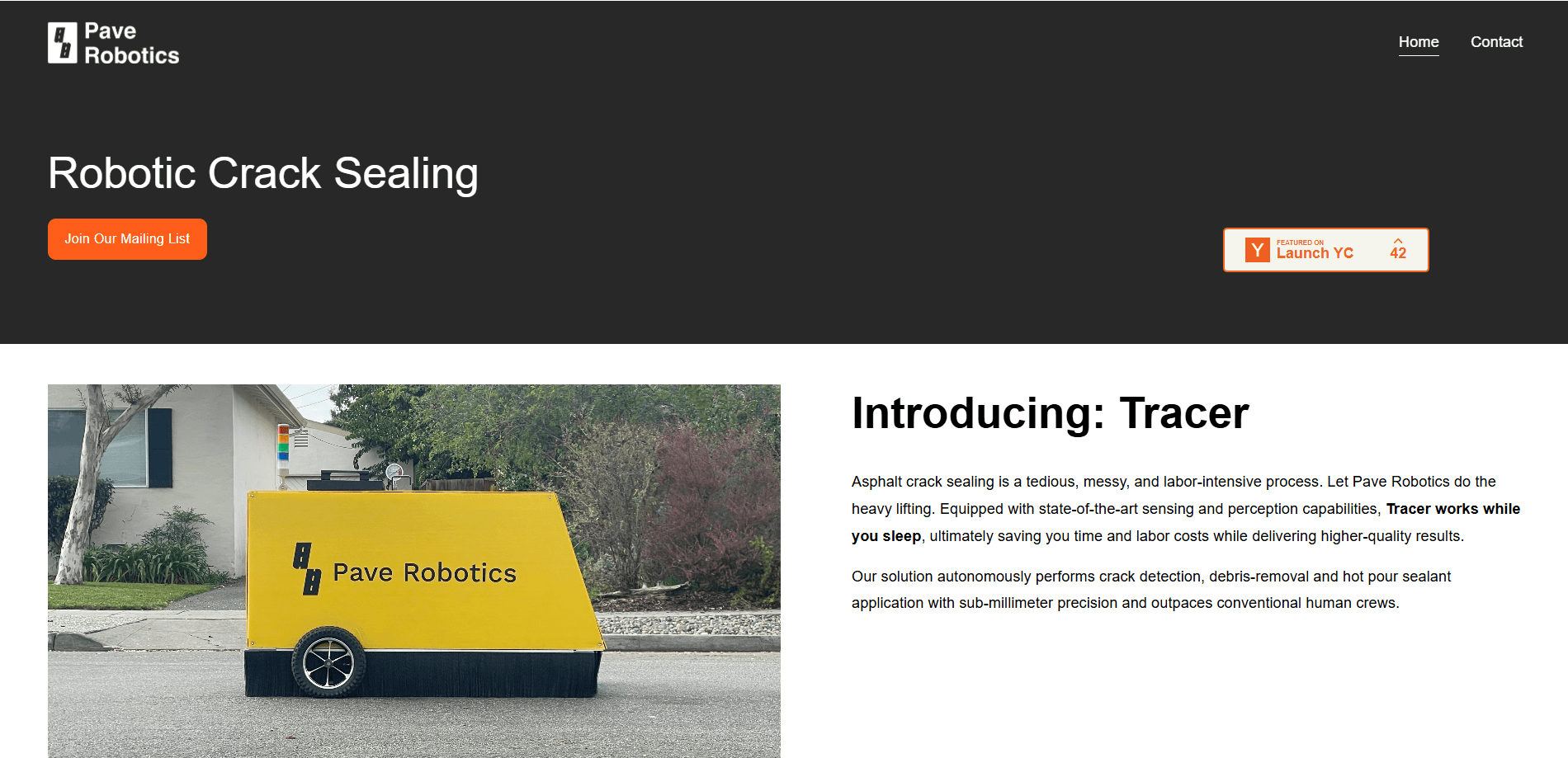
Pave Robotics builds Tracer, an autonomous robot that finds and seals asphalt cracks for DOTs, cities, and paving crews. It covers up to 2,500 ft per hour in a single shift.
About Pave Robotics
What Is Pave Robotics
Pave Robotics is a robotics company that makes self-driving machines for road maintenance. Its flagship product, Tracer, is a truck-towed platform that surveys a lane for cracks and then seals them with heated rubberized sealant, using cameras, lidar, and GPS-RTK to track every crack within a quarter inch as it moves.
The problem it targets is crack sealing, the first line of defense against crumbling pavement. That work is slow, expensive, and hard to staff, since fewer people want to stand next to 400°F kettles of sealant for a whole day. A cracking road left alone turns into potholes, and full repairs cost far more than early sealing. Pave Robotics points its robot at that gap: one operator tows and oversees the unit, and the platform logs every foot it seals for later records.
The main limits are scope and maturity. Tracer does crack sealing only, not pothole filling, resurfacing, or line painting, so it handles a narrow slice of road work. The company is also early: the first pilot fleet is deploying in 2026, and pricing is shared only through a demo, so buyers cannot yet self-serve or compare public rates.
Getting Started
- Book a demo through the official site and describe your road or lot, such as a state highway corridor or a municipal lane.
- Review a pilot setup, since the company brings a unit out and tunes the configuration to your site rather than selling a fixed box.
- Run a drive-by survey so the robot builds an inch-accurate crack map of the lane or corridor.
- Let the platform plan and seal: it sequences repairs to cut material and time, then tracks each crack and applies sealant to spec under one lane closure.
- Pull the cloud report, where every foot is photo-logged with GPS, time, material, and operator for procurement records.
Product Information
A quick look at Pave Robotics's pricing, supported platforms, and performance.
Best for
The users, tasks, and scenarios where this tool fits best.
Users
- State and local departments of transportation
- Paving contractors
- Municipal public works and property managers
Tasks
- Sealing long stretches of cracked asphalt
- Surveying pavement condition before repair
- Documenting work for procurement
- Keeping crews out of danger
Scenarios
- Working a busy highway corridor under one closure
- Running night shifts to avoid daytime traffic
- Piloting automation before committing budget
Key features
Autonomous Crack Detection
Onboard cameras and lidar map every crack in real time and grade its severity while the platform works the lane. Instead of a crew walking the road to spot damage, the robot builds a crack map as it moves, which becomes the basis for deciding where to seal first.
Robotic Sealing Head
A purpose-built robotic arm tracks each crack within a quarter inch and lays down heated rubberized sealant on the exact path. This is the part that replaces the hand wand a worker would drag along a crack, and it is why one operator can cover ground a full crew used to handle.
Operator-in-the-Loop Guidance
A driver tows and oversees the platform while GPS-RTK and visual odometry keep the sealing head locked to every crack. Full lanes and highway corridors get covered under a single closure. The robot is autonomous in its sealing, but a person stays in charge of the run, which keeps a human in the loop rather than removing them.
Fleet Telemetry and Reporting
Every foot sealed is logged with GPS, material flow, operator details, and before-and-after photos, and the record lands in the cloud. For public agencies and contractors, that means a permanent, verifiable account of the work done, which is often as valuable as the sealing itself when paperwork backs up payment.
Field-Ready Platform Specs
The unit seals at up to 2,500 ft per hour, carries a 125-gallon heated tank, and runs 16 hours on a single operator. It works from 20°F to 110°F and packs into a 20-foot by 6-foot footprint that extends to 12 feet for a full-lane pass, so it fits ordinary road work rather than a controlled factory.
Hybrid Diesel-Electric Power
The platform pairs a hybrid diesel-electric drivetrain with the sealing gear, which is what lets it run long shifts away from a charging point. That matters on highway corridors where there is no easy place to plug in, and it keeps the sealant tank heated through a cold morning start.
Pros and cons
Pros
- Seals cracks at up to 2,500 ft per hour, faster than a manual crew working the same lane.
- One operator runs the platform, so a paving firm can cover sealing work without a full crew.
- Cameras, lidar, and GPS-RTK track each crack within a quarter inch, which targets sealant where it counts.
- Every foot is logged with GPS, time, material, and photos, giving agencies a clean record for procurement.
- Backed by Y Combinator and built by engineers from Zipline, NASA JPL, and Crunch Labs.
Cons
- It only does crack sealing, so pothole filling, resurfacing, and line painting are out of scope.
- The first pilot fleet is deploying in 2026, so the platform is early and not yet widely proven on public roads.
- There is no free tier or public price list, and you need a demo and a quote to get started.
- It needs a truck to tow it, so it adds a vehicle and a driver to any job rather than working alone.
Frequently asked questions
Pave Robotics builds Tracer, an autonomous robot that seals cracks in asphalt. It detects cracks as it moves and applies heated rubberized sealant to them, aimed at road maintenance rather than factory work.
Related content
Explore related tools, skills, and articles for Pave Robotics.
Pave Robotics Alternatives

Odyssey 3
Odyssey · OtherOdyssey-3 is Odyssey's foundation world model. It simulates physics in real time, turns a prompt into an interactive environment, and adapts to robots, cars and games.

JarvisCore
Prescott Data · Coding · Productivity · OtherJarvisCore is an open source Python runtime where AI agents work as equal peers on an agent mesh, claim tasks from a shared ledger, and reach external services through a zero-trust broker.
Clef
Cloudflare · Business · OtherClef is Cloudflare's open-source decision model for Workers AI. It returns calibrated probabilities for typed questions, not generated text, so agents can classify, route, and act fast.