

Phala Cloud
Phala Network · Coding · Business
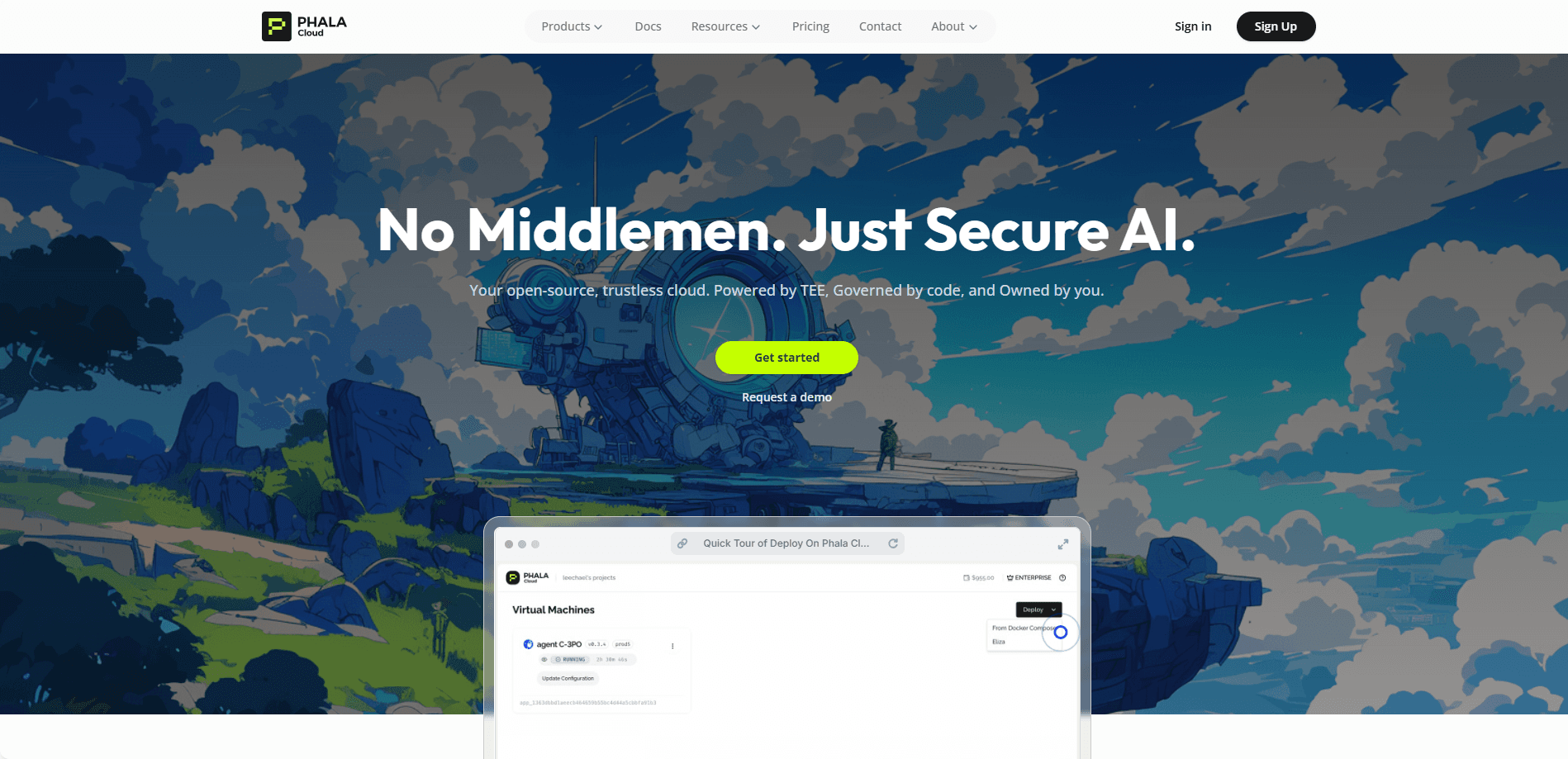
Phala Cloud is a confidential computing platform that runs Docker apps and AI models inside hardware-backed TEEs, keeping data private and attaching verifiable proof to each result.
About Phala Cloud
What Is Phala Cloud
Phala Cloud is a cloud platform from Phala Network that runs your workloads inside a Trusted Execution Environment, or TEE. A TEE is a locked-down area inside the CPU or GPU that the operating system, the hypervisor, and even the datacenter operator can't peer into. You deploy a standard Docker app or an AI model, and it executes inside that sealed boundary with encrypted memory.
The pitch is simple. Normal clouds ask you to trust their promises about private data. Phala instead emits cryptographic attestations that software can check on its own. Every confidential VM carries a quote that binds the hardware, firmware, image, and app config together, so you can verify what actually ran before you trust the output.
The main limit is that this is infrastructure for people who ship software. You work from a dashboard, a CLI, or an SDK, not a consumer app with a friendly editor. GPU TEE capacity is also reserved and availability-based, so pricing and slots can shift, and some features live behind an enterprise contract.
Getting Started
- Sign up at cloud.phala.com with GitHub, Google, or email, then add a card or top up your balance.
- Pick a CPU instance (tdx.small to tdx.large) or a GPU machine, and connect a docker-compose.yml file.
- Set encrypted environment variables so your keys stay sealed inside the CVM.
- Deploy the CVM and open the public HTTPS endpoint it returns.
- Pull the attestation report and verify the runtime measurement before you trust the result.
Product Information
A quick look at Phala Cloud's pricing, supported platforms, and performance.
Best for
The users, tasks, and scenarios where this tool fits best.
Users
- AI developers handling sensitive data
- Startups with compliance duties
- Web3 and crypto builders
Tasks
- Running private LLM inference
- Hosting Docker apps and APIs
- Training or fine-tuning on protected data
- Generating verifiable proofs
Scenarios
- A healthcare team processing patient records
- A trading desk running private models
- An AI agent that must prove its work
Key features
Confidential VM on Intel TDX
Phala runs your workload in a Confidential VM backed by Intel TDX. The virtual machine keeps memory encrypted and isolated from the host, the hypervisor, and the cloud operator. You bring a normal Docker image, and the platform handles the sealed runtime for you.
GPU TEE for Private AI
Confidential GPU capacity lets you run inference and training on machines like the H200 and B300 with NVIDIA Confidential Computing. Models and data stay protected while they process, and the platform claims near-native speed with roughly 5 to 10 percent overhead depending on the job.
Verifiable Attestation
Instead of asking you to trust a cloud claim, Phala emits attestation quotes that bind the hardware, firmware, image, and app config. You can pull a quote from the CLI or the API, and software can check it without human judgment. This is the part that separates Phala from a standard private cloud.
OpenAI-Compatible Model Endpoints
A catalog of TEE-hosted models serves through OpenAI-compatible endpoints. You can point existing tools at models such as GLM 5.3, Qwen3.8, and DeepSeek V4 Flash, and swap one in without rewriting your app. Private prompts and verifiable runtime state come as part of the deal.
Docker Compose Deployment
You deploy with the docker-compose.yml you already have. The platform handles the secure build, sealed keys, and networking, and returns a public HTTPS endpoint. Encrypted environment variables keep secrets out of plain view during the run.
CLI and SDK Workflow
A Phala CLI and the dstack SDK cover the command-line path. You can deploy, tail logs, check status, and fetch attestations without leaving the terminal. The SDK helps you wire TEE features like sealed keys and quotes into your own code.
Managed Keys and Scaling
Cloud KMS and Onchain KMS hold the cryptographic keys that unlock your environment, and you can replicate a CVM across nodes when you need more capacity. Replicas run the same image on the same or different hardware, which helps with uptime without breaking the confidentiality model.
Pros and cons
Pros
- Deploys standard Docker workloads with no code changes, so moving an existing app is quick.
- Attestation quotes let software verify the runtime instead of trusting a vendor's word.
- Core plans start cheap, with CPU CVMs from $0.06 per hour and $20 in credits after verification.
- Compliance footprint includes SOC 2 Type I, HIPAA, and GDPR-aligned processing.
Cons
- GPU TEE capacity is reserved and availability-based, so slots and prices can move with demand.
- It is a developer-first product, which means there's no drag-and-drop builder for non-technical users.
- Billing splits compute from storage, so a stopped CVM still bills for its disk until you delete it.
- Enterprise clusters and reserved GPU slots need a sales conversation, and API access to some model endpoints runs through a separate service.
Frequently asked questions
Phala Cloud is a confidential computing platform. You use it to run Docker apps, APIs, and AI models inside hardware-backed TEEs, so sensitive data stays private and results come with verifiable proof.
Related content
Explore related tools, skills, and articles for Phala Cloud.
Phala Cloud Alternatives

Base Code
Base44 (Wix) · Coding · ProductivityBase Code is a shared cloud development environment from Base44. Teammates describe changes to an existing GitHub codebase in chat, preview them live and send them back as pull requests.

Google EmbeddingGemma 2
Google DeepMind · Writing · Image · CodingGoogle EmbeddingGemma 2 is a 740M-parameter open model that turns text, code, images, audio, and video frames into vectors in one 768-dimension space, running on phones and laptops.

GitGlow
GitGlow · Coding · ProductivityGitGlow is a local-first desktop Git client that lets independent developers review their own code and their AI agents' changes in one place before shipping.