
Pheebs
Eversynced · Coding · Productivity
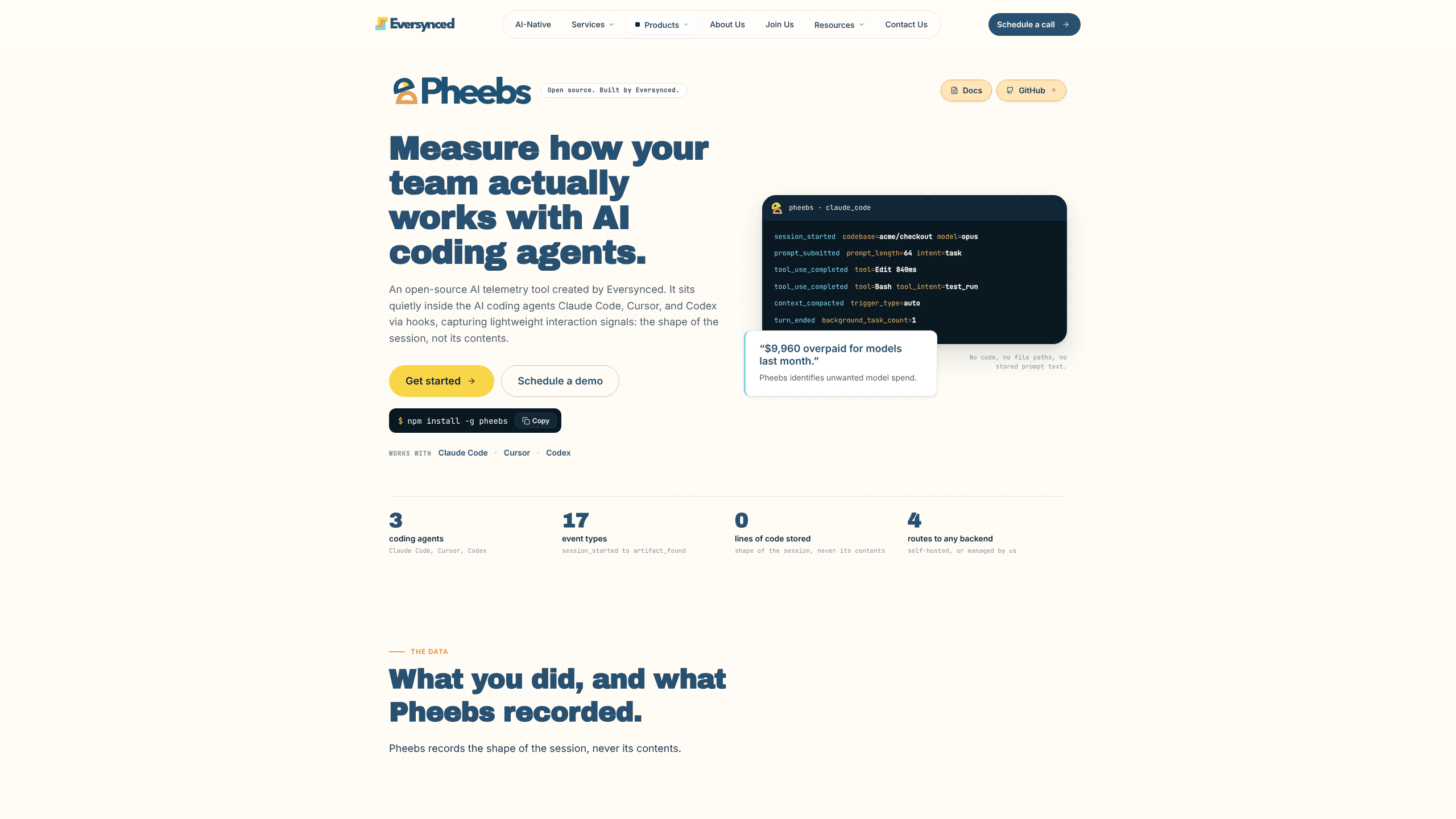
Pheebs is an open-source telemetry tool from Eversynced that records how engineers use Claude Code, Cursor, and Codex. It logs session shape, not code or prompts, then reports model fit and AI spend.
About Pheebs
What Is Pheebs
Pheebs is a command line tool that installs inside the AI coding agents your engineers already use and records what happened during each session. It registers hooks in Claude Code, Cursor, and Codex, then writes small events to a local log. The events describe structure: which tools ran, how long they took, whether a test followed an edit, which model handled the work. That is the whole surface: AI coding agent telemetry with no content attached.
The reason it exists is a gap most teams can feel but can't quantify. Seats and tokens are a real line item now, and almost nobody can say which sessions needed a frontier model and which ones burned budget on a one-file change. Pheebs sizes the work in every session, compares that against the model that actually ran, and prices the difference at API list rates.
It does not route prompts, block commands, or pick models for anyone. That restraint matters if you have engineers who are already suspicious of measurement. The tool reads the gap and puts a dollar figure on it. Whatever happens next stays a human decision.
The limits are worth stating up front. Pheebs is instrumentation, not a reporting product. A self-hosted install gives you raw logs and a documented endpoint contract, and you build the dashboards yourself. It also needs Node.js 20 or newer, and it only works with agents that expose lifecycle hooks.
Getting Started
- Install the CLI with
npm install -g pheebson a machine running Node.js 20 or newer. - Run
pheebs init. It detects the agents on the machine, asks which ones to configure, and asks where events should go. - Leave the destination blank if you want a purely local setup. Events then land in
~/.pheebs/logs/and nowhere else. - Run
pheebs doctorto confirm the wiring before you trust any numbers. - To send data to your own backend, set both
pheebs config set base-urlandpheebs config set token. With either one missing, nothing leaves the laptop.
Product Information
A quick look at Pheebs's pricing, supported platforms, and performance.
Best for
The users, tasks, and scenarios where this tool fits best.
Users
- Engineering leaders who pay for AI seats and tokens and want a baseline
- Platform and developer productivity teams
- Individual engineers who want their own numbers
Tasks
- Auditing model spend
- Checking whether AI code gets verified
- Measuring whether shared tooling landed
- Separating structural gaps from coaching gaps
Scenarios
- A 30-day AI enablement assessment
- A rollout of Claude Code or Cursor across several squads
- Regulated or privacy-sensitive organizations
Key features
Session Shape Capture for Three Agents
Pheebs hooks into Claude Code, Cursor, and Codex and fires on the events that mark real work: session start and end, prompt submission, tool calls and failures, skill and slash-command expansion, sub-agent spawns, compaction, and background tasks. Seventeen event types cover that range. Each prompt becomes a character count, plus an intent label when the optional prompt classifier is switched on. Claude Code analytics and Cursor usage tracking come through the same hook mechanism, so one install covers both.
Local JSONL Logs With a Backend You Control
Every event is appended to a local JSONL file, which stays the durable copy whether or not a backend is configured. A fresh install ships with no endpoint at all. Point it at your own server through a base URL and token, and the same events also post to your infrastructure. The reference backend and the endpoint contract live in the open repository, so the receiving side is something you can read before you trust it.
Model Fit Priced in Dollars
This is the feature most teams buy the tool for. Pheebs assigns every task prompt a scope, from a single-file change up to open-ended design, and judges the session by its hardest prompt. It then compares that size with the model class that ran. An over-provisioned session burns budget quietly, and an under-powered one shows up later as repair prompts. The gap between the two gets priced at API list rates, with an explicit caveat that the figure is an estimated upper bound.
Privacy Defaults That Store No Content
File contents, file paths, directory structures, prompt text, and command strings never reach the log. A command like npm test is read in process and recorded as tool_intent: test_run. Identity is either the id behind your token or a truncated hash of your git email. Pheebs doesn't look up GitHub handles. For teams where AI measurement died in legal review, these defaults are the part that gets it approved.
The AI Proficiency Model
Raw events are hard to argue about in a leadership meeting, so Pheebs ships a model that turns them into two layers. The first covers repertoire: 24 practices across six competencies, covering model choice, reusable artifacts, MCP connections, verification wired into the agent loop, context management, and multi-agent orchestration. The second covers judgement: verification coverage, pushback rate, refinement-to-repair ratio, wholesale-accept rate, and model fit. Each practice is detectable from telemetry, which means the reporting doesn't depend on self-reported surveys.
OpenTelemetry Passthrough
Claude Code and Codex emit native OpenTelemetry metrics and logs, and Pheebs proxies those signals to your collector instead of asking you to ship an observability credential to every laptop. That keeps existing tracing and logging stacks in play. Cursor runs on hooks alone, since that agent doesn't expose the same native export path.
Pros and cons
Pros
- The privacy model is unusually concrete. Naming exactly what is never stored, down to command strings and git identity handling, is more useful than a generic promise.
- Model fit converts an abstract efficiency argument into a dollar figure, which is the version of the argument that gets budget approved.
- Supporting Claude Code, Cursor, and Codex in one client avoids three separate measurement projects.
- Apache-2.0 licensing and a documented endpoint contract mean no vendor lock on the data you collect.
- The proficiency model gives structure to event streams, so a team can compare habits across engineers without inventing its own scoring system.
Cons
- Self-hosting means building your own reporting. The client produces logs and a contract, not the dashboards shown on the marketing site.
- The dollar figure is an estimate built on API list prices, so teams on negotiated enterprise rates will see a number that overshoots their real bill.
- Anything built on hooks inherits their blind spots. Work done in a terminal outside the agent, or in an editor without hook support, simply doesn't appear.
- Small teams get thin data. The model leans on recurring behavior over weeks, so a five-person team running Pheebs for a week will see mostly empty views.
Frequently asked questions
Event types, durations, counts, model names, and trigger types. It records that a prompt was submitted and how long it was, plus an intent label if the classifier is on. It doesn't record the prompt itself, file contents, or file paths.
Related content
Explore related tools, skills, and articles for Pheebs.
Pheebs Alternatives

Base Code
Base44 (Wix) · Coding · ProductivityBase Code is a shared cloud development environment from Base44. Teammates describe changes to an existing GitHub codebase in chat, preview them live and send them back as pull requests.

Google EmbeddingGemma 2
Google DeepMind · Writing · Image · CodingGoogle EmbeddingGemma 2 is a 740M-parameter open model that turns text, code, images, audio, and video frames into vectors in one 768-dimension space, running on phones and laptops.

GitGlow
GitGlow · Coding · ProductivityGitGlow is a local-first desktop Git client that lets independent developers review their own code and their AI agents' changes in one place before shipping.